
Tuesday, March 24, 2026
Mission Yearbook: North Carolina town marks one year since Hurricane Helene with day of hope and healing

The Sligo Presbyterian Church Celebration Service - Sunday, March 22, 2026
.jpg)
On Sunday, we finished this series by looking at how we can prepare for Easter by loving. Below is a video of the service, a presentation of the sermon, and the program & bulletin for the service. You can stream the service by going to the Sligo Presbyterian Church YouTube Channel on Sundays at 10:00 a.m. (EDT). You can hear a podcast of the service at the Sligo Presbyterian Church YouTube Channel or the Sligo Presbyterian Spotify Page.


.jpg)
.jpg)
Sunday's Message - Preparing for Easter (Loving)
.jpg)
On Sunday, we finished this series by looking at how we can prepare for Easter by loving. Below is a presentation and the text of the sermon. You can stream the service by going to the Sligo Presbyterian Church YouTube Channel on Sundays at 10:00 a.m. (EDT). You can hear a podcast of the service at the Sligo Presbyterian Church YouTube Channel or the Sligo Presbyterian Spotify Page.
Well, this morning we’re tying up the series we started on the first Sunday in Lent entitled Preparing for Easter. You see, next week, we’ll be moving on to what’s called Holy Week, the time between Jesus’s entry into Jerusalem on Palm Sunday through his last supper on Maundy Thursday and crucifixion on Good Friday right to the women finding the tomb empty on Easter morning. And during these last four weeks, we’ve talked about how we can get ready to celebrate the resurrection of Jesus Christ by fasting and forgiving, by repenting and praying. Now, if you missed any of these, they’re all on our church blog and our Facebook page. Now that’s where we’ve been.


No, this morning, we’re going to focus on how we might prepare for Easter by loving one another. And as we’ve done before, we’ll be spending a little time looking at what the Bible has to say about love. And then we’re going to focus on three things we might want to remember, if we’re really interested in showing more love to those around us.
Of course, as we saw with forgiving and repenting and praying, loving one another is a pretty big deal in the Bible, and I’m talking about both the Old and the New Testaments. And I think it’s really interesting, different passages give us a slightly different perspective on what this love business is all about. For example, in a couple of verses that both Apostle Paul and Jesus Christ quotes, just listen to what the writer of Leviticus had to say.

Now, that’s what it says. And I find it interesting that, in the nineteenth chapter of Leviticus, this command about loving others is smack dab in the middle of all these directions dealing with a whole lot of other stuff, you know, like economic justice and personal integrity, social protection and judicial fairness. Man, there’s even a command not to withhold a worker’s wages overnight. Now all of this surrounds the command to love others, which shows me just how broad and inclusive and practical Biblical love really is.
And then there’s this passage from Paul’s letter to the Romans;

In other words, in the sight of God, not only should our love for others be broad and inclusive and practical, we should actually view love as a debt that we owe to those around us; And you know, if this is what we believe, then all of sudden every encounter is an opportunity to act on our obligation and right now it’s up to us to get rid of any thing that might get in the way of us making our payment on time. Now that’s from Paul, love is a debt that we owe.
And from Jesus Christ himself, just listen to what he said to his disciples right before his arrest and crucifixion:

Now, for me, that pushes love even further than what we saw in Leviticus or with Paul. I mean, not only are we talking about something that’s commanded, you know, something that’s broad and inclusive and practical and also a debt we owe, love is also sacrificial, isn’t it? Let me ask you, for Christ, what was the definitive example of the love we’re commanded to show? Well, it sure isn’t superficial kindness or good feelings. Instead, it’s making a real sacrifice. It’s something that’s actually more than active; man, it’s proactive. And it’s independent of what the other guy is doing, you know, whether he deserves our love or not. I’ll tell you, it’s as radical and extreme as dying on a cross to save the ones who drove the nails. You see, whether we like it or not, that’s the kind of love we’re commanded to show.
And even though, I’m telling you, doing that kind of thing will never be easy, I really believe it’s more than possible, especially when we remember three characteristics of ἀγάπη/love that the Apostle Paul shared with the Corinthians in the thirteenth chapter of his first letter. And let me share with you what they are.

What if I could speak
all languages of humans
and even of angels?
If I did not love others,
I would be nothing more
than a noisy gong
or a clanging cymbal.
What if I could prophesy
and understand all mysteries
and all knowledge?
And what if I had faith
that moved mountains?
I would be nothing,
unless I loved others.
What if I gave away all
that I owned
and let myself
be burned alive?
I would gain nothing,
unless I loved others. [1 Corinthians 13:1-3, CEV]

And I’ll tell you, for me personally, that just makes sense. You see, our willingness to love gives meaning to everything else we do. For example, our words and our promises are worse than empty and shallow, if we don’t back them up with some action, something that James had in mind when we wrote, “If you know someone who doesn’t have any clothes or food, you shouldn’t just say, ‘I hope all goes well for you. I hope you will be warm and have plenty to eat.’ What good is it to say this, unless you do something to help?” [James 2:15-16, CEV] And all our wisdom and experience, even our faith is worth nothing, if we refuse to use what we know and what we can do and what we believe in order to help others. Man, even our relationship with God is absolutely worthless, if it’s not used to make a difference. Again, as James wrote, “faith that doesn’t lead us to do good deeds is all alone and dead!” [James 2:1, CEV] and a little later, “you can now see that we please God by what we do and not only by what we believe.” [James 2:24, CEV] As a matter of fact, even sacrifice without purpose is a big, fat waste of time and effort, because for action, even Christian action, to have meaning, love is essential, and for me, that’s the first thing we need to remember.

Love is patient and kind,
never jealous, boastful,
proud, or rude.
Love isn’t selfish
or quick tempered.
It doesn’t keep a record
of wrongs that others do.
Love rejoices in the truth,
but not in evil.
Love is always supportive,
loyal, hopeful,
and trusting. [1 Corinthians 13:4-7, CEV]


Love never fails!
Everyone who prophesies
will stop,
and unknown languages
will no longer
be spoken.
All that we know
will be forgotten.
We don’t know everything,
and our prophecies
are not complete.
But what is perfect
will someday appear,
and what isn’t perfect
will then disappear.
When we were children,
we thought and reasoned
as children do.
But when we grew up,
we quit our childish ways.
Now all we can see of God
is like a cloudy picture
in a mirror.
Later we will see him
face to face.
We don’t know everything,
but then we will,
just as God completely
understands us.
For now there are faith,
hope, and love.
But of these three,
the greatest is love. [1 Corinthians 13:8-13, CEV]

And now, we’re done with this series. Starting next Sunday, we’ll move from Palm Sunday to Maundy Thursday to Good Friday right to Easter. And along the way, I hope we experience some different feelings, you know, like joy and peace, grief and hope. And in this last week we have to prepare, let’s decide to make the effort to fast and to forgive, to repent and to pray. And as we leave here this morning, remembering that it’s essential and intentional and eternal, let’s prepare for Easter by loving.
Bible Readings for March 24, 2026

Monday, March 23, 2026
Bible Readings for March 23, 2026

Sunday, March 22, 2026
Bible Readings for March 22, 2026

Minute for Mission: World Water Day

Saturday, March 21, 2026
Mission Yearbook: Young adult advocates hold vigil at Michigan State Capitol in solidarity with immigrants and refugees

Prayers for Our Community, Our Nation and Our World

Bible Readings for March 21, 2026

Friday, March 20, 2026
Prayer Requests to be shared during Sunday’s service

On Sunday, March 22, Sligo Presbyterian Church will lift to God the needs below.
- Adam & Shaina Hile
- Antonio Jimenez
- Bade Mohn
- Barbara Yarchuk
- Betty Phillips
- Betty Terwint
- Bob Varner
- Brooke
- Butch, Cass's brother
- Cara Maguire Defibaugh
- Carla Hepler
- Cathy Hale
- Corbin
- Dan Wallace
- Denny Conaway
- Denny Myers
- Don Free and Family
- Duane Quinn
- Evelyn Barkafelt
- Fred Summerville
- Gabe
- Gavin Blazosky
- Jane
- Jason
- Jayden Shorts
- Jeb Rapp
- Jeff Raybuck
- Jerry & Tracy Hawks
- Jim Mahle
- Jim Mason
- Joann Klamer
- Joe Rainey
- Karen Defibaugh
- Kaylyn Bashline
- Kirby McCall
- Lana Todd
- Landdon Chalmers
- Len Gaulin
- Levi Jack
- Mary Young
- Mason Martin
- Matt
- Mike Curran
- Nancy Blauser
- Pamela
- Patty Divins
- Rev. Bruce & Fab Gander
- Ron & Shelly Haines
- Ron Lerch
- Rowan Pinson
- Rudy
- Ryan Cornecki & Family
- Sam & Carol Mason
- Tadd French
- TJ
- Tom Mason
- Tyler & Tamlynn
- Valerie Haight and family
- Van Watkins
- Vickie White Templin
- Wes Summerville
- William Ford
- Zach Schieberl
Study, Learn and Grow: Bible Readings for March 20, 2026

Thursday, March 19, 2026
The Program and Bulletin for the SPC Worship Service - Sunday, March 22, 2026
In this season of Lent, we're moving through a sermon series entitled “Preparing for Easter.” During these five services, we're considering how we might get ourselves ready to celebrate the resurrection of Jesus Christ. We’re focusing on the following:
On Sunday, we’ll continue this series by looking at how we can prepare for Easter by loving one another. Below is the program and bulletin for the service. You can stream the service by going to the Sligo Presbyterian Church YouTube Channel on Sundays at 10:00 a.m. (EDT). You can hear a podcast of the service at the Sligo Presbyterian Church YouTube Channel or the Sligo Presbyterian Spotify Page.


.jpg)
.jpg)
Bible Readings for March 19, 2026

Wednesday, March 18, 2026
Mission Yearbook: New confession in the works ahead of this year’s General Assembly

On the Road from Jerusalem: A Study of Acts (The Big Time - Acts 18:1-28)
.jpg)
- Session 1 - Preparing for the Journey (Acts 1:1-2)
- Session 2 - Transition (Acts 1:3-26)
- Session 3 - Birth (Acts 2:1-47)
- Session 4 - The Work Begins (Acts 3:1-26)
- Session 5 - When Faced with Opposition (Acts 4:1-37)
- Session 6 - But... (Acts 5:1-42)
- Session 7 - Problem Solved (Acts 6:1-15)
- Session 8 - When Something Bad Happens (Acts 7:1-60)
- Session 9 - Step Two (Acts 8:1-40)
- Session 10 - Saul (Acts 9:1-43)
- Session 11 - Clean People (Acts 10:1-48)
- Session 12 - Phase Three Begins (Acts 11:1-30)
- Session 13 - Even Above Kings (Acts 12:1-25)
- Session 14 - The New Kid Takes the Stage (Acts 13:1-52)
- Session 15 - Approaching a New Community (Acts 14:1-28)
- Session 16 - Issue Resolved (Acts 15:1-41)
- Session 17 - A New World (Acts 16:1-40)
- Session 18 - Know Your Audience (Acts 17:1-34)
- Session 19 - The Big Time (Acts 18:1-28)
- Session 20 - Christ and Culture (Acts 19:1-41)
- Session 21 - Farewell (Acts 20:1-38)
- Session 22 - Jerusalem (Acts 21:1-40)
- Session 23 - A Personal Testimony (Acts 22:1-30)
- Session 24 - The Plot Thickens (Acts 23:1-35)
- Session 25 - The Way Continues (Acts 24:1-27)
- Session 26 - Different Singer, Same Song (Acts 25:1-27)
- Session 27 - A Message to God’s People (Acts 26:1-32)
- Session 28 - Will He Make It (Acts 27:1-44)
- Session 29 - Without Hindrance (Acts 28:1-31)
In our nineteenth session, we looked at Acts 18:1-28 and discussed Paul's mission to Corinth. The discussion and passage are below.
Acts 18:1-28 [New Revised Standard Version Updated Edition]

When Silas and Timothy arrived from Macedonia, Paul was occupied with proclaiming the word, testifying to the Jews that the Messiah was Jesus. When they opposed and reviled him, in protest he shook the dust from his clothes and said to them, “Your blood be on your own heads! I am innocent. From now on I will go to the gentiles.” Then he left the synagogue and went to the house of a man named Titius Justus, a worshiper of God; his house was next door to the synagogue. Crispus, the official of the synagogue, became a believer in the Lord, together with all his household, and many of the Corinthians who heard Paul became believers and were baptized. One night the Lord said to Paul in a vision, “Do not be afraid, but speak and do not be silent, for I am with you, and no one will lay a hand on you to harm you, for there are many in this city who are my people.” He stayed there a year and six months, teaching the word of God among them.
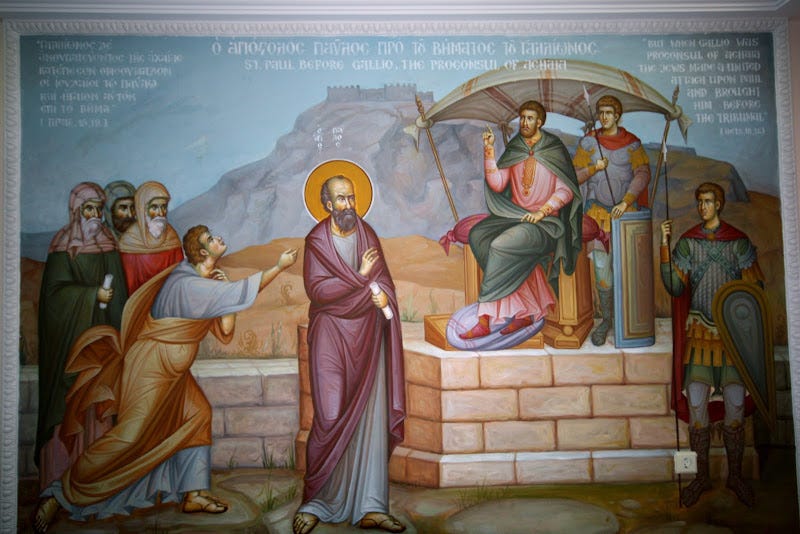
After staying there for a considerable time, Paul said farewell to the brothers and sisters and sailed for Syria, accompanied by Priscilla and Aquila. At Cenchreae he had his hair cut, for he was under a vow. When they reached Ephesus, he left them there, but first he himself went into the synagogue and had a discussion with the Jews. When they asked him to stay longer, he declined, but on taking leave of them he said, “I will return to you, if God wills.” Then he set sail from Ephesus.
When he had landed at Caesarea, he went up to Jerusalem and greeted the church and then went down to Antioch. After spending some time there he departed and went from place to place through the region of Galatia and Phrygia, strengthening all the disciples.

Subscribe to:
Comments (Atom)
Mission Yearbook: North Carolina town marks one year since Hurricane Helene with day of hope and healing
Witness, Share and Evangelize: Mission Yearbook: North Carolina town marks one ye... : Boone, North Carolina, recently observed the one-year...
-
Velma Grace Stewart, 92, of Shippenville Health Care Center, formerly of Perry Township, Parker, PA, passed away on Sunday, June 15, at the ...
-
Tracy L. Simpson, 55, of East Brady died Wednesday, June 4, 2025 after a brief illness. Born August 7, 1969 in Louisville, KY, she was the d...
-
Below is the obituary for Bus as it appears on the Varner Funeral Home website. William “Bus, Buster” Clark, 78, of Sligo, passed away on W...


