In this blog, we'll focus on the working being done at Sligo Presbyterian Church, Sligo, Pennsylvania. We'll also look at what's happening in Sligo, Rimersburg, Clarion, and all the other communities served by our congregation.
Below is a recording and the text of an article that Pastor Rudiger wrote for the Leader-Vindicator.
A couple of weeks ago, two profound events impacted my life. On April 5, we celebrated the resurrection of our Lord. And even though I’ve led worship services on Easter Sunday almost forty times, it’s always special. You see, it comes at the end of a week in which we move from the enthusiasm of Palm Sunday to the pain and sacrifice represented by the cross. And Easter, well, that’s a wonderful way to finish this journey, with the hope made real by an empty tomb. And throughout my pastoral career, I’ve tried to help people focus on this pivotal event.
But for me, this year was different. My father died on April 3. And although it was unexpected, it really wasn’t a surprise. Dad would have been 92 on April 15, and frankly, the last year was challenging. Still, he was in very good physical shape; therefore, we didn’t expect him to pass. As a matter of fact, my wife and I were planning to go down to Norfolk, Virginia during the week after Easter for a visit. Of course, we still went, but the reason was radically different.
And as I’ve been working through these two events, I believe I’ve found a genuine sense of hope and peace in the resurrection. You see, as the Apostle Paul reminds us, “But Christ has been raised to life! And he makes us certain that others will also be raised to life.” [1 Corinthians 15:20, CEV] In other words, since those women found the tomb empty, someday ours will be too.
And I’ll tell you, just believing this has given me enormous hope and peace. You see, my faith is grounded in something real and solid, not vague and obscure. Simply put, I trust that I’ll see my father again, along with my mother, grandparents and all those to whom I’ve said, “Good-bye,” because a process started when God raised Jesus from death. Again, as Paul wrote, “Just as we will die because of Adam, we will be raised to life because of Christ. Adam brought death to all of us, and Christ will bring life to all of us. But we must each wait our turn. Christ was the first to be raised to life, and his people will be raised to life when he returns.” [1 Corinthians 15:21-23, CEV] Now this is at the core of my faith. You see, my trust is not based on disembodied spirits floating around on clouds. Instead, it’s grounded in the sound of a trumpet, in the mortal bodies we now have putting on immortality and in the fulfillment of that promise: Death has lost the battle! Where is its victory? Where is its sting? [1 Corinthians 15:54b-55, CEV] And to me, that’s why the resurrection is important.
For me and my family, both events that recently impacted my life are now in the past. We celebrated Easter, and we endured a funeral. But personally, I doubt that I’ll ever be able to unlink the two, because I can now see that the time of separation we’re facing will end in the twinkling of an eye when God does for us what he’s already done for Jesus Christ. You see, as I’ve tried to convey during every Easter service, our hope is grounded in the resurrection.
The members and friends of Sligo Presbyterian Church are discussing the time after the resurrection. We meet on Thursday evenings, at 6:30 p.m., to consider passages that deal with the time between Easter and Pentecost. During this series, we’ll consider the following topics:
April 23 - Easter (Mark 16:1-8; Matthew 28:1-10; Luke 24:1-12; John 20:1-18)
April 30 - Two Endings in Mark (Mark 16:9-19)
May 7 - The Commission in Matthew (Matthew 28:11-20)
May 14 - Two Appearances in Luke (Luke 24:13-49)
May 21 - The Coming of the Spirit in John (John 20:19-31)
May 28 - The Commission in John (John 21:1-25)
June 4 - From the Ascension to the Spirit in Luke and Acts (Luke 24:50-53; Acts 1:1-26)
In our first session, we looked at the story of the resurrection from Matthew, Mark, Luke, and John. The discussion and passages are below.
When the Sabbath was over, Mary Magdalene and Mary the mother of James and Salome bought spices, so that they might go and anoint him. And very early on the first day of the week, when the sun had risen, they went to the tomb. They had been saying to one another, “Who will roll away the stone for us from the entrance to the tomb?” When they looked up, they saw that the stone, which was very large, had already been rolled back. As they entered the tomb, they saw a young man dressed in a white robe sitting on the right side, and they were alarmed. But he said to them, “Do not be alarmed; you are looking for Jesus of Nazareth, who was crucified. He has been raised; he is not here. Look, there is the place they laid him. But go, tell his disciples and Peter that he is going ahead of you to Galilee; there you will see him, just as he told you.” So they went out and fled from the tomb, for terror and amazement had seized them, and they said nothing to anyone, for they were afraid.
After the Sabbath, as the first day of the week was dawning, Mary Magdalene and the other Mary went to see the tomb. And suddenly there was a great earthquake, for an angel of the Lord, descending from heaven, came and rolled back the stone and sat on it. His appearance was like lightning and his clothing white as snow. For fear of him the guards shook and became like dead men. But the angel said to the women, “Do not be afraid, for I know that you are looking for Jesus who was crucified. He is not here, for he has been raised, as he said. Come, see the place where he lay. Then go quickly and tell his disciples, ‘He has been raised from the dead, and indeed he is going ahead of you to Galilee; there you will see him.’ This is my message for you.” So they left the tomb quickly with fear and great joy and ran to tell his disciples. Suddenly Jesus met them and said, “Greetings!” And they came to him, took hold of his feet, and worshiped him. Then Jesus said to them, “Do not be afraid; go and tell my brothers and sisters to go to Galilee; there they will see me.”
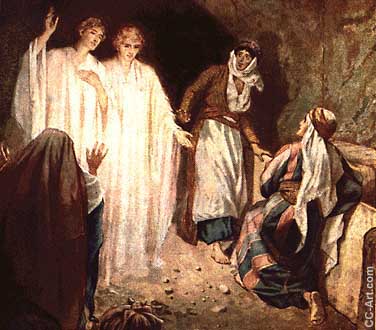
But on the first day of the week, at early dawn, they went to the tomb, taking the spices that they had prepared. They found the stone rolled away from the tomb, but when they went in they did not find the body. While they were perplexed about this, suddenly two men in dazzling clothes stood beside them. The women were terrified and bowed their faces to the ground, but the men said to them, “Why do you look for the living among the dead? He is not here but has risen. Remember how he told you, while he was still in Galilee, that the Son of Man must be handed over to the hands of sinners and be crucified and on the third day rise again.” Then they remembered his words, and returning from the tomb they told all this to the eleven and to all the rest. Now it was Mary Magdalene, Joanna, Mary the mother of James, and the other women with them who told this to the apostles. But these words seemed to them an idle tale, and they did not believe them. But Peter got up and ran to the tomb; stooping and looking in, he saw the linen cloths by themselves; then he went home, amazed at what had happened.
Early on the first day of the week, while it was still dark, Mary Magdalene came to the tomb and saw that the stone had been removed from the tomb. So she ran and went to Simon Peter and the other disciple, the one whom Jesus loved, and said to them, “They have taken the Lord out of the tomb, and we do not know where they have laid him.” Then Peter and the other disciple set out and went toward the tomb. The two were running together, but the other disciple outran Peter and reached the tomb first. He bent down to look in and saw the linen wrappings lying there, but he did not go in. Then Simon Peter came, following him, and went into the tomb. He saw the linen wrappings lying there, and the cloth that had been on Jesus’s head, not lying with the linen wrappings but rolled up in a place by itself. Then the other disciple, who reached the tomb first, also went in, and he saw and believed, for as yet they did not understand the scripture, that he must rise from the dead. Then the disciples returned to their homes.
But Mary stood weeping outside the tomb. As she wept, she bent over to look into the tomb, and she saw two angels in white sitting where the body of Jesus had been lying, one at the head and the other at the feet. They said to her, “Woman, why are you weeping?” She said to them, “They have taken away my Lord, and I do not know where they have laid him.” When she had said this, she turned around and saw Jesus standing there, but she did not know that it was Jesus. Jesus said to her, “Woman, why are you weeping? Whom are you looking for?” Supposing him to be the gardener, she said to him, “Sir, if you have carried him away, tell me where you have laid him, and I will take him away.” Jesus said to her, “Mary!” She turned and said to him in Hebrew, “Rabbouni!” (which means Teacher). Jesus said to her, “Do not touch me, because I have not yet ascended to the Father. But go to my brothers and say to them, ‘I am ascending to my Father and your Father, to my God and your God.’ ” Mary Magdalene went and announced to the disciples, “I have seen the Lord,” and she told them that he had said these things to her.
During the worship services of Holy Week, we’re focusing on The Paradox of the Passion: Exploring Holy Week in the Gospel of Matthew. Now, a paradox is a statement, idea, or situation that seems to contradict itself or defy logic, but which may actually be true or reveal a hidden truth. During Holy Week, we'll consider the paradox present in the following four stories:
During the worship services of Holy Week, we’re focusing on The Paradox of the Passion: Exploring Holy Week in the Gospel of Matthew. Now, a paradox is a statement, idea, or situation that seems to contradict itself or defy logic, but which may actually be true or reveal a hidden truth. We'll consider the paradox present in the following four stories:
Well, here we are, Easter morning. And even though it’s not as beautiful as it was yesterday, it’s still a magnificent day, especially for Christians. In fact, in my opinion, it’s the most important day in the entire year. Now, I recognize that, if you’re talking about how it’s celebrated, dyed eggs and silent bunnies really can’t hold a candle to Santa Claus and decorated trees. Still, in my opinion, the meaning and importance of the resurrection puts it head and shoulders above the other 365.
And I’ll tell you, that’s the reason we spent five weeks talking about how we might prepare to celebrate Easter. And then last week, on Palm Sunday, we refined our focus a little bit and started talking about the four episodes in Matthew that led up to the resurrection, each of which, I believe, has a paradox, a contradiction, some kind of unexpected twist either within or connected to the story. For example, last week, we looked at how the same crowd who waved palm branches and shouted “Hosannas” would later cry, “Nail him to a cross” while standing in Pilate’s court. And then, on Maundy Thursday, we considered how the closeness and unity of the last supper led to Jesus praying alone in Gethsemane and the disciples running away. And then, on Good Friday, we shared the most dramatic paradox of all, how an event that involved Jesus saying, “My God, my God, why have you abandoned me” as he died alone on a cross, how did this could culminate with earthquakes and dead people walking around and a group of Roman soldiers who saw it all saying, “This man really was God’s Son!” Now, that’s been our trip through what’s called Holy Week.
And this morning, we reach the conclusion of our little journey toward Easter, and I’m talking about the resurrection of the Lord. And you know, I think it’s interesting, just like we saw with the triumphal entry and the Last Supper and the crucifixion, as described by Matthew, well, I think there’s a paradox here as well. And just like we did last week, we’ll cover it by looking at three aspects of the account. I mean, first, we’ll consider the story itself. And then second, we’ll focus on the paradox within the story. And then third, we’ll discuss a lesson we might take from what’s happening here in Matthew.
Now that’s the plan, which starts with the story as written by the Evangelist Matthew. Now just listen to what he wrote:
The Sabbath was over, and it was almost daybreak on Sunday when Mary Magdalene and the other Mary went to see the tomb. Suddenly a strong earthquake struck, and the Lord’s angel came down from heaven. He rolled away the stone and sat on it. The angel looked as bright as lightning, and his clothes were white as snow. The guards shook from fear and fell down, as though they were dead.
The angel said to the women, “Don’t be afraid! I know you are looking for Jesus, who was nailed to a cross. He isn’t here! God has raised him to life, just as Jesus said he would. Come, see the place where his body was lying. Now hurry! Tell his disciples he has been raised to life and is on his way to Galilee. Go there, and you will see him. This is what I came to tell you.” [Matthew 28:1-7, CEV]
Now that’s the resurrection according to Matthew. And even though the stuff that happened at the beginning is really exciting, I mean, it sounds like something you might see in a Steven Spielberg movie and very similar to the kind of thing that those soldiers saw right after Jesus died, I want to focus on what the angel said to the women. For example, he said two things about Jesus, didn’t he, you know, that he wasn’t in the tomb because God had raised him to life, and since he wasn’t where he’d been lying, he had to be somewhere else. That’s one. And then he said that Jesus was on his way to Galilee, a distance of about 70 miles as the crow flies. And so, according to what the angel said, Jesus was no longer anywhere near the tomb and they would be seeing him later. Now file that away.
But the angel didn’t just talk about Jesus, did he? I mean, he also mentioned the women, and in particular, two things he wanted them to do. I mean, he said, “Don’t be afraid!”, a command that really makes a lot of sense, considering what they saw. And then he said, “Tell his disciples he has been raised to life and is on his way to Galilee.” In other words, that angel clearly and emphatically gave those women a purpose, didn’t he? They had a very specific mission, a message to share with the other disciples, you know, that Jesus was covering those 70 miles between Jerusalem and Galilee. And as a reminder that they would be taking this message all by themselves, the angel added, “Go there [meaning Galilee], and you will see him. This is what I came to tell you.” Now, in a nutshell, that’s the story.
Well, having said that, let me take a half-step back, because, according to the Evangelist Matthew, something happened within the story itself that really contradicted what the angel had just said. In other words, for me, right here is the paradox. Just listen:
The women were frightened and yet very happy, as they hurried from the tomb and ran to tell his disciples. Suddenly Jesus met them and greeted them. They went near him, held on to his feet, and worshiped him. Then Jesus said, “Don’t be afraid! Tell my followers to go to Galilee. They will see me there.” [Matthew 28:8-10, CEV]
Now, according to Matthew, that’s what happened. You see, as those women were claiming their purpose, you know, as they were doing what the angel told them to do and as they were going to tell the other disciples that Jesus wasn’t there at the tomb, instead he was going to get together with them 70 miles away in Galilee, as all this was going on, who did they meet? They met Jesus, right? As they were accomplishing their purpose, they met Jesus along the way. And obviously they knew right away who he was, because without any hesitation, “they went near him, held on to his feet, and worshiped him.” You see, the one whom they weren’t supposed to see, the one who wasn’t there and who would meet them in Galilee, man, there he was, a contradiction to what the angel said, a paradox within the story itself. And to leave no doubt that there was a connection between his presence there on the road with the purpose of those women, Jesus said, “Don’t be afraid! Tell my followers to go to Galilee. They will see me there.”
Of course, we’re going to see this same kind of connection between purpose and presence a little later in the story. Just listen:
Jesus’ eleven disciples went to a mountain in Galilee, where Jesus had told them to meet him. They saw him and worshiped him, but some of them doubted.
Jesus came to them and said:
I have been given all authority in heaven and on earth! Go to the people of all nations and make them my disciples. Baptize them in the name of the Father, the Son, and the Holy Spirit, and teach them to do everything I have told you. I will be with you always, even until the end of the world. [Matthew 28:16-20, CEV]
Now, in case you don’t know it, this is how the Gospel of Matthew ends, with our purpose and Christ’s presence coming together, something that I believe is apparent when we take the paradox within the story seriously.
Of course, both the story and the paradox, well, they’re just nice to know information without the lesson. And I’ll tell you, in my opinion, the lesson we can take from the resurrection according to Matthew, not only have we been talking about it but I believe we can claim it as soon as we leave here this morning. And here it is.
You see, as we think about the story and the paradox, I believe the resurrection reminds us that we, right here and right now, we also have a purpose. I mean, like those women who left the tomb and those disciples who went down from that mountain, we have the opportunity to share the love and the mercy and the generosity of Jesus Christ to those around us. Now I recognize that when I say “share,” some of y’all may cringe just a little bit. You see, often we assume that sharing means telling and talking. And when you get right down to it, doing that kind of thing may demand a pretty definite skill set that not everyone has. I mean, that’s what preachers do. They tell the story, and they do it by talking and talking and talking, right? Now that’s what we assume “sharing” means. But you know, I really don’t think that’s true, at least not about sharing. I mean, let me ask y’all. What’s the best way to communicate love, is it by talking about it or by deciding to be loving, even to folks we don’t like? And what’s the best way to communicate mercy, is it by defining it or by deciding to be merciful, even to people who don’t deserve it? And what’s the best way to communicate generosity, is it by telling folks how generous we are or by deciding to be truly generous, even if that means sacrificing some of our wants so that we can address the needs of others. You see, maybe that’s what sharing Jesus Christ is all about. And I’ll tell you, we can do that all by ourselves, by the words we speak and the work we do and the attitude we show. But you know, we can also do it as communities, can’t we? And just imagine, just imagine the impact we might have if we got together to be loving and to be merciful and to be generous. Who knows, we might change the world, or at the very least, change our little piece of it. You see, as written by Matthew, I think the resurrection reminds us that we have a purpose.
But take it to the bank, it also reminds us that we have a presence, a presence that we’re going to experience in just a few minutes when we gather around the Lord’s Table and a presence that we have the opportunity to take into the world. You know, I think it’s really interesting. The one who met those women as they were doing what the angel told them to do and the one who promised the disciples that he would be with them until the end of the world, he was given a name before he was even born that reminds us who and what he is and will always be. I mean, according to Matthew, Jesus came to be Emmanuel, which means, “God with us.” That’s who he was going to be before his birth. And that’s who he is after his resurrection. And that’s who he will be for us as we move forward. In other words, regardless of where we go, through Jesus Christ, God is with us, inspiring us to be loving. And regardless of whom we’re with, through Jesus Christ, God is with us, enabling us to be merciful. And regardless of what we do, through Jesus Christ, God is with us, empowering us to be generous. You see, not only do we have a purpose, man, we’ve got a presence. And for me, that’s the lesson of the story and the paradox.
Of course, having said all that, I think you could say that the Cadbury egg is now in our court. You see, as we move through our celebration of Easter, let’s remember the story of that angel who told the women about how Jesus wasn’t there and who gave them a very definite mission to accomplish. And then, let’s remember the paradox, you know, how that person who wasn’t there met them along the way as they were doing the very thing they were told to do. And then, let’s remember the lesson, that like those women, we also have a purpose and a presence with us all the time. Let’s remember. And I’ll tell you, if we do, I think we’ll be claiming and living the paradox of the resurrection.
During the worship service next week, we’re focusing on The Paradox of the Passion: Exploring Holy Week in the Gospel of Matthew. Now, a paradox is a statement, idea, or situation that seems to contradict itself or defy logic, but which may actually be true or reveal a hidden truth. During Holy Week, we're considering the paradox present in the following four stories:
During the worship services of Holy Week, we’re focusing on The Paradox of the Passion: Exploring Holy Week in the Gospel of Matthew. Now, a paradox is a statement, idea, or situation that seems to contradict itself or defy logic, but which may actually be true or reveal a hidden truth. During Holy Week, we'll consider the paradox present in the following four stories:
Sunday, March 29 - Palm / Passion Sunday (The Paradox of the Triumphal Entry)
Thursday, April 2 - Maundy Thursday Love Feast (The Paradox of the Last Supper)
Friday, April 3 - Good Friday Tenebrae Service (The Paradox of the Crucifixion)
Sunday, April 5 - Easter Celebration Service (The Paradox of the Resurrection)
On Sunday, we celebrated Palm/Passion Sunday by focusing on the paradox of Jesus triumphal entry into Jerusalem. Below is a video of the service, a presentation of the sermon, and the program & bulletin for the service. You can stream the service by going to the Sligo Presbyterian Church YouTube Channel on Sundays at 10:00 a.m. (EDT). You can hear a podcast of the service at the Sligo Presbyterian Church YouTube Channel or the Sligo Presbyterian Spotify Page.
During the worship services of Holy Week, we’re focusing on The Paradox of the Passion: Exploring Holy Week in the Gospel of Matthew. Now, a paradox is a statement, idea, or situation that seems to contradict itself or defy logic, but which may actually be true or reveal a hidden truth. We'll consider the paradox present in the following four stories:
Sunday, March 29 - Palm / Passion Sunday (The Paradox of the Triumphal Entry)
Thursday, April 2 - Maundy Thursday Love Feast (The Paradox of the Last Supper)
Friday, April 3 - Good Friday Tenebrae Service (The Paradox of the Crucifixion)
Sunday, April 5 - Easter Celebration Service (The Paradox of the Resurrection)
On Sunday, we celebrated Palm/Passion Sunday by focusing on the paradox of Jesus triumphal entry into Jerusalem. Below is a presentation and the text of the sermon. You can stream the service by going to the Sligo Presbyterian Church YouTube Channel on Sundays at 10:00 a.m. (EDT). You can hear a podcast of the service at the Sligo Presbyterian Church YouTube Channel or the Sligo Presbyterian Spotify Page.
Now, today we’re entering a period in the church year called “Holy Week,” a time that begins on Palm Sunday and ends with Easter. And since we’re moving from preparation to the event itself, we’ll be starting a series based on how this week is presented in the Gospel of Matthew entitled The Paradox of the Passion.
But before I tell y’all a little bit about what we’ll be doing, let me make sure we’re all on the same page about what the word “paradox” means. You see, according to the Merriam-Webster dictionary,
A paradox is a statement, person, or situation that seems self-contradictory, illogical, or absurd but may contain an underlying truth or valid reasoning. It challenges conventional thinking by combining opposing ideas. [Merriam-Webster Dictionary]
Now that’s the definition according to Merriam-Webster. In other words, it’s like saying, “This sentence is false” or “Doing hard things makes life easier” or “I must be cruel, only to be kind.” Each of those reflect a paradox.
And I’ll tell you, I think we see this kind of thing going on in each of the four stories that we generally associate with the last week of Jesus’s life, at least as written by the Evangelist Matthew. For example, just think about his last supper with his apostles, something we remember on Maundy Thursday. I mean, this intimate time with his closest followers led to Jesus praying alone in the Garden of Gethsemane while Peter, James and John slept, and being dragged off as his disciples ran away. And the crucifixion, man, that might be the ultimate paradox. My goodness, how can a death that ends with “My God, my God, why have you deserted me?” [Matthew 27:46b, CEV] led those who saw him die to say, “This man really was God’s Son!” ?[Matthew 27:54b, CEV] And as written by Matthew, instead of it being the first step in Jesus’s departure from this world, the resurrection becomes the assurance of his constant presence with us. You see, according to Matthew, in each of these events, there’s something going on that’s a contradiction, that’s inconsistent and ironic.
In other words, I believe there are paradoxes throughout the passion story, starting with the one we’re looking at this morning, and now I’m talking about Jesus’s triumphal entry into Jerusalem. You see, when you think about what happened and compare it with what’s about to happen, there’s something going on that, on one hand, doesn’t make sense, but that, on the other hand, just may show us a lot about who we are and what might happen, if we’re not careful. And that’s what we’re going to talk about this morning. And to do that, we’re going to focus on three things. First, we’re going to look at the story itself, in other words, the passage from the Gospel of Matthew. And then, second, we’re going to talk about the paradox within the account and think about how it might represent a real problem for us. And then, third, we’ll consider the practical lesson we might be able to take from this story and apply to our daily living. Now that’s the plan for the next ten minutes or so.
Of course, we can’t really talk about the paradox or consider any kind of lesson we might learn until we’ve heard the story itself. You see, according to the Evangelist Matthew, right after Jesus left Jericho, this was what happened:
When Jesus and his disciples came near Jerusalem, he went to Bethphage on the Mount of Olives and sent two of them on ahead. He told them, “Go into the next village, where you will at once find a donkey and her colt. Untie the two donkeys and bring them to me. If anyone asks why you are doing this, just say, ‘The Lord needs them.’ He will at once let you have the donkeys.”
So God’s promise came true, just as the prophet had said,
“Announce to the people of Jerusalem: ‘Your king is coming to you! He is humble and rides on a donkey. He comes on the colt of a donkey.’ “
The disciples left and did what Jesus had told them to do. They brought the donkey and its colt and laid some clothes on their backs. Then Jesus got on.
Many people spread clothes in the road, while others put down branches which they had cut from trees. Some people walked ahead of Jesus and others followed behind. They were all shouting,
“Hooray for the Son of David! God bless the one who comes in the name of the Lord. Hooray for God in heaven above!”
When Jesus came to Jerusalem, everyone in the city was excited and asked, “Who can this be?”
The crowds answered, “This is Jesus, the prophet from Nazareth in Galilee.” [Matthew 21:1-11, CEV]
Now, that’s what Matthew wrote. And I’ve got to tell you, from my perspective, it seems pretty clear and straight-forward. I mean, on one hand, Jesus seemed to be cool and composed and in complete control, didn’t he? He knew exactly what he wanted and how to get it. And what he did was exactly what he was supposed to do. In fact, absolutely nothing got in the way of his first entry into the city. You see, on one hand, Jesus was calm and collected as he rode into Jerusalem. On the other hand though, the crowds were anything but cool and composed. Man, they were really excited, weren’t they, and I’m talking about when they spread their clothes on the road and put down branches that they’d cut from trees and shouted about “the one who comes in the name of the Lord.” You see, while Jesus was calm and composed, “everyone in the city was excited” and those in the crowd believed they were following a prophet. Now, that’s the story in a nutshell.
And I’ll tell you, it’s right there where we run into the paradox, especially when you compare it to what will come later. You see, in the space of four days, this crowd which was so excited and so exuberant and so enthusiastic would be the same group standing in Pilate’s courtyard, shouting something radically different. Just listen to what Matthew wrote:
During Passover the governor always freed a prisoner chosen by the people. At that time a well-known terrorist named Jesus Barabbas was in jail. So when the crowd came together, Pilate asked them, “Which prisoner do you want me to set free? Do you want Jesus Barabbas or Jesus who is called the Messiah?” Pilate knew the leaders had brought Jesus to him because they were jealous.
While Pilate was judging the case, his wife sent him a message. It said, “Don’t have anything to do with that innocent man. I have had nightmares because of him.”
But the chief priests and the leaders convinced the crowds to ask for Barabbas to be set free and for Jesus to be killed.
Pilate asked the crowd again, “Which of these two men do you want me to set free?”
“Barabbas!” they shouted.
Pilate asked them, “What am I to do with Jesus, who is called the Messiah?”
They all yelled, “Nail him to a cross!”
Pilate answered, “But what crime has he done?”
“Nail him to a cross!” they yelled even louder.
Pilate saw that there was nothing he could do and that the people were starting to riot. So he took some water and washed his hands in front of them and said, “I won’t have anything to do with killing this man. You are the ones doing it!”
Everyone answered, “We and our own families will take the blame for his death!”
Pilate set Barabbas free. Then he ordered his soldiers to beat Jesus with a whip and nail him to a cross. [Matthew 27:15-26, CEV]
Now that’s what happened. And you tell me, why? Why would that crowd turn on a dime? I mean, didn’t they understand the one they followed into Jerusalem? And didn’t they believe in the one they compared to a son of David? Well, clearly they didn’t, because if they had, if they had understood and if they had believed, they sure wouldn’t have gathered there in Pilate’s court and they sure wouldn’t have yelled, “Nail him to a cross!” There’s the paradox.
But I’ll tell you, before we judge them too harshly, we might want to take a step back, because I think this is something that’s really easy for us to do ourselves. For example, I think we’ve all known folks who sure seem to be all fired up about Jesus. Good night nurse, they talk about what they’ve given and who’s their Lord and how following Christ and doing what he wants them to do, man, that’s the most important thing in their lives. He’s number one and everything else is secondary. Man, they’d do anything for Jesus, even die, if that was necessary. And I’ll tell you, when they say it, I believe they are completely sincere and honest in their excitement and exuberance and enthusiasm. In other words, based on what they say, if he were entering Sligo on a donkey this morning, they’d be out there, lifting up branches and laying down jackets and shouting “Hosannas,” right? And that sounds all well and good, until you ask them about some of their moral values and political beliefs or until you see how they treat other folks who might disagree with them or until you compare their words and work with what Jesus actually said and did. And then, well, imagining them before Pilate shouting that the one about whom Matthew wrote in his gospel, not the one they want to follow, you know, the one who validates their desires and endorses their prejudices, but rather the one who talked about radical humility and self-sacrifice and unconditional love, man, seeing them shouting that this uncomfortable trouble-maker should be nailed to a cross, well, that doesn’t seem to be quite a stretch. I guess you could say, the paradox there in Jesus’s entry can be a real problem for us.
But you know, it doesn’t have to be, not if we take seriously the lesson offered by this story. You see, we don’t have to be like those folks with the branches and the “Hosannas” who couldn’t have understood who Jesus was and who didn’t believe in what he came to do. Man, we don’t have to be like them, calling for this revelation of Jesus Christ, his actual words and his genuine example to be nailed on a cross. And I’ll tell you why.
You see, right here now, we can decide to grow. In other words, we can decide that we’re going to understand, and I mean, really understand who Jesus was and what he taught. Of course, to do that, well, we might have to make a few changes in our lives. For example, to understand what Jesus taught we might have to study a little bit. You see, we might have to dig out the Bible that’s been gathering dust for years and do something really extreme, you know, like opening it and reading it. And if we don’t understand what we’re reading because our dusty Bible is full of dusty words like “thee” and “thou,” we can return it to its place on the shelf under the coffee table and get ourselves a Bible we can understand or maybe even an app phone with all kinds of translations. Trust me, they’re all pretty good, and they’ll help us learn about what Jesus actually taught. And along with studying, man, we can also pray, pray that the Spirit helps us understand what’s going on in God’s word on a deeper level so that we’re not fooled by some folks who just plain don’t know as much as they claim or think. And after studying and praying, we can engage with our Christian brothers and sisters, in worship or in studies or in service, because, as Jesus Christ himself said, “Whenever two or three of you come together in my name, I am there with you.” [Matthew 18:20, CEV] I’ll tell you, if we’re serious about understanding more about Jesus, we can decide to study and to pray and to engage. And in that way, I believe we’ll grow. Now that’s one thing we can do.
And along with growing, we can also decide to trust. In other words, we can choose to believe that Jesus is exactly who said he was. But while growing involves actions that we can do on the outside, I think trusting has more to do with what’s happening on the inside. I mean, for our faith to become stronger, somewhere down the line, we’re probably going to have to work a little acceptance and submission into our lives, and I’m talking about a willingness to accept that we just don’t have all the answers and to submit to the one who does. And we might also need to develop an attitude of repentance and humility, something we can do when we’re willing to admit our personal limitations and to rely on Jesus for both eternal salvation and daily living. And finally, there’s really no faith without a willingness to be obedient and active, in other words, taking everything we now understand and applying it to our moral values and political beliefs and to how we treat both our friends and our enemies. You see, in my opinion, to avoid falling into the paradox trap reflected by the crowds who welcomed Jesus into Jerusalem, we can decide to grow and to trust. And for me, that’s the lesson of this story.
Of course, the triumphal entry, man, that’s just our first Holy Week stop. On Thursday, we’ll experience both the broad fellowship and isolated loneliness that surrounded the last supper. And on Friday, we’ll share in both the despair and glory of the crucifixion. And finally, on Easter, we’ll consider how an empty tomb can remind us that Christ is with us all the time. Now that’s what we’ll be doing for the rest of the week. But today, before we put the palms and Hosannas away and move on, let’s remember the story about how Jesus entered Jerusalem surrounded by people who felt enormous excitement and exuberance and enthusiasm. And let’s remember the paradox, you know, how the crowd that followed him shouting, “Hooray for the Son of David!” would in less than a week be yelling, “Nail him to a cross,” something that can happen to us if we don’t understand and believe. And then, let’s remember that we can avoid this situation by applying a simple lesson, that right here and now, we can decide to grow and we can decide to trust. Now we can choose to do this. And I’ll tell you, if we do, I think we’ll be learning from this paradox of the triumphal entry.


.jpg)




.jpg)


.jpg)
.jpg)
.jpg)


.jpg)
.jpg)
.jpg)


.jpg)
.jpg)
