Thursday, August 3, 2023

From Captivity to Freedom: A Study of the Exodus - A Complaining Bunch (Numbers 11:1 – 14:45)

During the SPC Wednesday morning Bible Study, we're studying the story of the Hebrew Exodus as recorded in the books of Exodus and Numbers. During the ten sessions in this series, we’ll look at the following topics:

During our seventh session, we looked at Numbers 11:1 – 14:45. Below is a recording our discussion and the passage.


Numbers 11:1 – 14:45

Now when the people complained in the hearing of the Lord about their misfortunes, the Lord heard it and his anger was kindled. Then the fire of the Lord burned against them, and consumed some outlying parts of the camp. But the people cried out to Moses; and Moses prayed to the Lord, and the fire abated. So that place was called Taberah, because the fire of the Lord burned against them.

The rabble among them had a strong craving; and the Israelites also wept again, and said, “If only we had meat to eat! We remember the fish we used to eat in Egypt for nothing, the cucumbers, the melons, the leeks, the onions, and the garlic; but now our strength is dried up, and there is nothing at all but this manna to look at.” Now the manna was like coriander seed, and its color was like the color of gum resin. The people went around and gathered it, ground it in mills or beat it in mortars, then boiled it in pots and made cakes of it; and the taste of it was like the taste of cakes baked with oil. When the dew fell on the camp in the night, the manna would fall with it. Moses heard the people weeping throughout their families, all at the entrances of their tents. Then the Lord became very angry, and Moses was displeased. So Moses said to the Lord, “Why have you treated your servant so badly? Why have I not found favor in your sight, that you lay the burden of all this people on me? Did I conceive all this people? Did I give birth to them, that you should say to me, ‘Carry them in your bosom, as a nurse carries a sucking child,’ to the land that you promised on oath to their ancestors? Where am I to get meat to give to all this people? For they come weeping to me and say, ‘Give us meat to eat!’ I am not able to carry all this people alone, for they are too heavy for me. If this is the way you are going to treat me, put me to death at once—if I have found favor in your sight—and do not let me see my misery.”

So the Lord said to Moses, “Gather for me seventy of the elders of Israel, whom you know to be the elders of the people and officers over them; bring them to the tent of meeting, and have them take their place there with you. I will come down and talk with you there; and I will take some of the spirit that is on you and put it on them; and they shall bear the burden of the people along with you so that you will not bear it all by yourself. And say to the people: Consecrate yourselves for tomorrow, and you shall eat meat; for you have wailed in the hearing of the Lord, saying, ‘If only we had meat to eat! Surely it was better for us in Egypt.’ Therefore the Lord will give you meat, and you shall eat. You shall eat not only one day, or two days, or five days, or ten days, or twenty days, but for a whole month—until it comes out of your nostrils and becomes loathsome to you—because you have rejected the Lord who is among you, and have wailed before him, saying, ‘Why did we ever leave Egypt?’” But Moses said, “The people I am with number six hundred thousand on foot; and you say, ‘I will give them meat, that they may eat for a whole month’! Are there enough flocks and herds to slaughter for them? Are there enough fish in the sea to catch for them?” The Lord said to Moses, “Is the Lord’s power limited? Now you shall see whether my word will come true for you or not.”

So Moses went out and told the people the words of the Lord; and he gathered seventy elders of the people, and placed them all around the tent. Then the Lord came down in the cloud and spoke to him, and took some of the spirit that was on him and put it on the seventy elders; and when the spirit rested upon them, they prophesied. But they did not do so again. Two men remained in the camp, one named Eldad, and the other named Medad, and the spirit rested on them; they were among those registered, but they had not gone out to the tent, and so they prophesied in the camp. And a young man ran and told Moses, “Eldad and Medad are prophesying in the camp.” And Joshua son of Nun, the assistant of Moses, one of his chosen men, said, “My lord Moses, stop them!” But Moses said to him, “Are you jealous for my sake? Would that all the Lord’s people were prophets, and that the Lord would put his spirit on them!” And Moses and the elders of Israel returned to the camp.

Then a wind went out from the Lord, and it brought quails from the sea and let them fall beside the camp, about a day’s journey on this side and a day’s journey on the other side, all around the camp, about two cubits deep on the ground. So the people worked all that day and night and all the next day, gathering the quails; the least anyone gathered was ten homers; and they spread them out for themselves all around the camp. But while the meat was still between their teeth, before it was consumed, the anger of the Lord was kindled against the people, and the Lord struck the people with a very great plague. So that place was called Kibroth-hattaavah, because there they buried the people who had the craving. From Kibroth-hattaavah the people journeyed to Hazeroth.

While they were at Hazeroth, Miriam and Aaron spoke against Moses because of the Cushite woman whom he had married (for he had indeed married a Cushite woman); and they said, “Has the Lord spoken only through Moses? Has he not spoken through us also?” And the Lord heard it. Now the man Moses was very humble, more so than anyone else on the face of the earth.

Suddenly the Lord said to Moses, Aaron, and Miriam, “Come out, you three, to the tent of meeting.” So the three of them came out. Then the Lord came down in a pillar of cloud, and stood at the entrance of the tent, and called Aaron and Miriam; and they both came forward. And he said, “Hear my words: When there are prophets among you, I the Lord make myself known to them in visions; I speak to them in dreams. Not so with my servant Moses; he is entrusted with all my house. With him I speak face to face— clearly, not in riddles; and he beholds the form of the Lord. Why then were you not afraid to speak against my servant Moses?” And the anger of the Lord was kindled against them, and he departed.

When the cloud went away from over the tent, Miriam had become leprous, as white as snow. And Aaron turned towards Miriam and saw that she was leprous. Then Aaron said to Moses, “Oh, my lord, do not punish us for a sin that we have so foolishly committed. Do not let her be like one stillborn, whose flesh is half consumed when it comes out of its mother’s womb.” And Moses cried to the Lord, “O God, please heal her.” But the Lord said to Moses, “If her father had but spit in her face, would she not bear her shame for seven days? Let her be shut out of the camp for seven days, and after that she may be brought in again.” So Miriam was shut out of the camp for seven days; and the people did not set out on the march until Miriam had been brought in again. After that the people set out from Hazeroth, and camped in the wilderness of Paran.

The Lord said to Moses, “Send men to spy out the land of Canaan, which I am giving to the Israelites; from each of their ancestral tribes you shall send a man, every one a leader among them.” So Moses sent them from the wilderness of Paran, according to the command of the Lord, all of them leading men among the Israelites. These were their names: From the tribe of Reuben, Shammua son of Zaccur; from the tribe of Simeon, Shaphat son of Hori; from the tribe of Judah, Caleb son of Jephunneh; from the tribe of Issachar, Igal son of Joseph; from the tribe of Ephraim, Hoshea son of Nun; from the tribe of Benjamin, Palti son of Raphu; from the tribe of Zebulun, Gaddiel son of Sodi; from the tribe of Joseph (that is, from the tribe of Manasseh), Gaddi son of Susi; from the tribe of Dan, Ammiel son of Gemalli; from the tribe of Asher, Sethur son of Michael; from the tribe of Naphtali, Nahbi son of Vophsi; from the tribe of Gad, Geuel son of Machi. These were the names of the men whom Moses sent to spy out the land. And Moses changed the name of Hoshea son of Nun to Joshua. Moses sent them to spy out the land of Canaan, and said to them, “Go up there into the Negeb, and go up into the hill country, and see what the land is like, and whether the people who live in it are strong or weak, whether they are few or many, and whether the land they live in is good or bad, and whether the towns that they live in are unwalled or fortified, and whether the land is rich or poor, and whether there are trees in it or not. Be bold, and bring some of the fruit of the land.” Now it was the season of the first ripe grapes.

So they went up and spied out the land from the wilderness of Zin to Rehob, near Lebo-hamath. They went up into the Negeb, and came to Hebron; and Ahiman, Sheshai, and Talmai, the Anakites, were there. (Hebron was built seven years before Zoan in Egypt.) And they came to the Wadi Eshcol, and cut down from there a branch with a single cluster of grapes, and they carried it on a pole between two of them. They also brought some pomegranates and figs. That place was called the Wadi Eshcol, because of the cluster that the Israelites cut down from there. At the end of forty days they returned from spying out the land.

And they came to Moses and Aaron and to all the congregation of the Israelites in the wilderness of Paran, at Kadesh; they brought back word to them and to all the congregation, and showed them the fruit of the land. And they told him, “We came to the land to which you sent us; it flows with milk and honey, and this is its fruit. Yet the people who live in the land are strong, and the towns are fortified and very large; and besides, we saw the descendants of Anak there. The Amalekites live in the land of the Negeb; the Hittites, the Jebusites, and the Amorites live in the hill country; and the Canaanites live by the sea, and along the Jordan.” But Caleb quieted the people before Moses, and said, “Let us go up at once and occupy it, for we are well able to overcome it.” Then the men who had gone up with him said, “We are not able to go up against this people, for they are stronger than we.” So they brought to the Israelites an unfavorable report of the land that they had spied out, saying, “The land that we have gone through as spies is a land that devours its inhabitants; and all the people that we saw in it are of great size. There we saw the Nephilim (the Anakites come from the Nephilim); and to ourselves we seemed like grasshoppers, and so we seemed to them.”

Then all the congregation raised a loud cry, and the people wept that night. And all the Israelites complained against Moses and Aaron; the whole congregation said to them, “Would that we had died in the land of Egypt! Or would that we had died in this wilderness! Why is the Lord bringing us into this land to fall by the sword? Our wives and our little ones will become booty; would it not be better for us to go back to Egypt?” So they said to one another, “Let us choose a captain, and go back to Egypt.”

Then Moses and Aaron fell on their faces before all the assembly of the congregation of the Israelites. And Joshua son of Nun and Caleb son of Jephunneh, who were among those who had spied out the land, tore their clothes and said to all the congregation of the Israelites, “The land that we went through as spies is an exceedingly good land. If the Lord is pleased with us, he will bring us into this land and give it to us, a land that flows with milk and honey. Only, do not rebel against the Lord; and do not fear the people of the land, for they are no more than bread for us; their protection is removed from them, and the Lord is with us; do not fear them.” But the whole congregation threatened to stone them. Then the glory of the Lord appeared at the tent of meeting to all the Israelites.

And the Lord said to Moses, “How long will this people despise me? And how long will they refuse to believe in me, in spite of all the signs that I have done among them? I will strike them with pestilence and disinherit them, and I will make of you a nation greater and mightier than they.” But Moses said to the Lord, “Then the Egyptians will hear of it, for in your might you brought up this people from among them, and they will tell the inhabitants of this land. They have heard that you, O Lord, are in the midst of this people; for you, O Lord, are seen face to face, and your cloud stands over them and you go in front of them, in a pillar of cloud by day and in a pillar of fire by night. Now if you kill this people all at one time, then the nations who have heard about you will say, ‘It is because the Lord was not able to bring this people into the land he swore to give them that he has slaughtered them in the wilderness.’ And now, therefore, let the power of the Lord be great in the way that you promised when you spoke, saying, ‘The Lord is slow to anger, and abounding in steadfast love, forgiving iniquity and transgression, but by no means clearing the guilty, visiting the iniquity of the parents upon the children to the third and the fourth generation.’ Forgive the iniquity of this people according to the greatness of your steadfast love, just as you have pardoned this people, from Egypt even until now.”

Then the Lord said, “I do forgive, just as you have asked; nevertheless—as I live, and as all the earth shall be filled with the glory of the Lord— none of the people who have seen my glory and the signs that I did in Egypt and in the wilderness, and yet have tested me these ten times and have not obeyed my voice, shall see the land that I swore to give to their ancestors; none of those who despised me shall see it. But my servant Caleb, because he has a different spirit and has followed me wholeheartedly, I will bring into the land into which he went, and his descendants shall possess it. Now, since the Amalekites and the Canaanites live in the valleys, turn tomorrow and set out for the wilderness by the way to the Red Sea.” And the Lord spoke to Moses and to Aaron, saying: How long shall this wicked congregation complain against me? I have heard the complaints of the Israelites, which they complain against me. Say to them, “As I live,” says the Lord, “I will do to you the very things I heard you say: your dead bodies shall fall in this very wilderness; and of all your number, included in the census, from twenty years old and upward, who have complained against me, not one of you shall come into the land in which I swore to settle you, except Caleb son of Jephunneh and Joshua son of Nun. But your little ones, who you said would become booty, I will bring in, and they shall know the land that you have despised. But as for you, your dead bodies shall fall in this wilderness. And your children shall be shepherds in the wilderness for forty years, and shall suffer for your faithlessness, until the last of your dead bodies lies in the wilderness. According to the number of the days in which you spied out the land, forty days, for every day a year, you shall bear your iniquity, forty years, and you shall know my displeasure.” I the Lord have spoken; surely I will do thus to all this wicked congregation gathered together against me: in this wilderness they shall come to a full end, and there they shall die.

And the men whom Moses sent to spy out the land, who returned and made all the congregation complain against him by bringing a bad report about the land— the men who brought an unfavorable report about the land died by a plague before the Lord. But Joshua son of Nun and Caleb son of Jephunneh alone remained alive, of those men who went to spy out the land. When Moses told these words to all the Israelites, the people mourned greatly. They rose early in the morning and went up to the heights of the hill country, saying, “Here we are. We will go up to the place that the Lord has promised, for we have sinned.” But Moses said, “Why do you continue to transgress the command of the Lord? That will not succeed. Do not go up, for the Lord is not with you; do not let yourselves be struck down before your enemies. For the Amalekites and the Canaanites will confront you there, and you shall fall by the sword; because you have turned back from following the Lord, the Lord will not be with you.” But they presumed to go up to the heights of the hill country, even though the ark of the covenant of the Lord, and Moses, had not left the camp. Then the Amalekites and the Canaanites who lived in that hill country came down and defeated them, pursuing them as far as Hormah.

Bible Readings for August 3, 2023

Study, Learn and Grow: Bible Readings for August 3, 2023: Let's read the Bible together in the next year.  Today our passages are 2 Chronicles 33:14–34:33; Romans 16:8-27; Psalm 26:1-12; an...

Tuesday, August 1, 2023

Today in the Mission Yearbook - Office of Christian Formation webinars offer resources and camaraderie for church educators

Witness, Share and Evangelize: Today in the Mission Yearbook - Office of Christia...: A recent webinar included an exploration of at-home resources August 1, 2023 Photo by Alexander Dummer via Unsplash The  Office of Christian...

The Sligo Presbyterian Church Celebration Service - Sunday, July 30, 2023

We're going to spend the summer of 2023 with the Patriarchs. During eleven worship services, beginning on Father's Day, we'll use passages from the book of Genesis to look at Abraham, Isaac, Jacob, and Joseph, focusing on how the Lord was consistently and actively involved in their lives. And by the end of the summer, we should have a better understanding of the one whom they followed and on how that same God can lead us. During this series, we'll look at the stories and passages below:

On Sunday, the message focused on what we can learn from the story of Jacob's dream at Bethel according to Genesis 28:10-19a. A video of the service, a recording of the sermon and copy of the bulletin are below. You can stream the service by going to the Sligo Presbyterian Church YouTube Channel at 10:00 a.m.


Sunday's Message - The Patriarchs: Encountering the God of Abraham, Isaac, Jacob, and Joseph (Jacob's Dream at Bethel)

We're going to spend the summer of 2023 with the Patriarchs. During eleven worship services, beginning on Father's Day, we'll use passages from the book of Genesis to look at Abraham, Isaac, Jacob, and Joseph, focusing on how the Lord was consistently and actively involved in their lives. And by the end of the summer, we should have a better understanding of the one whom they followed and on how that same God can lead us. During this series, we'll look at the stories and passages below:

On Sunday, the message focused on what we can learn from the story of Jacob's dream at Bethel, Genesis 28:10-19a. A recording and copy of the sermon are below. You can stream the service by going to the Sligo Presbyterian Church YouTube Channel at 10:00 a.m.


You know, although I have a hard time remembering my own, personally, I believe dreams are important. But, of course, I’m not alone. For example, the famous French novelist, Victor Hugo believed that “there is nothing like a dream to create the future. ...Each man should frame life so that at some future hour fact and his dreaming meet.” And that important American transcendentalist, Henry David Thoreau wrote, “Go confidently in the direction of your dreams. Live the life you have imagined.” And of course, the great British philosopher, Thomas Frederick Cooper said, “Last night I dreamed I ate a ten-pound marshmallow, and when I woke up the pillow was gone.” Like I said, dreams are important.

And that’s what we’ll be talking about this morning, but not dreams in general. Rather, we’re going to be looking at a very specific dream, one experienced by Jacob when he was between Beersheba and Haran. Now, in case you don’t know it, this is the sixth message in a series we started back in the middle of June, entitled The Patriarchs: Encountering the God of Abraham, Isaac, Jacob, and Joseph. And to this point, we’ve already looked at how the Lord chose Abram and how he promised Abraham and Sarah a son. And then we talked about how Abraham had to send Hagar and Ishmael away and how the Lord tested Abraham. And in the last couple of weeks, we focused on stories about Abraham’s servant finding Isaac a wife and the relationship between Isaac and Rebekah’s twin boys: Jacob and Esau. Now those are the stories we’ve already discussed and applied to ourselves.

And this morning, we’re going to do the same kind of thing with another patriarchal story from Genesis, this one dealing with a dream Jacob had at a place called Bethel. You see, we’re going to take this story, and we’re going to look at what was going on at the beginning, the dream itself and how Jacob responded. And then, as we’ve done six times before, we’ll take what we discussed and apply it to ourselves. And even though I know this is sort of a spoiler alert, when we do that, I think we’re going to see how we might be better able to move beyond the troubles we might carry from the past by remembering three things that God offers us in the present. Now that’s what we’re going to be doing this morning.

But of course, to do that, we’re going to spend some time talking about what’s going on in Genesis 28:10-19. Now, this was how it started:

Jacob left the town of Beersheba and started out for Haran. At sunset he stopped for the night and went to sleep, resting his head on a large rock. [Genesis 28:10-11, CEV]

Now that’s what it says. But to understand that’s happening here, I think we really need a little bit of background, you know, like why “Jacob left the town of Beersheba and started out for Haran.” [Genesis 28:10, CEV] Now that’s a pretty important question. And here’s the answer; Jacob was in big trouble. As a matter fact, in a very real sense, Jacob was on the lam, but not from the police. He was trying to get away from his twin brother Esau who wanted to kill him. Of course, if you were here last week, you know exactly why Esau hated Jacob so much, but if you weren’t, here’s the back story. Before they were born or had done anything good or bad, God told their mother, Rebekah, that the older, Esau, would serve the younger, Jacob. In other words, Jacob was going to carry the promise God had already made to his granddaddy, Abraham, and his daddy, Isaac. And to have everything he’d need to be what God chose him to be, Jacob needed to get a couple of things from Esau. I mean, one, Jacob needed to get his brother’s birthright, you know, his share of the inheritance, something Jacob got when we traded it for a big, streaming bowl of red stuff. And two, Jacob also needed to get Esau’s blessing, which Jacob got by lying to their father, convincing the old man that he was actually his big and beautiful older brother. Now that was what Jacob did, and so it’s really no surprise that, according to Genesis, “Esau hated his brother Jacob because he had stolen the blessing that was supposed to be his. So he said to himself, ‘Just as soon as my father dies, I’ll kill Jacob.’” [Genesis 27:41, CEV] And so, right after the funeral, Jacob had to get the heck out of Dodge, heading to his mother’s brother, Laban, to sort of hide out until the heat was off. Now that’s how the story begins. 

And as he was running away, he had a dream, and this was how it was described:

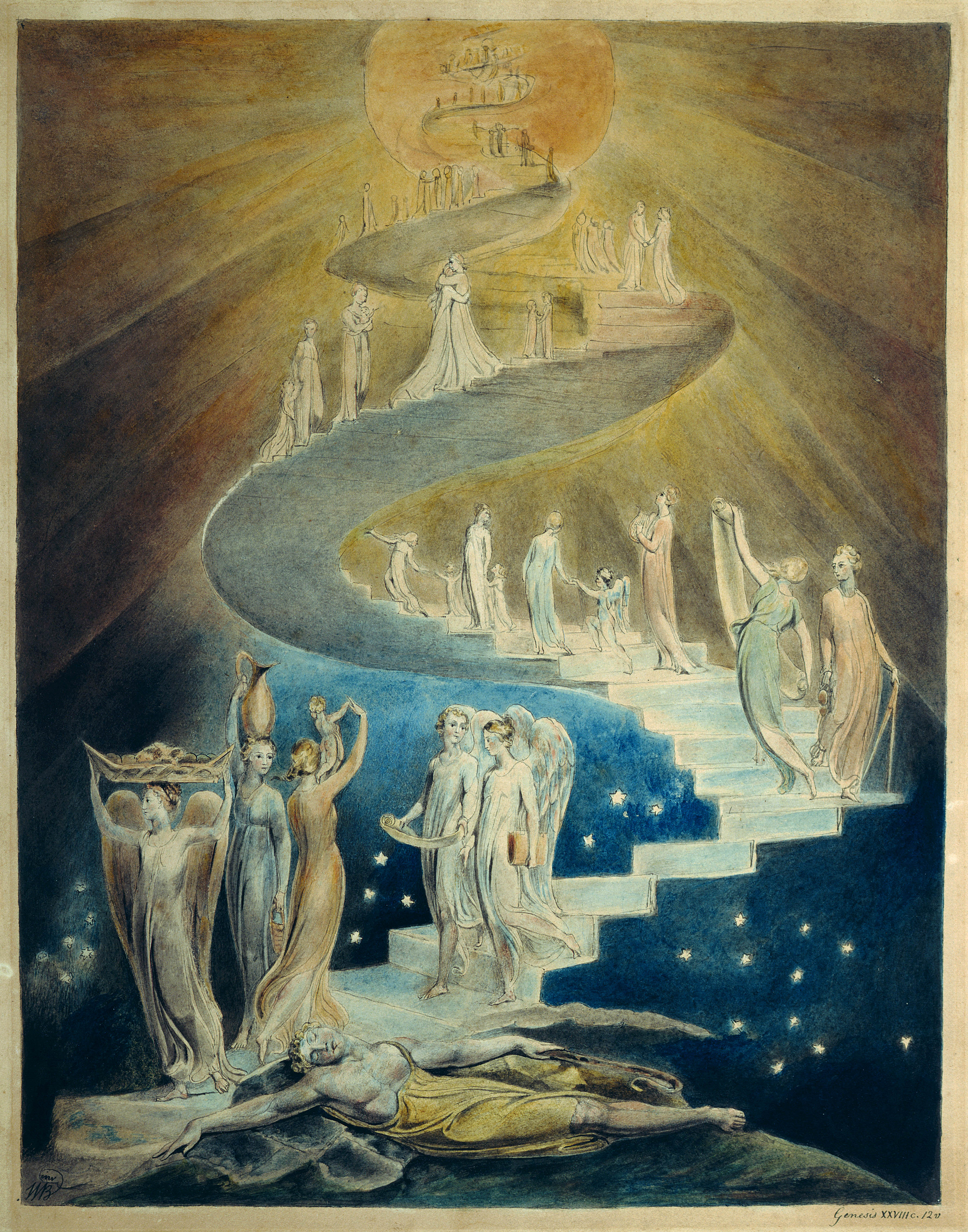
In a dream he saw a ladder that reached from earth to heaven, and God’s angels were going up and down on it. 

The Lord was standing beside the ladder and said:

I am the Lord God who was worshiped by Abraham and Isaac. I will give to you and your family the land on which you are now sleeping. Your descendants will spread over the earth in all directions and will become as numerous as the specks of dust. Your family will be a blessing to all people. Wherever you go, I will watch over you, then later I will bring you back to this land. I won’t leave you — I will do all I have promised. [Genesis 28:12-15, CEV]

Now that’s Jacob’s dream. And even though the idea of angels going up and down a ladder is kind of cool, for me, what God said was a whole lot more important. You see, as Jacob was sleeping with his head on that large rock, God offered him three promises, didn’t he? I mean, first, he promised Jacob that he was going to be with him, just like he was with Abraham and Isaac. And second, God said that he was going to protect Jacob, you know to watch over him. And third, God promised Jacob a place, as a matter of fact, the same place that was part of the covenant God had made to Jacob’s grandfather and father. In other words, even though Jacob might have to spend some time with Laban in northern Syria, eventually Jacob’s place would be in the land of Canaan. Now, presence and protection and place, you see, that’s what God promised this guy who was sleeping with his head on a rock in the middle of a desert because he was running away from a brother he’d cheated twice. 

And I’ll tell you, after the promise was made, the story concluded. This is what is says in Genesis:

Jacob woke up suddenly and thought, “The Lord is in this place, and I didn’t even know it.” Then Jacob became frightened and said, “What a frightening place! It must be the house of God and the gateway to heaven.”

When Jacob got up early the next morning, he took the rock that he had used for a pillow and stood it up as a place of worship. Then he poured olive oil on the rock to dedicate it to God, and he named the place Bethel. [Genesis 28:16-19a, CEV]

You see, after hearing the promises, Jacob responded with faith. He got up. And he recognized that it was at this place where God had talked to him; therefore, it was right and appropriate to anoint and to dedicate the rock on which he slept. And right after what we just read, again according to Genesis:

Jacob solemnly promised God, “If you go with me and watch over me as I travel, and if you give me food and clothes and bring me safely home again, you will be my God. This rock will be your house, and I will give back to you a tenth of everything you give me.” [Genesis 28:20-22, CEV]

You see, according to this story, three things happened: Jacob was in trouble. God made three promises to Jacob. And Jacob responded with faith.

And I’ll tell you, I think we can apply this exact same thing to ourselves, and I’m talking about right here and right now. For example, from time to time, we all face troubles, don’t we? Of course, just like it was for Jacob, sometimes the troubles we face are of our own creation. And even if it’s not our intention, an unfortunate attempt at humor or an off-hand comment or even a forgotten phone call or a missed appointment, man, they can all have consequences that we neither expect nor want. And these are problems we’ve sort of had a hand in creating. When you add to it a whole bunch of stuff that, when you get right down to it, just happens, well, I think we all know that facing some problems and pain, man, that’s just a fact of life. And that applies to Christians just like it does everyone else. It’s like the Apostle Peter wrote in this first letter:

Dear friends, don’t be surprised or shocked that you are going through testing that is like walking through fire. Be glad for the chance to suffer as Christ suffered. It will prepare you for even greater happiness when he makes his glorious return. [1 Peter 4:12-13, CEV]

I mean, even if we’re not trying to escape a sibling who wants to even the score, I think I’m safe in saying that, into every life, a little rain must fall. In other words, just like it was for Jacob, we all face troubles.

And I’ll tell you, because I believe that’s the case, I think it’s really important for us to remember that God makes promises to us. You see, when we’re trying to wade through the disappointments and difficulties, God speaks, and even though there’s not a biblical patriarch here this morning, I think he says the same thing to us that he said to Jacob.

For example, first, I think he also promises us his presence, the assurance that no matter where we go or what we do, he’s here with us. You see, we’re never alone, something that Jesus wanted his disciples to remember when he said this right before his crucifixion:

The Spirit will show you what is true. The people of this world cannot accept the Spirit, because they don’t see or know him. But you know the Spirit, who is with you and will keep on living in you.

I won’t leave you like orphans. I will come back to you. In a little while the people of this world won’t be able to see me, but you will see me. And because I live, you will live. Then you will know I am one with the Father. You will know you are one with me, and I am one with you. [John 14:17-20, CEV]

You see, God is present with us, and that’s one thing he promised to Jacob and promises to us.

But that’s not all, because, second, he also promises us his protection. In other words, no matter how tough life gets and no matter how discouraged we might be, man, we can always look to God, trusting that our ultimate destiny is in his loving and gracious hands. As a matter of fact, on our worse day, we can claim the words of the Psalmist:

Live under the protection
    of God Most High
and stay in the shadow
    of God All-Powerful.
Then you will say to the Lord,
“You are my fortress,
    my place of safety;
you are my God,
    and I trust you.”

The Lord will keep you safe
from secret traps
    and deadly diseases.
He will spread his wings 
over you
    and keep you secure.
His faithfulness is like
    a shield or a city 

You won’t need to worry
about dangers at night
    or arrows during the day.
And you won’t fear diseases
that strike in the dark
    or sudden disaster at noon. [Psalm 91:1-6, CEV]

You see, when we decide to trust that God’s control is absolute and eternal, we can always feel a sense of peace and even hope. Why? Because God protects us, and that’s another thing that God promised to Jacob and that God promises to us.

And third, he also promises us a place, a place where we can feel safe, a place where we’re accepted and a place where we can become everything God created and called us to be. And do you want to know where that place is? Man, just look around. This is our place. It’s like Paul said to the Ephesians:

You Gentiles are no longer strangers and foreigners. You are citizens with everyone else who belongs to the family of God. You are like a building with the apostles and prophets as the foundation and with Christ as the most important stone. Christ is the one who holds the building together and makes it grow into a holy temple for the Lord. And you are part of that building Christ has built as a place for God’s own Spirit to live. [Ephesians 2:19-22, CEV]

You see, the Body of Christ is a gift given to us by God himself, which is great for us. But I’ll tell you, it’s even better when we make a conscious decision to share it with others and an intentional effort to invite them in. Because God loves us, we have a place, and that’s something else that God promised to Jacob and that God promises to us.

And given these promises, well, now we can respond; man, we can respond with faith. You see, we can trust in the promises of God. And we can claim the presence and the protection and the place that he’s given us. This we can do. And even if we still have to deal with difficulties and disappointments and even if we’re still going to encounter some problems and pain along the way and even if we still find ourselves dealing with troubles from time to time, we’re going to make it. We’re going to be able to move forward. You see, we’re going to start doing what God has called us to do and to start becoming the kind of men and women God created us to be. As a matter of fact, we might even be able to take the same perspective Paul had when he shared this with the Corinthians:

Three times I begged the Lord to make this suffering go away. But he replied, “My gift of undeserved grace is all you need. My power is strongest when you are weak.” So if Christ keeps giving me his power, I will gladly brag about how weak I am. Yes, I am glad to be weak or insulted or mistreated or to have troubles and sufferings, if it is for Christ. Because when I am weak, I am strong. [2 Corinthians 12:8-10, CEV]

You see, as God’s people, just like Jacob, we can get ourselves up and respond to the promises of God.

I guess, when you get right down to it, although all dreams are important, well, some are more important than others. I mean, without contradicting Victor Hugo or Henry David Thoreau or Thomas Frederick Cooper, I think what Jacob experienced at Bethel was more profound than anything these great men envisioned. You see, according to what’s written in Genesis, Jacob was in trouble. God made three promises to Jacob. And he responded with faith. And I’ll tell you, that’s really good news for us, isn’t it? Why? Because sometimes we face troubles. And when we do, we can remember the three promises God makes to us, and I’m talking about his presence and his protection and this place. And with that in mind, we can respond and move forward with faith. Now all this we know because of a single dream, namely Jacob’s dream at Bethel. 

Bible Readings for August 1, 2023

Study, Learn and Grow: Bible Readings for August 1, 2023: Let's read the Bible together in the next year.  Today our passages are 2 Chronicles 29:1-36; Romans 14:1-23; Psalm 24:1-10; and Pr...

Mission Yearbook: Minneapolis church hosts a ‘Purple People Eater’

Witness, Share and Evangelize: Mission Yearbook: Minneapolis church hosts a ‘Purp... : Image The Minnesota Vikings’ defense that Alan Page a...