Showing posts with label 1 Samuel. Show all posts

Tuesday, June 16, 2026

The Testimony of Faithful Witnesses: Hannah, the Faithful Supplicant (1 Samuel 1:9-20, 25)

Whenever we come to the Bible, we often read looking for instruction and encouragement for the day. But the Bible isn’t meant only to guide us day-by-day. The Scriptures are a historical record. They reveal what God has done and is doing in the world—and introduce us to the people who played a particular role in His plans for the world.

If you’re a longtime reader of the Bible, you’re more than likely familiar with many of these people. Some are examples of faithfulness. Others are cautionary tales against faithlessness. But all were examples of people who furthered God’s plan to give “God loved the people of this world so much that he gave his only Son, so that everyone who has faith in him will have eternal life and never really die.” [John 3:16, CEV]

During this series, we’re discussing the following witnesses to God’s authority and love:

  • June 7: Deborah, the Dutiful Judge (Judges 4:4-10, 14, 21-22)
  • June 14: Hannah, the Faithful Supplicant (1 Samuel 1:9-20, 25)
  • June 28: Amos, Courageous Prophet (Amos 1:1; 2:11-12; 3:7-8; 7:10-15)
  • July 5: The Believing Centurion (Matthew 8:5-13)
  • July 12: Simon Peter, Restored Disciple (Mark 8:27-29; Luke 22:31-34; John 18:25-27, 21:15-17)
  • July 19: Zacchaeus, Repentant Tax Collector (Luke 19:-11)
  • July 26: Mary, Loyal Mother (Luke 2:15-19; John 2:1-5; 19:25-27)
  • August 9: Stephen, Unwavering Martyr (Acts 6:7-10; 7:54-60)
  • August 16: Saul of Tarsus, Unlikely Disciple (Acts 22:3-15)
  • August 23: Timothy, Leader with a Legacy (2 Timothy 1:1-6; 3:14-16)
  • August 30: Lydia, Generous Hostess (Acts 16:11-15, 40)

In the second session, we discussed Hannah, Samuel's mother. The discussion and passage are below:

1 Samuel 1:9-20, 25 [New International Version]

Once when they had finished eating and drinking in Shiloh, Hannah stood up. Now Eli the priest was sitting on his chair by the doorpost of the Lord’s house. In her deep anguish Hannah prayed to the Lord, weeping bitterly. And she made a vow, saying, “Lord Almighty, if you will only look on your servant’s misery and remember me, and not forget your servant but give her a son, then I will give him to the Lord for all the days of his life, and no razor will ever be used on his head.”

As she kept on praying to the Lord, Eli observed her mouth. Hannah was praying in her heart, and her lips were moving but her voice was not heard. Eli thought she was drunk and said to her, “How long are you going to stay drunk? Put away your wine.”

“Not so, my lord,” Hannah replied, “I am a woman who is deeply troubled. I have not been drinking wine or beer; I was pouring out my soul to the Lord. Do not take your servant for a wicked woman; I have been praying here out of my great anguish and grief.”

Eli answered, “Go in peace, and may the God of Israel grant you what you have asked of him.”

She said, “May your servant find favor in your eyes.” Then she went her way and ate something, and her face was no longer downcast.

Early the next morning they arose and worshiped before the Lord and then went back to their home at Ramah. Elkanah made love to his wife Hannah, and the Lord remembered her. So in the course of time Hannah became pregnant and gave birth to a son. She named him Samuel, saying, “Because I asked the Lord for him.”

When the bull had been sacrificed, they brought the boy to Eli,

Wednesday, January 31, 2024

Of Kings & Covenants: A Study of 1 & 2 Samuel (A Fall from Grace - 1 Samuel 13:1–15:35)

The Sligo Presbyterian Church Wednesday Morning Bible Study is continuing its study of the Old Testament by looking at how God led David from watching a flock to leading a nation. Below is an outline for the series.

  • Session 1 - 1 Samuel 1:1–4:1
  • Session 2 - 1 Samuel 4:2–7:17
  • Session 3 - 1 Samuel 8:1–10:27
  • Session 4 - 1 Samuel 11:1–12:25
  • Session 5 - 1 Samuel 13:1–15:35
  • Session 6 - 1 Samuel 16:1–17:58
  • Session 7 - 1 Samuel 18:1–20:42
  • Session 8 - 1 Samuel 21:1–23:29
  • Session 9 - 1 Samuel 24:1–26:25
  • Session 10 - 1 Samuel 27:1–29:11
  • Session 11 - 1 Samuel 30:1–31:13
  • Session 12 - 2 Samuel 1:1–3:21
  • Session 13 - 2 Samuel 3:22–5:10
  • Session 14 - 2 Samuel 5:11–8:18
  • Session 15 - 2 Samuel 9:1–11:27
  • Session 16 - 2 Samuel 12:1–14:33
  • Session 17 - 2 Samuel 15:1–18:8
  • Session 18 - 2 Samuel 18:9–20:26
  • Session 19 - 2 Samuel 21:1–24:25
During our fifth session, we discussed Saul's fall from grace, 1 Samuel 13:1–15:35. Below is a recording of our discussion and the text from 1 Samuel.


1 Samuel 13:1–15:35 [New Revised Standard Version]

Saul was...years old when he began to reign; and he reigned...and two years over Israel. Saul chose three thousand out of Israel; two thousand were with Saul in Michmash and the hill country of Bethel, and a thousand were with Jonathan in Gibeah of Benjamin; the rest of the people he sent home to their tents. Jonathan defeated the garrison of the Philistines that was at Geba; and the Philistines heard of it. And Saul blew the trumpet throughout all the land, saying, “Let the Hebrews hear!” When all Israel heard that Saul had defeated the garrison of the Philistines, and also that Israel had become odious to the Philistines, the people were called out to join Saul at Gilgal. The Philistines mustered to fight with Israel, thirty thousand chariots, and six thousand horsemen, and troops like the sand on the seashore in multitude; they came up and encamped at Michmash, to the east of Beth-aven. When the Israelites saw that they were in distress (for the troops were hard pressed), the people hid themselves in caves and in holes and in rocks and in tombs and in cisterns. Some Hebrews crossed the Jordan to the land of Gad and Gilead. Saul was still at Gilgal, and all the people followed him trembling.

He waited seven days, the time appointed by Samuel; but Samuel did not come to Gilgal, and the people began to slip away from Saul. So Saul said, “Bring the burnt offering here to me, and the offerings of well-being.” And he offered the burnt offering. As soon as he had finished offering the burnt offering, Samuel arrived; and Saul went out to meet him and salute him. Samuel said, “What have you done?” Saul replied, “When I saw that the people were slipping away from me, and that you did not come within the days appointed, and that the Philistines were mustering at Michmash, I said, ‘Now the Philistines will come down upon me at Gilgal, and I have not entreated the favor of the Lord’; so I forced myself, and offered the burnt offering.” Samuel said to Saul, “You have done foolishly; you have not kept the commandment of the Lord your God, which he commanded you. The Lord would have established your kingdom over Israel forever, but now your kingdom will not continue; the Lord has sought out a man after his own heart; and the Lord has appointed him to be ruler over his people, because you have not kept what the Lord commanded you.”

And Samuel left and went on his way from Gilgal. The rest of the people followed Saul to join the army; they went up from Gilgal toward Gibeah of Benjamin. Saul counted the people who were present with him, about six hundred men. Saul, his son Jonathan, and the people who were present with them stayed in Geba of Benjamin; but the Philistines encamped at Michmash. And raiders came out of the camp of the Philistines in three companies; one company turned toward Ophrah, to the land of Shual, another company turned toward Beth-horon, and another company turned toward the mountain that looks down upon the valley of Zeboim toward the wilderness. Now there was no smith to be found throughout all the land of Israel; for the Philistines said, “The Hebrews must not make swords or spears for themselves”; so all the Israelites went down to the Philistines to sharpen their plowshare, mattocks, axes, or sickles; The charge was two-thirds of a shekel for the plowshares and for the mattocks, and one-third of a shekel for sharpening the axes and for setting the goads. So on the day of the battle neither sword nor spear was to be found in the possession of any of the people with Saul and Jonathan; but Saul and his son Jonathan had them. Now a garrison of the Philistines had gone out to the pass of Michmash.

One day Jonathan son of Saul said to the young man who carried his armor, “Come, let us go over to the Philistine garrison on the other side.” But he did not tell his father. Saul was staying in the outskirts of Gibeah under the pomegranate tree that is at Migron; the troops that were with him were about six hundred men, along with Ahijah son of Ahitub, Ichabod’s brother, son of Phinehas son of Eli, the priest of the Lord in Shiloh, carrying an ephod. Now the people did not know that Jonathan had gone. In the pass, by which Jonathan tried to go over to the Philistine garrison, there was a rocky crag on one side and a rocky crag on the other; the name of the one was Bozez, and the name of the other Seneh. One crag rose on the north in front of Michmash, and the other on the south in front of Geba. Jonathan said to the young man who carried his armor, “Come, let us go over to the garrison of these uncircumcised; it may be that the Lord will act for us; for nothing can hinder the Lord from saving by many or by few.” His armor-bearer said to him, “Do all that your mind inclines to. I am with you; as your mind is, so is mine.” Then Jonathan said, “Now we will cross over to those men and will show ourselves to them. If they say to us, ‘Wait until we come to you,’ then we will stand still in our place, and we will not go up to them. But if they say, ‘Come up to us,’ then we will go up; for the Lord has given them into our hand. That will be the sign for us.” So both of them showed themselves to the garrison of the Philistines; and the Philistines said, “Look, Hebrews are coming out of the holes where they have hidden themselves.” The men of the garrison hailed Jonathan and his armor-bearer, saying, “Come up to us, and we will show you something.” Jonathan said to his armor-bearer, “Come up after me; for the Lord has given them into the hand of Israel.” Then Jonathan climbed up on his hands and feet, with his armor-bearer following after him. The Philistines fell before Jonathan, and his armor-bearer, coming after him, killed them. In that first slaughter Jonathan and his armor-bearer killed about twenty men within an area about half a furrow long in an acre of land. There was a panic in the camp, in the field, and among all the people; the garrison and even the raiders trembled; the earth quaked; and it became a very great panic.

Saul’s lookouts in Gibeah of Benjamin were watching as the multitude was surging back and forth. Then Saul said to the troops that were with him, “Call the roll and see who has gone from us.” When they had called the roll, Jonathan and his armor-bearer were not there. Saul said to Ahijah, “Bring the ark of God here.” For at that time the ark of God went with the Israelites. While Saul was talking to the priest, the tumult in the camp of the Philistines increased more and more; and Saul said to the priest, “Withdraw your hand.” Then Saul and all the people who were with him rallied and went into the battle; and every sword was against the other, so that there was very great confusion. Now the Hebrews who previously had been with the Philistines and had gone up with them into the camp turned and joined the Israelites who were with Saul and Jonathan. Likewise, when all the Israelites who had gone into hiding in the hill country of Ephraim heard that the Philistines were fleeing, they too followed closely after them in the battle. So the Lord gave Israel the victory that day. The battle passed beyond Beth-aven, and the troops with Saul numbered altogether about ten thousand men. The battle spread out over the hill country of Ephraim.

Now Saul committed a very rash act on that day. He had laid an oath on the troops, saying, “Cursed be anyone who eats food before it is evening and I have been avenged on my enemies.” So none of the troops tasted food. All the troops came upon a honeycomb; and there was honey on the ground. When the troops came upon the honeycomb, the honey was dripping out; but they did not put their hands to their mouths, for they feared the oath. But Jonathan had not heard his father charge the troops with the oath; so he extended the staff that was in his hand, and dipped the tip of it in the honeycomb, and put his hand to his mouth; and his eyes brightened. Then one of the soldiers said, “Your father strictly charged the troops with an oath, saying, ‘Cursed be anyone who eats food this day.’ And so the troops are faint.” Then Jonathan said, “My father has troubled the land; see how my eyes have brightened because I tasted a little of this honey. How much better if today the troops had eaten freely of the spoil taken from their enemies; for now the slaughter among the Philistines has not been great.” After they had struck down the Philistines that day from Michmash to Aijalon, the troops were very faint; so the troops flew upon the spoil, and took sheep and oxen and calves, and slaughtered them on the ground; and the troops ate them with the blood. Then it was reported to Saul, “Look, the troops are sinning against the Lord by eating with the blood.” And he said, “You have dealt treacherously; roll a large stone before me here.” Saul said, “Disperse yourselves among the troops, and say to them, ‘Let all bring their oxen or their sheep, and slaughter them here, and eat; and do not sin against the Lord by eating with the blood.’” So all of the troops brought their oxen with them that night, and slaughtered them there. And Saul built an altar to the Lord; it was the first altar that he built to the Lord.

Then Saul said, “Let us go down after the Philistines by night and despoil them until the morning light; let us not leave one of them.” They said, “Do whatever seems good to you.” But the priest said, “Let us draw near to God here.” So Saul inquired of God, “Shall I go down after the Philistines? Will you give them into the hand of Israel?” But he did not answer him that day. Saul said, “Come here, all you leaders of the people; and let us find out how this sin has arisen today. For as the Lord lives who saves Israel, even if it is in my son Jonathan, he shall surely die!” But there was no one among all the people who answered him. He said to all Israel, “You shall be on one side, and I and my son Jonathan will be on the other side.” The people said to Saul, “Do what seems good to you.” Then Saul said, “O Lord God of Israel, why have you not answered your servant today? If this guilt is in me or in my son Jonathan, O Lord God of Israel, give Urim; but if this guilt is in your people Israel, give Thummim.” And Jonathan and Saul were indicated by the lot, but the people were cleared. Then Saul said, “Cast the lot between me and my son Jonathan.” And Jonathan was taken. Then Saul said to Jonathan, “Tell me what you have done.” Jonathan told him, “I tasted a little honey with the tip of the staff that was in my hand; here I am, I will die.” Saul said, “God do so to me and more also; you shall surely die, Jonathan!” Then the people said to Saul, “Shall Jonathan die, who has accomplished this great victory in Israel? Far from it! As the Lord lives, not one hair of his head shall fall to the ground; for he has worked with God today.” So the people ransomed Jonathan, and he did not die. Then Saul withdrew from pursuing the Philistines; and the Philistines went to their own place.

When Saul had taken the kingship over Israel, he fought against all his enemies on every side—against Moab, against the Ammonites, against Edom, against the kings of Zobah, and against the Philistines; wherever he turned he routed them. He did valiantly, and struck down the Amalekites, and rescued Israel out of the hands of those who plundered them. Now the sons of Saul were Jonathan, Ishvi, and Malchishua; and the names of his two daughters were these: the name of the firstborn was Merab, and the name of the younger, Michal. The name of Saul’s wife was Ahinoam daughter of Ahimaaz. And the name of the commander of his army was Abner son of Ner, Saul’s uncle; Kish was the father of Saul, and Ner the father of Abner was the son of Abiel. There was hard fighting against the Philistines all the days of Saul; and when Saul saw any strong or valiant warrior, he took him into his service.

Samuel said to Saul, “The Lord sent me to anoint you king over his people Israel; now therefore listen to the words of the Lord. Thus says the Lord of hosts, ‘I will punish the Amalekites for what they did in opposing the Israelites when they came up out of Egypt. Now go and attack Amalek, and utterly destroy all that they have; do not spare them, but kill both man and woman, child and infant, ox and sheep, camel and donkey.’” So Saul summoned the people, and numbered them in Telaim, two hundred thousand foot soldiers, and ten thousand soldiers of Judah. Saul came to the city of the Amalekites and lay in wait in the valley. Saul said to the Kenites, “Go! Leave! Withdraw from among the Amalekites, or I will destroy you with them; for you showed kindness to all the people of Israel when they came up out of Egypt.” So the Kenites withdrew from the Amalekites. Saul defeated the Amalekites, from Havilah as far as Shur, which is east of Egypt. He took King Agag of the Amalekites alive, but utterly destroyed all the people with the edge of the sword. Saul and the people spared Agag, and the best of the sheep and of the cattle and of the fatlings, and the lambs, and all that was valuable, and would not utterly destroy them; all that was despised and worthless they utterly destroyed.

The word of the Lord came to Samuel: “I regret that I made Saul king, for he has turned back from following me, and has not carried out my commands.” Samuel was angry; and he cried out to the Lord all night. Samuel rose early in the morning to meet Saul, and Samuel was told, “Saul went to Carmel, where he set up a monument for himself, and on returning he passed on down to Gilgal.” When Samuel came to Saul, Saul said to him, “May you be blessed by the Lord; I have carried out the command of the Lord.” But Samuel said, “What then is this bleating of sheep in my ears, and the lowing of cattle that I hear?” Saul said, “They have brought them from the Amalekites; for the people spared the best of the sheep and the cattle, to sacrifice to the Lord your God; but the rest we have utterly destroyed.” Then Samuel said to Saul, “Stop! I will tell you what the Lord said to me last night.” He replied, “Speak.” Samuel said, “Though you are little in your own eyes, are you not the head of the tribes of Israel? The Lord anointed you king over Israel. And the Lord sent you on a mission, and said, ‘Go, utterly destroy the sinners, the Amalekites, and fight against them until they are consumed.’ Why then did you not obey the voice of the Lord? Why did you swoop down on the spoil, and do what was evil in the sight of the Lord?” Saul said to Samuel, “I have obeyed the voice of the Lord, I have gone on the mission on which the Lord sent me, I have brought Agag the king of Amalek, and I have utterly destroyed the Amalekites. But from the spoil the people took sheep and cattle, the best of the things devoted to destruction, to sacrifice to the Lord your God in Gilgal.” And Samuel said, “Has the Lord as great delight in burnt offerings and sacrifices, as in obeying the voice of the Lord? Surely, to obey is better than sacrifice, and to heed than the fat of rams. For rebellion is no less a sin than divination, and stubbornness is like iniquity and idolatry. Because you have rejected the word of the Lord, he has also rejected you from being king.”

Saul said to Samuel, “I have sinned; for I have transgressed the commandment of the Lord and your words, because I feared the people and obeyed their voice. Now therefore, I pray, pardon my sin, and return with me, so that I may worship the Lord.” Samuel said to Saul, “I will not return with you; for you have rejected the word of the Lord, and the Lord has rejected you from being king over Israel.” As Samuel turned to go away, Saul caught hold of the hem of his robe, and it tore. And Samuel said to him, “The Lord has torn the kingdom of Israel from you this very day, and has given it to a neighbor of yours, who is better than you. Moreover the Glory of Israel will not recant or change his mind; for he is not a mortal, that he should change his mind.” Then Saul said, “I have sinned; yet honor me now before the elders of my people and before Israel, and return with me, so that I may worship the Lord your God.” So Samuel turned back after Saul; and Saul worshiped the Lord.

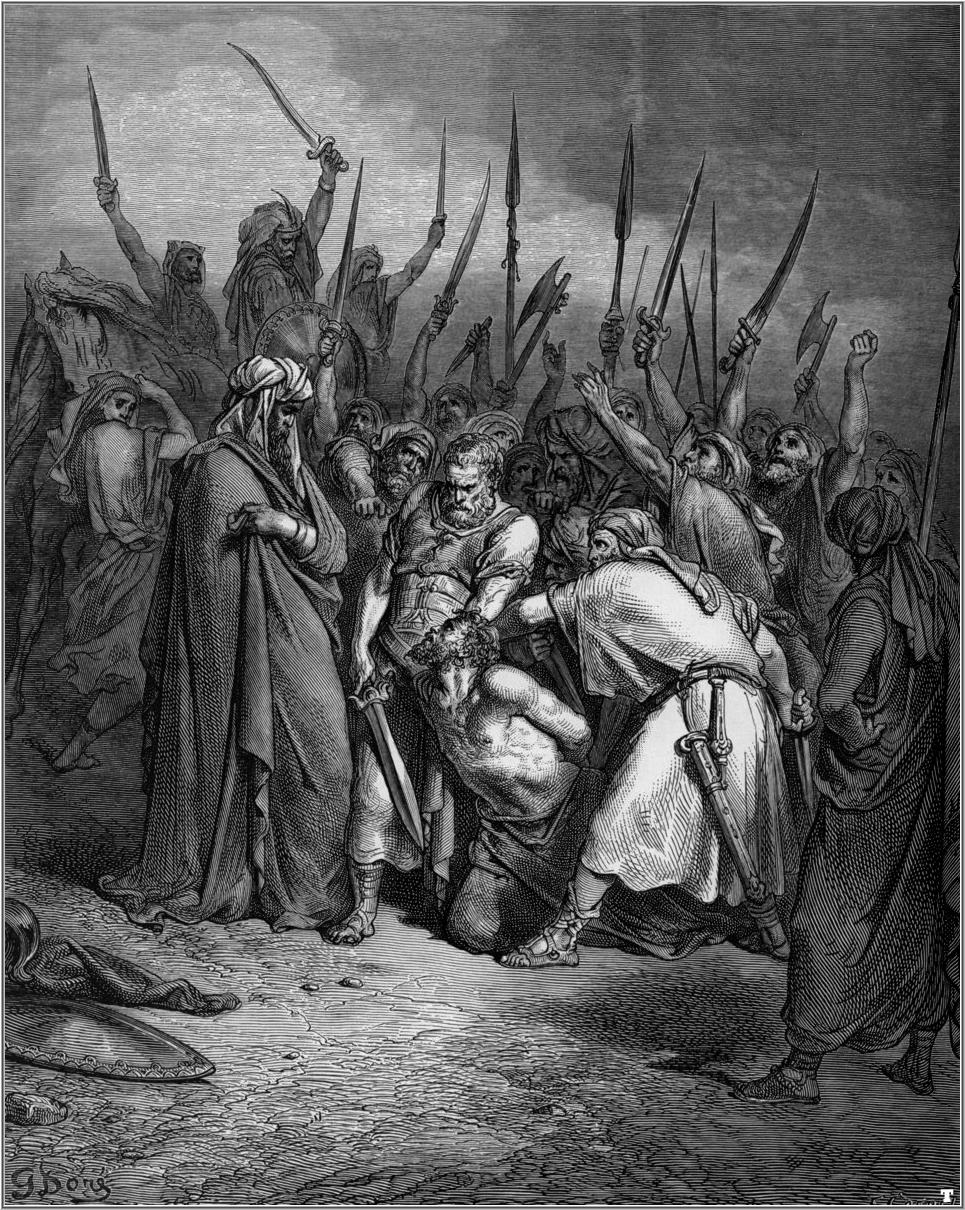
Then Samuel said, “Bring Agag king of the Amalekites here to me.” And Agag came to him haltingly. Agag said, “Surely this is the bitterness of death.” But Samuel said, “As your sword has made women childless, so your mother shall be childless among women.” And Samuel hewed Agag in pieces before the Lord in Gilgal. Then Samuel went to Ramah; and Saul went up to his house in Gibeah of Saul. Samuel did not see Saul again until the day of his death, but Samuel grieved over Saul. And the Lord was sorry that he had made Saul king over Israel.

Wednesday, January 10, 2024

Of Kings & Covenants: A Study of 1 & 2 Samuel (A New Judge - 1 Samuel 4:2–7:17)

The Sligo Presbyterian Church Wednesday Morning Bible Study is continuing its study of the Old Testament by looking at how God led David from watching a flock to leading a nation. Below is an outline for the series.

  • Session 1 - 1 Samuel 1:1–4:1
  • Session 2 - 1 Samuel 4:2–7:17
  • Session 3 - 1 Samuel 8:1–10:27
  • Session 4 - 1 Samuel 11:1–12:25
  • Session 5 - 1 Samuel 13:1–15:35
  • Session 6 - 1 Samuel 16:1–17:58
  • Session 7 - 1 Samuel 18:1–20:42
  • Session 8 - 1 Samuel 21:1–23:29
  • Session 9 - 1 Samuel 24:1–26:25
  • Session 10 - 1 Samuel 27:1–29:11
  • Session 11 - 1 Samuel 30:1–31:13
  • Session 12 - 2 Samuel 1:1–3:21
  • Session 13 - 2 Samuel 3:22–5:10
  • Session 14 - 2 Samuel 5:11–8:18
  • Session 15 - 2 Samuel 9:1–11:27
  • Session 16 - 2 Samuel 12:1–14:33
  • Session 17 - 2 Samuel 15:1–18:8
  • Session 18 - 2 Samuel 18:9–20:26
  • Session 19 - 2 Samuel 21:1–24:25
During our second session, we discussed the conflict between the Philistines and Israel and Samuel becoming the last judge, 1 Samuel 4:2–7:17. Below is a recording of our discussion and the text from 1 Samuel.


1 Samuel 4:2–7:17 [New Revised Standard Version]

The Philistines drew up in line against Israel, and when the battle was joined, Israel was defeated by the Philistines, who killed about four thousand men on the field of battle. When the troops came to the camp, the elders of Israel said, “Why has the Lord put us to rout today before the Philistines? Let us bring the ark of the covenant of the Lord here from Shiloh, so that he may come among us and save us from the power of our enemies.” So the people sent to Shiloh, and brought from there the ark of the covenant of the Lord of hosts, who is enthroned on the cherubim. The two sons of Eli, Hophni and Phinehas, were there with the ark of the covenant of God. When the ark of the covenant of the Lord came into the camp, all Israel gave a mighty shout, so that the earth resounded. When the Philistines heard the noise of the shouting, they said, “What does this great shouting in the camp of the Hebrews mean?” When they learned that the ark of the Lord had come to the camp, the Philistines were afraid; for they said, “Gods have come into the camp.” They also said, “Woe to us! For nothing like this has happened before. Woe to us! Who can deliver us from the power of these mighty gods? These are the gods who struck the Egyptians with every sort of plague in the wilderness. Take courage, and be men, O Philistines, in order not to become slaves to the Hebrews as they have been to you; be men and fight.”

So the Philistines fought; Israel was defeated, and they fled, everyone to his home. There was a very great slaughter, for there fell of Israel thirty thousand foot soldiers. The ark of God was captured; and the two sons of Eli, Hophni and Phinehas, died.

A man of Benjamin ran from the battle line, and came to Shiloh the same day, with his clothes torn and with earth upon his head. When he arrived, Eli was sitting upon his seat by the road watching, for his heart trembled for the ark of God. When the man came into the city and told the news, all the city cried out. When Eli heard the sound of the outcry, he said, “What is this uproar?” Then the man came quickly and told Eli. Now Eli was ninety-eight years old and his eyes were set, so that he could not see. The man said to Eli, “I have just come from the battle; I fled from the battle today.” He said, “How did it go, my son?” The messenger replied, “Israel has fled before the Philistines, and there has also been a great slaughter among the troops; your two sons also, Hophni and Phinehas, are dead, and the ark of God has been captured.” When he mentioned the ark of God, Eli fell over backward from his seat by the side of the gate; and his neck was broken and he died, for he was an old man, and heavy. He had judged Israel forty years.

Now his daughter-in-law, the wife of Phinehas, was pregnant, about to give birth. When she heard the news that the ark of God was captured, and that her father-in-law and her husband were dead, she bowed and gave birth; for her labor pains overwhelmed her. As she was about to die, the women attending her said to her, “Do not be afraid, for you have borne a son.” But she did not answer or give heed. She named the child Ichabod, meaning, “The glory has departed from Israel,” because the ark of God had been captured and because of her father-in-law and her husband. She said, “The glory has departed from Israel, for the ark of God has been captured.”

When the Philistines captured the ark of God, they brought it from Ebenezer to Ashdod; then the Philistines took the ark of God and brought it into the house of Dagon and placed it beside Dagon. When the people of Ashdod rose early the next day, there was Dagon, fallen on his face to the ground before the ark of the Lord. So they took Dagon and put him back in his place. But when they rose early on the next morning, Dagon had fallen on his face to the ground before the ark of the Lord, and the head of Dagon and both his hands were lying cut off upon the threshold; only the trunk of Dagon was left to him. This is why the priests of Dagon and all who enter the house of Dagon do not step on the threshold of Dagon in Ashdod to this day.

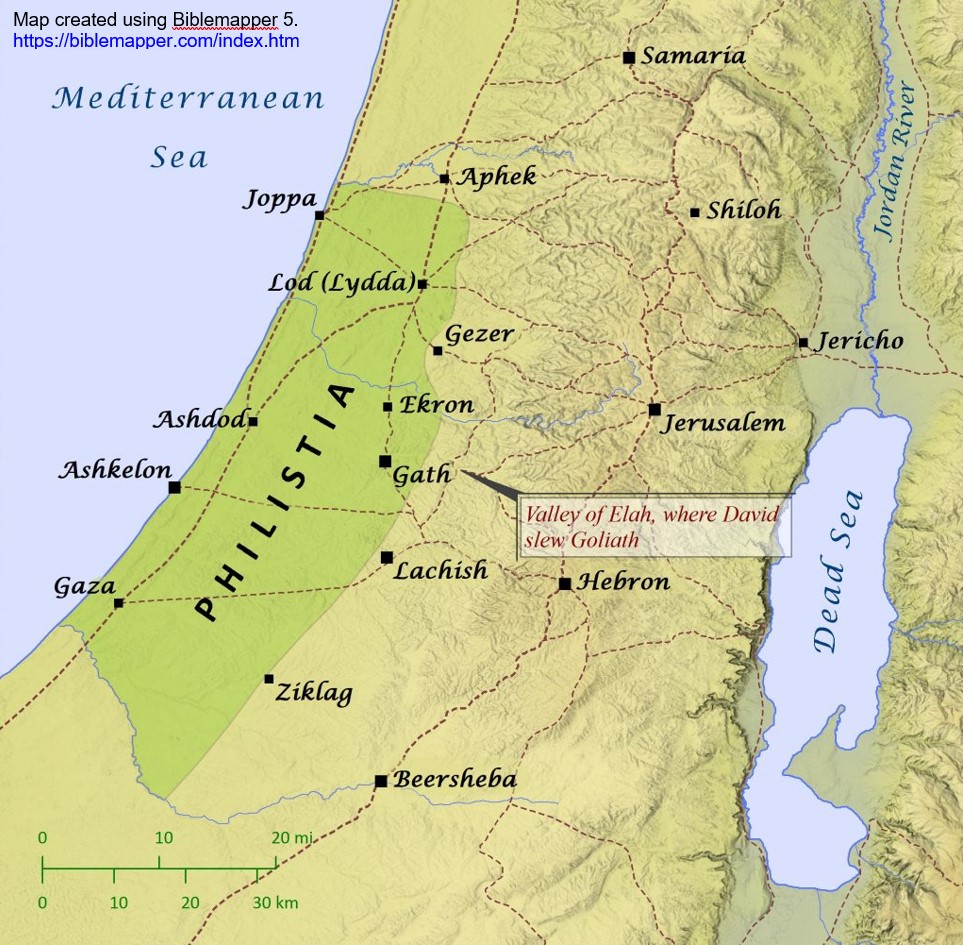
The hand of the Lord was heavy upon the people of Ashdod, and he terrified and struck them with tumors, both in Ashdod and in its territory. And when the inhabitants of Ashdod saw how things were, they said, “The ark of the God of Israel must not remain with us; for his hand is heavy on us and on our god Dagon.” So they sent and gathered together all the lords of the Philistines, and said, “What shall we do with the ark of the God of Israel?” The inhabitants of Gath replied, “Let the ark of God be moved on to us.” So they moved the ark of the God of Israel to Gath. But after they had brought it to Gath, the hand of the Lord was against the city, causing a very great panic; he struck the inhabitants of the city, both young and old, so that tumors broke out on them. So they sent the ark of the God of Israel to Ekron. But when the ark of God came to Ekron, the people of Ekron cried out, “Why have they brought around to us the ark of the God of Israel to kill us and our people?” They sent therefore and gathered together all the lords of the Philistines, and said, “Send away the ark of the God of Israel, and let it return to its own place, that it may not kill us and our people.” For there was a deathly panic throughout the whole city. The hand of God was very heavy there; those who did not die were stricken with tumors, and the cry of the city went up to heaven.

The ark of the Lord was in the country of the Philistines seven months. Then the Philistines called for the priests and the diviners and said, “What shall we do with the ark of the Lord? Tell us what we should send with it to its place.” They said, “If you send away the ark of the God of Israel, do not send it empty, but by all means return him a guilt offering. Then you will be healed and will be ransomed; will not his hand then turn from you?” And they said, “What is the guilt offering that we shall return to him?” They answered, “Five gold tumors and five gold mice, according to the number of the lords of the Philistines; for the same plague was upon all of you and upon your lords. So you must make images of your tumors and images of your mice that ravage the land, and give glory to the God of Israel; perhaps he will lighten his hand on you and your gods and your land. Why should you harden your hearts as the Egyptians and Pharaoh hardened their hearts? After he had made fools of them, did they not let the people go, and they departed? Now then, get ready a new cart and two milch cows that have never borne a yoke, and yoke the cows to the cart, but take their calves home, away from them. Take the ark of the Lord and place it on the cart, and put in a box at its side the figures of gold, which you are returning to him as a guilt offering. Then send it off, and let it go its way. And watch; if it goes up on the way to its own land, to Beth-shemesh, then it is he who has done us this great harm; but if not, then we shall know that it is not his hand that struck us; it happened to us by chance.”

The men did so; they took two milch cows and yoked them to the cart, and shut up their calves at home. They put the ark of the Lord on the cart, and the box with the gold mice and the images of their tumors. The cows went straight in the direction of Beth-shemesh along one highway, lowing as they went; they turned neither to the right nor to the left, and the lords of the Philistines went after them as far as the border of Beth-shemesh. Now the people of Beth-shemesh were reaping their wheat harvest in the valley. When they looked up and saw the ark, they went with rejoicing to meet it. The cart came into the field of Joshua of Beth-shemesh, and stopped there. A large stone was there; so they split up the wood of the cart and offered the cows as a burnt offering to the Lord. The Levites took down the ark of the Lord and the box that was beside it, in which were the gold objects, and set them upon the large stone. Then the people of Beth-shemesh offered burnt offerings and presented sacrifices on that day to the Lord. When the five lords of the Philistines saw it, they returned that day to Ekron. These are the gold tumors, which the Philistines returned as a guilt offering to the Lord: one for Ashdod, one for Gaza, one for Ashkelon, one for Gath, one for Ekron; also the gold mice, according to the number of all the cities of the Philistines belonging to the five lords, both fortified cities and unwalled villages. The great stone, beside which they set down the ark of the Lord, is a witness to this day in the field of Joshua of Beth-shemesh.

The descendants of Jeconiah did not rejoice with the people of Beth-shemesh when they greeted the ark of the Lord; and he killed seventy men of them. The people mourned because the Lord had made a great slaughter among the people. Then the people of Beth-shemesh said, “Who is able to stand before the Lord, this holy God? To whom shall he go so that we may be rid of him?” So they sent messengers to the inhabitants of Kiriath-jearim, saying, “The Philistines have returned the ark of the Lord. Come down and take it up to you.”

And the people of Kiriath-jearim came and took up the ark of the Lord, and brought it to the house of Abinadab on the hill. They consecrated his son, Eleazar, to have charge of the ark of the Lord. From the day that the ark was lodged at Kiriath-jearim, a long time passed, some twenty years, and all the house of Israel lamented after the Lord.

Then Samuel said to all the house of Israel, “If you are returning to the Lord with all your heart, then put away the foreign gods and the Astartes from among you. Direct your heart to the Lord, and serve him only, and he will deliver you out of the hand of the Philistines.” So Israel put away the Baals and the Astartes, and they served the Lord only. Then Samuel said, “Gather all Israel at Mizpah, and I will pray to the Lord for you.” So they gathered at Mizpah, and drew water and poured it out before the Lord. They fasted that day, and said, “We have sinned against the Lord.” And Samuel judged the people of Israel at Mizpah.

When the Philistines heard that the people of Israel had gathered at Mizpah, the lords of the Philistines went up against Israel. And when the people of Israel heard of it they were afraid of the Philistines. The people of Israel said to Samuel, “Do not cease to cry out to the Lord our God for us, and pray that he may save us from the hand of the Philistines.” So Samuel took a sucking lamb and offered it as a whole burnt offering to the Lord; Samuel cried out to the Lord for Israel, and the Lord answered him. As Samuel was offering up the burnt offering, the Philistines drew near to attack Israel; but the Lord thundered with a mighty voice that day against the Philistines and threw them into confusion; and they were routed before Israel. And the men of Israel went out of Mizpah and pursued the Philistines, and struck them down as far as beyond Beth-car. Then Samuel took a stone and set it up between Mizpah and Jeshanah, and named it Ebenezer; for he said, “Thus far the Lord has helped us.”

So the Philistines were subdued and did not again enter the territory of Israel; the hand of the Lord was against the Philistines all the days of Samuel. The towns that the Philistines had taken from Israel were restored to Israel, from Ekron to Gath; and Israel recovered their territory from the hand of the Philistines. There was peace also between Israel and the Amorites. Samuel judged Israel all the days of his life. He went on a circuit year by year to Bethel, Gilgal, and Mizpah; and he judged Israel in all these places. Then he would come back to Ramah, for his home was there; he administered justice there to Israel, and built there an altar to the Lord.

Wednesday, January 3, 2024

Of Kings & Covenants: A Study of 1 & 2 Samuel (A New Day - 1 Samuel 1:1–4:1)

The Sligo Presbyterian Church Wednesday Morning Bible Study is continuing its study of the Old Testament by looking at how God led David from watching a flock to leading a nation. Below is an outline for the series.

  • Session 1 - 1 Samuel 1:1–4:1
  • Session 2 - 1 Samuel 4:2–7:17
  • Session 3 - 1 Samuel 8:1–10:27
  • Session 4 - 1 Samuel 11:1–12:25
  • Session 5 - 1 Samuel 13:1–15:35
  • Session 6 - 1 Samuel 16:1–17:58
  • Session 7 - 1 Samuel 18:1–20:42
  • Session 8 - 1 Samuel 21:1–23:29
  • Session 9 - 1 Samuel 24:1–26:25
  • Session 10 - 1 Samuel 27:1–29:11
  • Session 11 - 1 Samuel 30:1–31:13
  • Session 12 - 2 Samuel 1:1–3:21
  • Session 13 - 2 Samuel 3:22–5:10
  • Session 14 - 2 Samuel 5:11–8:18
  • Session 15 - 2 Samuel 9:1–11:27
  • Session 16 - 2 Samuel 12:1–14:33
  • Session 17 - 2 Samuel 15:1–18:8
  • Session 18 - 2 Samuel 18:9–20:26
  • Session 19 - 2 Samuel 21:1–24:25
During our first session, we discussed Samuel and Eli, 1 Samuel 1:1–4:1. Below is a recording of our discussion and the text from 1 Samuel.

1 Samuel 1:1–4:1 [New Revised Standard Version]

There was a certain man of Ramathaim, a Zuphite from the hill country of Ephraim, whose name was Elkanah son of Jeroham son of Elihu son of Tohu son of Zuph, an Ephraimite. He had two wives; the name of the one was Hannah, and the name of the other Peninnah. Peninnah had children, but Hannah had no children. Now this man used to go up year by year from his town to worship and to sacrifice to the Lord of hosts at Shiloh, where the two sons of Eli, Hophni and Phinehas, were priests of the Lord. On the day when Elkanah sacrificed, he would give portions to his wife Peninnah and to all her sons and daughters; but to Hannah he gave a double portion, because he loved her, though the Lord had closed her womb. Her rival used to provoke her severely, to irritate her, because the Lord had closed her womb. So it went on year by year; as often as she went up to the house of the Lord, she used to provoke her. Therefore Hannah wept and would not eat. Her husband Elkanah said to her, “Hannah, why do you weep? Why do you not eat? Why is your heart sad? Am I not more to you than ten sons?”

After they had eaten and drunk at Shiloh, Hannah rose and presented herself before the Lord. Now Eli the priest was sitting on the seat beside the doorpost of the temple of the Lord. She was deeply distressed and prayed to the Lord, and wept bitterly. She made this vow: “O Lord of hosts, if only you will look on the misery of your servant, and remember me, and not forget your servant, but will give to your servant a male child, then I will set him before you as a nazirite until the day of his death. He shall drink neither wine nor intoxicants, and no razor shall touch his head.” As she continued praying before the Lord, Eli observed her mouth. Hannah was praying silently; only her lips moved, but her voice was not heard; therefore Eli thought she was drunk. So Eli said to her, “How long will you make a drunken spectacle of yourself? Put away your wine.” But Hannah answered, “No, my lord, I am a woman deeply troubled; I have drunk neither wine nor strong drink, but I have been pouring out my soul before the Lord. Do not regard your servant as a worthless woman, for I have been speaking out of my great anxiety and vexation all this time.” Then Eli answered, “Go in peace; the God of Israel grant the petition you have made to him.” And she said, “Let your servant find favor in your sight.” Then the woman went to her quarters, ate and drank with her husband, and her countenance was sad no longer.

They rose early in the morning and worshiped before the Lord; then they went back to their house at Ramah. Elkanah knew his wife Hannah, and the Lord remembered her. In due time Hannah conceived and bore a son. She named him Samuel, for she said, “I have asked him of the Lord.” The man Elkanah and all his household went up to offer to the Lord the yearly sacrifice, and to pay his vow. But Hannah did not go up, for she said to her husband, “As soon as the child is weaned, I will bring him, that he may appear in the presence of the Lord, and remain there forever; I will offer him as a nazirite for all time.” Her husband Elkanah said to her, “Do what seems best to you, wait until you have weaned him; only—may the Lord establish his word.” So the woman remained and nursed her son, until she weaned him. When she had weaned him, she took him up with her, along with a three-year-old bull, an ephah of flour, and a skin of wine. She brought him to the house of the Lord at Shiloh; and the child was young. Then they slaughtered the bull, and they brought the child to Eli. And she said, “Oh, my lord! As you live, my lord, I am the woman who was standing here in your presence, praying to the Lord. For this child I prayed; and the Lord has granted me the petition that I made to him. Therefore I have lent him to the Lord; as long as he lives, he is given to the Lord.” She left him there for the Lord.

Hannah prayed and said, “My heart exults in the Lord; my strength is exalted in my God. My mouth derides my enemies, because I rejoice in my victory. “There is no Holy One like the Lord, no one besides you; there is no Rock like our God. Talk no more so very proudly, let not arrogance come from your mouth; for the Lord is a God of knowledge, and by him actions are weighed. The bows of the mighty are broken, but the feeble gird on strength. Those who were full have hired themselves out for bread, but those who were hungry are fat with spoil. The barren has borne seven, but she who has many children is forlorn. The Lord kills and brings to life; he brings down to Sheol and raises up. The Lord makes poor and makes rich; he brings low, he also exalts. He raises up the poor from the dust; he lifts the needy from the ash heap, to make them sit with princes and inherit a seat of honor. For the pillars of the earth are the Lord’s, and on them he has set the world. “He will guard the feet of his faithful ones, but the wicked shall be cut off in darkness; for not by might does one prevail. The Lord! His adversaries shall be shattered; the Most High will thunder in heaven. The Lord will judge the ends of the earth; he will give strength to his king, and exalt the power of his anointed.”
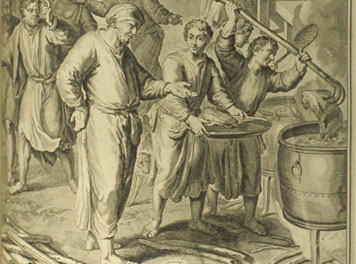
Then Elkanah went home to Ramah, while the boy remained to minister to the Lord, in the presence of the priest Eli. Now the sons of Eli were scoundrels; they had no regard for the Lord or for the duties of the priests to the people. When anyone offered sacrifice, the priest’s servant would come, while the meat was boiling, with a three-pronged fork in his hand, and he would thrust it into the pan, or kettle, or caldron, or pot; all that the fork brought up the priest would take for himself. This is what they did at Shiloh to all the Israelites who came there. Moreover, before the fat was burned, the priest’s servant would come and say to the one who was sacrificing, “Give meat for the priest to roast; for he will not accept boiled meat from you, but only raw.” And if the man said to him, “Let them burn the fat first, and then take whatever you wish,” he would say, “No, you must give it now; if not, I will take it by force.” Thus the sin of the young men was very great in the sight of the Lord; for they treated the offerings of the Lord with contempt. Samuel was ministering before the Lord, a boy wearing a linen ephod. His mother used to make for him a little robe and take it to him each year, when she went up with her husband to offer the yearly sacrifice. Then Eli would bless Elkanah and his wife, and say, “May the Lord repay you with children by this woman for the gift that she made to the Lord”; and then they would return to their home. And the Lord took note of Hannah; she conceived and bore three sons and two daughters. And the boy Samuel grew up in the presence of the Lord. Now Eli was very old. He heard all that his sons were doing to all Israel, and how they lay with the women who served at the entrance to the tent of meeting. He said to them, “Why do you do such things? For I hear of your evil dealings from all these people. No, my sons; it is not a good report that I hear the people of the Lord spreading abroad. If one person sins against another, someone can intercede for the sinner with the Lord; but if someone sins against the Lord, who can make intercession?” But they would not listen to the voice of their father; for it was the will of the Lord to kill them. Now the boy Samuel continued to grow both in stature and in favor with the Lord and with the people.

A man of God came to Eli and said to him, “Thus the Lord has said, ‘I revealed myself to the family of your ancestor in Egypt when they were slaves to the house of Pharaoh. I chose him out of all the tribes of Israel to be my priest, to go up to my altar, to offer incense, to wear an ephod before me; and I gave to the family of your ancestor all my offerings by fire from the people of Israel. Why then look with greedy eye at my sacrifices and my offerings that I commanded, and honor your sons more than me by fattening yourselves on the choicest parts of every offering of my people Israel?’ Therefore the Lord the God of Israel declares: ‘I promised that your family and the family of your ancestor should go in and out before me forever’; but now the Lord declares: ‘Far be it from me; for those who honor me I will honor, and those who despise me shall be treated with contempt. See, a time is coming when I will cut off your strength and the strength of your ancestor’s family, so that no one in your family will live to old age. Then in distress you will look with greedy eye on all the prosperity that shall be bestowed upon Israel; and no one in your family shall ever live to old age. The only one of you whom I shall not cut off from my altar shall be spared to weep out his eyes and grieve his heart; all the members of your household shall die by the sword. The fate of your two sons, Hophni and Phinehas, shall be the sign to you—both of them shall die on the same day. I will raise up for myself a faithful priest, who shall do according to what is in my heart and in my mind. I will build him a sure house, and he shall go in and out before my anointed one forever. Everyone who is left in your family shall come to implore him for a piece of silver or a loaf of bread, and shall say, Please put me in one of the priest’s places, that I may eat a morsel of bread.’”

Now the boy Samuel was ministering to the Lord under Eli. The word of the Lord was rare in those days; visions were not widespread. At that time Eli, whose eyesight had begun to grow dim so that he could not see, was lying down in his room; the lamp of God had not yet gone out, and Samuel was lying down in the temple of the Lord, where the ark of God was. Then the Lord called, “Samuel! Samuel!” and he said, “Here I am!” and ran to Eli, and said, “Here I am, for you called me.” But he said, “I did not call; lie down again.” So he went and lay down. The Lord called again, “Samuel!” Samuel got up and went to Eli, and said, “Here I am, for you called me.” But he said, “I did not call, my son; lie down again.” Now Samuel did not yet know the Lord, and the word of the Lord had not yet been revealed to him. The Lord called Samuel again, a third time. And he got up and went to Eli, and said, “Here I am, for you called me.” Then Eli perceived that the Lord was calling the boy. Therefore Eli said to Samuel, “Go, lie down; and if he calls you, you shall say, ‘Speak, Lord, for your servant is listening.’” So Samuel went and lay down in his place. Now the Lord came and stood there, calling as before, “Samuel! Samuel!” And Samuel said, “Speak, for your servant is listening.”

Then the Lord said to Samuel, “See, I am about to do something in Israel that will make both ears of anyone who hears of it tingle. On that day I will fulfill against Eli all that I have spoken concerning his house, from beginning to end. For I have told him that I am about to punish his house forever, for the iniquity that he knew, because his sons were blaspheming God, and he did not restrain them. Therefore I swear to the house of Eli that the iniquity of Eli’s house shall not be expiated by sacrifice or offering forever.” Samuel lay there until morning; then he opened the doors of the house of the Lord. Samuel was afraid to tell the vision to Eli. But Eli called Samuel and said, “Samuel, my son.” He said, “Here I am.” Eli said, “What was it that he told you? Do not hide it from me. May God do so to you and more also, if you hide anything from me of all that he told you.” So Samuel told him everything and hid nothing from him. Then he said, “It is the Lord; let him do what seems good to him.”

As Samuel grew up, the Lord was with him and let none of his words fall to the ground. And all Israel from Dan to Beer-sheba knew that Samuel was a trustworthy prophet of the Lord. The Lord continued to appear at Shiloh, for the Lord revealed himself to Samuel at Shiloh by the word of the Lord.

And the word of Samuel came to all Israel. 

Bible Readings for November 2, 2026

Study, Learn and Grow: Bible Readings for November 2, 2026 :   Let's read the Bible together in the next year. Today, our passages are ...