In this blog, we'll focus on the working being done at Sligo Presbyterian Church, Sligo, Pennsylvania. We'll also look at what's happening in Sligo, Rimersburg, Clarion, and all the other communities served by our congregation.
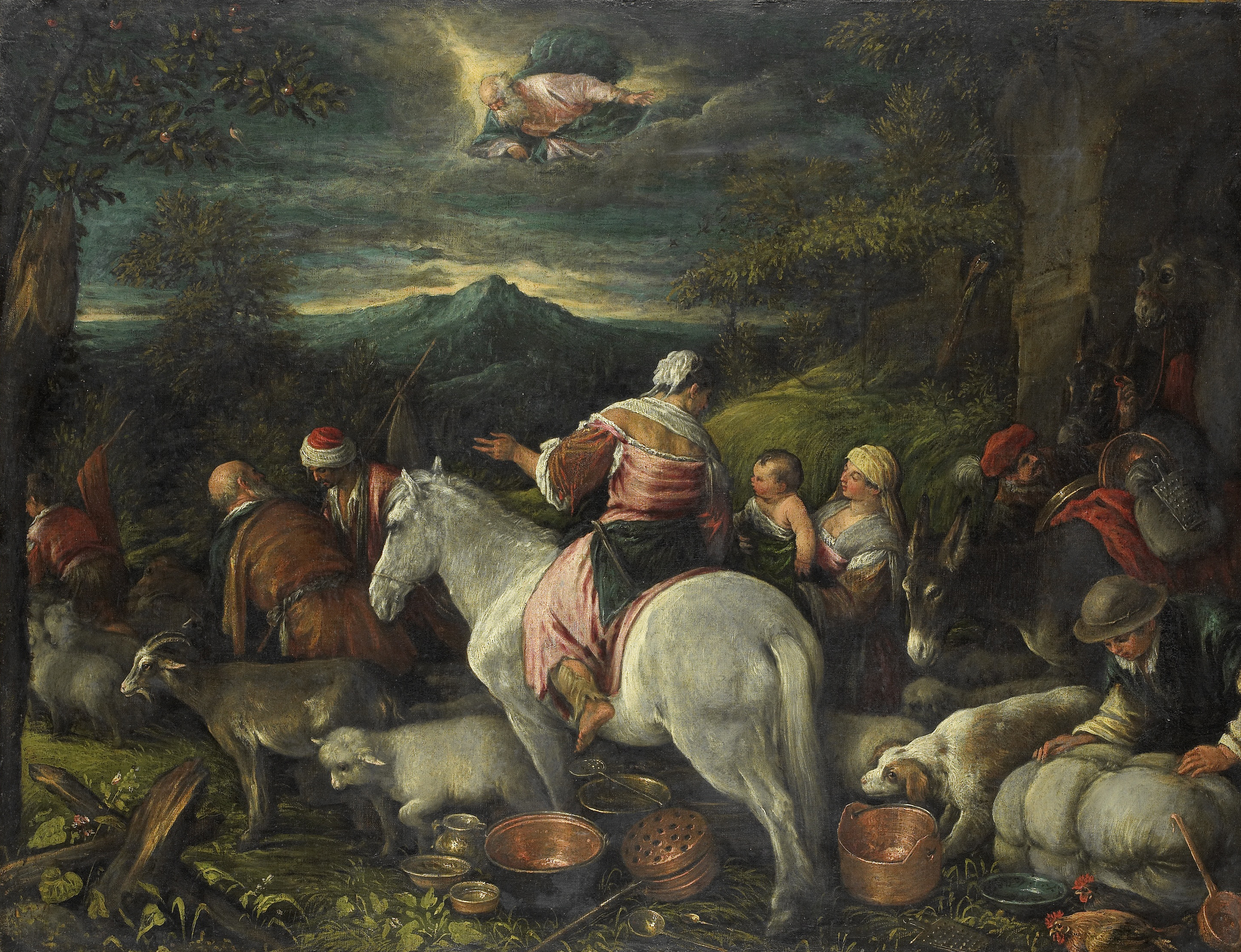
We're going to spend the summer of 2023 with the Patriarchs. During eleven worship services, beginning on Father's Day, we'll use passages from the book of Genesis to look at Abraham, Isaac, Jacob, and Joseph, focusing on how the Lord was consistently and actively involved in their lives. And by the end of the summer, we should have a better understanding of the one whom they followed and on how that same God can lead us. During this series, we'll look at the stories and passages below:
June 18 - The Lord Chooses Abram (Genesis 12:1-9)
June 25 - The Lord Promises Abraham a Son (Genesis 18:1-15)
July 2 - Abraham Sends Hagar and Ishmael Away (Genesis 21:8-21)
July 9 - The Lord Tests Abraham (Genesis 22:1-14)
July 16 - Abrahams Finds Isaac a Wife (Genesis 24:34-38, 42-49)
July 23 - Jacob and Esau (Genesis 25:19-34)
July 30 - Jacob's Dream at Bethel (Genesis 28:10-19a)
August 6 - Jacob with Leah and Rachel (Genesis 29:15-28)
August 13 - Jacob Becomes Israel (Genesis 32:22-31)
August 20 - Joseph and His Brothers (Genesis 37:1-4, 12-28)
August 27 - Joseph Tells His Brothers Who He Is (Genesis 45:1-15)
On Sunday, the service focused on what we can learn from the Lord choosing Abram, Genesis 12:1-9. A video of the service, a recording of the sermon and a copy of the bulletin are below. You can stream the service by going to the Sligo Presbyterian Church YouTube Channel at 10:00 a.m.
We're going to spend the summer of 2023 with the Patriarchs. During eleven worship services, beginning on Father's Day, we'll use passages from the book of Genesis to look at Abraham, Isaac, Jacob, and Joseph, focusing on how the Lord was consistently and actively involved in their lives. And by the end of the summer, we should have a better understanding of the one whom they followed and on how that same God can lead us. During this series, we'll look at the stories and passages below:
June 18 - The Lord Chooses Abram (Genesis 12:1-9)
June 25 - The Lord Promises Abraham a Son (Genesis 18:1-15)
July 2 - Abraham Sends Hagar and Ishmael Away (Genesis 21:8-21)
July 9 - The Lord Tests Abraham (Genesis 22:1-14)
July 16 - Abrahams Finds Isaac a Wife (Genesis 24:34-38, 42-49)
July 23 - Jacob and Esau (Genesis 25:19-34)
July 30 - Jacob's Dream at Bethel (Genesis 28:10-19a)
August 6 - Jacob with Leah and Rachel (Genesis 29:15-28)
August 13 - Jacob Becomes Israel (Genesis 32:22-31)
August 20 - Joseph and His Brothers (Genesis 37:1-4, 12-28)
August 27 - Joseph Tells His Brothers Who He Is (Genesis 45:1-15)
On Sunday, the message focused on what we can learn from the Lord choosing Abram, Genesis 12:1-9. A recording and copy of the sermon are below. You can stream the service by going to the Sligo Presbyterian Church YouTube Channel at 10:00 a.m.
Well, as y’all already know, today is Father’s Day, the one time a year when everyone pretends that old situation comedy from the ’50s is spot on and that Father Knows Best. Well, at least it’s nice to dream one day a year. And speaking as a father, let me tell you how much I appreciate the breakfast served by our deacons and the talk offered by our brother, Jess Quinn. And Jess, if I use anything you talked about in a future sermon, I’ll definitely give you credit but probably not a royalty.
And you know, because we’re celebrating fathers today, I thought it was appropriate to use this service to sort of kick off the sermon series we’ll be following this summer, you know, the one I entitled The Patriarchs: Encountering the God of Abraham, Isaac, Jacob, and Joseph. Now, just so that we’re all on the same page, the word “patriarch” literally refers to a man who’s the father of someone or the founder of something. And for the Jews, they applied the term to the individuals who were their fathers, you know, the founders of their people and their faith. And those are the men we’ll be looking at over the next few months, namely Abraham, who’ll start life as Abram, and his son Isaac and his son Jacob or Israel and his twelve sons, with a special focus on his favorite, Joseph. And using their journey through the Book of Genesis, we’ll certainly spend some time talking about their lives, but more importantly, we’ll focus on the one who was with them every step of the way and we’ll consider how God often does the same thing for us. Now that’s what we’ll be doing right up to the end of August.
And on this Father’s Day, we’re going to begin by looking at how this whole Patriarch thing got started, and I’m talking about the choosing and the calling of Abram, the patriarch whom God will rename Abraham and the one I think you could call the granddaddy of them all. And to do that, we’re going to use a passage from the twelfth chapter of Genesis to accomplish two things. First, we’re going to focus on the example of Abram himself. And then second, we’ll take this encounter with God and apply it to ourselves. Now that’s what we’ll be doing this morning and hopefully, by the time we stand up and sing, “My Faith Looks Up to Thee,” we’ll have a better idea about what responding to God is all about.
And so, we’ll start by looking at the example of Abram. And you know, it’s kind of interesting; even though we’re given some background information, you know, like the place he grew up and the woman he married, during his very first encounter with the Lord, God called Abram. I mean, just listen to what was written:
The Lord said to Abram:
Leave your country, your family, and your relatives and go to the land that I will show you. I will bless you and make your descendants into a great nation. You will become famous and be a blessing to others. I will bless those who bless you, but I will put a curse on anyone who puts a curse on you. Everyone on earth will be blessed because of you. [Genesis 12:1-3, CEV]
Now, that’s what was written. And I’ll tell you, when we look at what God actually said, I think his call involved both action and trust, didn’t it? For example, I believe God was crystal clear about what he wanted Abram to do. Man, God wanted him to get up and to go, you know, to leave behind his country and his home and his extended family and to get going to a land that he’ll be shown later. Now, that was what God wanted. But he also wanted Abram to trust, you know, to trust that the Lord was going to take care of him, you know, that God was going to bless him and that through him, somehow God was going to bless everybody else. I mean, God wanted Abram to trust that he was going to be a patriarch, the father of many descendants, the founder of a great nation. You see, in a nutshell, that was why God chose this boy from Ur, because this was exactly what God called him to do.
And I’ll tell you, with the ball clearly in his court, that was exactly what Abram decided to do, isn’t it? In other words, when God called, Abram responded. And this was how he did it.
So Abram went, as the Lord had told him; and Lot went with him. Abram was seventy-five years old when he departed from Haran. Abram took his wife Sarai and his brother’s son Lot, and all the possessions that they had gathered, and the persons whom they had acquired in Haran; and they set forth to go to the land of Canaan. When they had come to the land of Canaan, Abram passed through the land to the place at Shechem, to the oak of Moreh. At that time the Canaanites were in the land. Then the Lord appeared to Abram, and said, “To your offspring I will give this land.” So he built there an altar to the Lord, who had appeared to him. From there he moved on to the hill country on the east of Bethel, and pitched his tent, with Bethel on the west and Ai on the east; and there he built an altar to the Lord and invoked the name of the Lord. And Abram journeyed on by stages toward the Negeb. [Genesis 12:4-9, CEV]
Now I’ve got to tell you, I really love this. God told Abram to go and Abram went. I mean, even though he was seventy-five years old, he got Sarai and his brother’s son Lot, and he packed all his stuff, and he left behind the life he had in Haran. And then he entered a new land, a land that God had shown him, a land that was full of Canaanites and as everybody back in the day knew, Canaanites were no good. And yet it would be in this land that God would make him the father of all kinds of descendants and shower him with all kinds of blessings. In other words, when God said jump, Abram asked, “how high?” But of course, he knew he wasn’t going alone. God was with him every step of the way, even appearing to him at Shechem, where he promised this land. And you know, Abram must have believed this, because he built two altars dedicated to the Lord as he was moving forward. You see, when God called, Abram responded. Now that’s what we can see in the example of Abram.
And I’ll tell you, I think that’s an example we can apply to ourselves, and I’m talking about right here and right now. You see, just like he did with Abram, I believe God has also called us. And even though it’s really tempting to say that we’ve been called to leave behind everything from the past and to move into an unknown future, frankly, I think what God really wants us to do is far more simple and straightforward. I mean, just listen to what Jesus Christ told his disciples right before his crucifixion:
After Judas had gone, Jesus said:
Now the Son of Man will be given glory, and he will bring glory to God. Then, after God is given glory because of him, God will bring glory to him, and God will do it very soon.
My children, I will be with you for only a little while longer. Then you will look for me, but you won't find me. I tell you just as I told the people, “You cannot go where I am going.” But I am giving you a new command. You must love each other, just as I have loved you. If you love each other, everyone will know that you are my disciples. [John 13:31-35, CEV]
Now that’s what Jesus Christ, the Son of God, said. He simply wants us to love one another as we’ve been loved ourselves. And I’ll tell you, if we aren’t entirely clear about what this means, well, I think the Apostle Paul gives us some pretty good insight into what this kind of loving is all about. I mean, this was what he wrote to the Corinthians:
What if I could speak
all languages of humans
and even of angels?
If I did not love others,
I would be nothing more
than a noisy gong
or a clanging cymbal.
What if I could prophesy
and understand all mysteries
and all knowledge?
And what if I had faith
that moved mountains?
I would be nothing,
unless I loved others.
What if I gave away all
that I owned
and let myself
be burned alive?
I would gain nothing,
unless I loved others.
Love is patient and kind,
never jealous, boastful,
proud, or rude.
Love isn't selfish
or quick tempered.
It doesn't keep a record
of wrongs that others do.
Love rejoices in the truth,
but not in evil.
Love is always supportive,
loyal, hopeful,
and trusting.
Love never fails! [1 Corinthian 13:1-8, CEV]
You see, that’s it; that’s what love is. It’s about treating one another in a loving way. Now that sure seems to be what God chose and called us to do.
And I’ll tell you, just like it was for Abram, now it’s up to us to decide whether or not we’re going to do it. In other words, we have to decide whether or not we’re going to love one another as we’ve been loved. And we have to decide whether or not we’re going to be loving and kind, but not just to the folks we like. You see, somewhere down the line, we have to decide whether or not we’re going to listen to what the Apostle Paul wrote to the Ephesians and live like the kind of men and women we were chosen and called to be. I mean, Paul wrote,
As a prisoner of the Lord, I beg you to live in a way that is worthy of the people God has chosen to be his own. Always be humble and gentle. Patiently put up with each other and love each other. Try your best to let God's Spirit keep your hearts united. Do this by living at peace. All of you are part of the same body. There is only one Spirit of God, just as you were given one hope when you were chosen to be God's people. We have only one Lord, one faith, and one baptism. There is one God who is the Father of all people. Not only is God above all others, but he works by using all of us, and he lives in all of us. [Ephesians 4:1-6, CEV]
You see, we face the same kind of decision Abram faced when God spoke to him in Haran.
But also like him, we can also trust that we won’t be doing this alone. I mean, when we decide to forget about ourselves and to take up our crosses and to follow Jesus Christ and when we decide to claim the example of the one who came to serve and not be served and when we decide that we’re going to feed the hungry and give drink to the thirsty, to clothe the naked and welcome the stranger, to care for the sick and visit the prisoner and we’re going to do not because it’s easy or comfortable or popular but because it’s simply what love demands, in other words, when we decide to do what God wants us to do, I believe God will be with us every step of the way. It’s like what the prophet Isaiah wrote:
Don't be afraid. I am with you.
Don't tremble with fear.
I am your God.
I will make you strong,
as I protect you with my arm
and give you victories. [Isaiah 41:10, CEV]
I’ll tell you, just like it was for Abram, when God calls us, we can also respond. And for me, that’s how we can apply his story to ourselves.
Now, as I was putting this sermon together, I ran across a Father’s Day quote that I thought was pretty good. It’s by a counselor and life coach named Craig D. Lounsbrough. And this was what he wrote:
“The call of fatherhood is in fact a call of sacrifice, not in some heroic sense where a father is lifted high on some glowing pedestal with all of his sacrifices held up to the awe of those around him. Rather, it is a call that will cost him all that he has, that will be absent of accolades, where rewards will be sparse, and where he will someday find himself having spent all, but in the spending have gained everything. And this is the glory of fatherhood.” [Craig D. Lounsbrough]
You see, for Mr. Lounsbrough, fatherhood is actually a calling, one that demands sacrifice, but that also holds the possibility of incredible blessings. Now, that’s what he wrote.And for me personally, I think that’s not only accurate but also really comforting.
And you know what; I think it’s appropriate as well, especially this morning, as we start talking about the Patriarchs, the Fathers. You see, according to this first passage from Genesis, Abram’s example was clear: God called and he responded. And I’ll tell you, I believe we can take what happened with him, and we can apply his example to ourselves. I mean, God has called us to love one another as we’ve been loved. And right now we have the opportunity to respond by getting ourselves up, brushing ourselves off and then actually doing it. And this we know, because God chose Abram.
We're going to spend the summer of 2023 with the Patriarchs. During eleven worship services, beginning on Father's Day, we'll use passages from the book of Genesis to look at Abraham, Isaac, Jacob, and Joseph, focusing on how the Lord was consistently and actively involved in their lives. And by the end of the summer, we should have a better understanding of the one whom they followed and on how that same God can lead us. During this series, we'll look at the stories and passages below:
June 18 - The Lord Chooses Abram (Genesis 12:1-9)
June 25 - The Lord Promises Abraham a Son (Genesis 18:1-15)
July 2 - Abraham Sends Hagar and Ishmael Away (Genesis 21:8-21)
July 9 - The Lord Tests Abraham (Genesis 22:1-14)
July 16 - Abrahams Finds Isaac a Wife (Genesis 24:34-38, 42-49)
July 23 - Jacob and Esau (Genesis 25:19-34)
July 30 - Jacob's Dream at Bethel (Genesis 28:10-19a)
August 6 - Jacob with Leah and Rachel (Genesis 29:15-28)
August 13 - Jacob Becomes Israel (Genesis 32:22-31)
August 20 - Joseph and His Brothers (Genesis 37:1-4, 12-28)
August 27 - Joseph Tells His Brothers Who He Is (Genesis 45:1-15)
On Sunday, we'll focus on what we can learn from the Lord choosing Abram, Genesis 12:1-9. The bulletin for the service is below. You can stream the service by going to the Sligo Presbyterian Church YouTube Channel at 10:00 a.m.
The Book of Genesis establishes the foundation on which the Bible rests. It offers us insight into the nature of both God and humanity, and it begins a story of promise and hope that will culminate in the coming of Jesus. Over sixteen weeks, we’ll study the Genesis, focusing on the following:
Session 15 - Joseph and His Brothers, part 2 (Genesis 42:1 – 45:28)
Session 16 - Israel in Egypt (Genesis 46:1 – 50:26)
During our fifth discussion, we looked at the flood from Genesis 11:27 – 14:24. The passage is below:
Now these are the descendants of Terah. Terah was the father of Abram, Nahor, and Haran; and Haran was the father of Lot. Haran died before his father Terah in the land of his birth, in Ur of the Chaldeans. Abram and Nahor took wives; the name of Abram’s wife was Sarai, and the name of Nahor’s wife was Milcah. She was the daughter of Haran the father of Milcah and Iscah. Now Sarai was barren; she had no child. Terah took his son Abram and his grandson Lot son of Haran, and his daughter-in-law Sarai, his son Abram’s wife, and they went out together from Ur of the Chaldeans to go into the land of Canaan; but when they came to Haran, they settled there. The days of Terah were two hundred five years; and Terah died in Haran.
Now the Lord said to Abram, “Go from your country and your kindred and your father’s house to the land that I will show you. I will make of you a great nation, and I will bless you, and make your name great, so that you will be a blessing. I will bless those who bless you, and the one who curses you I will curse; and in you all the families of the earth shall be blessed.”
So Abram went, as the Lord had told him; and Lot went with him. Abram was seventy-five years old when he departed from Haran. Abram took his wife Sarai and his brother’s son Lot, and all the possessions that they had gathered, and the persons whom they had acquired in Haran; and they set forth to go to the land of Canaan. When they had come to the land of Canaan,
Abram passed through the land to the place at Shechem, to the oak of Moreh. At that time the Canaanites were in the land. Then the Lord appeared to Abram, and said, “To your offspring I will give this land.” So he built there an altar to the Lord, who had appeared to him. From there he moved on to the hill country on the east of Bethel, and pitched his tent, with Bethel on the west and Ai on the east; and there he built an altar to the Lord and invoked the name of the Lord. And Abram journeyed on by stages toward the Negeb.
Now there was a famine in the land. So Abram went down to Egypt to reside there as an alien, for the famine was severe in the land. When he was about to enter Egypt, he said to his wife Sarai, “I know well that you are a woman beautiful in appearance; and when the Egyptians see you, they will say, ‘This is his wife’; then they will kill me, but they will let you live. Say you are my sister, so that it may go well with me because of you, and that my life may be spared on your account.”
When Abram entered Egypt the Egyptians saw that the woman was very beautiful. When the officials of Pharaoh saw her, they praised her to Pharaoh. And the woman was taken into Pharaoh’s house. And for her sake he dealt well with Abram; and he had sheep, oxen, male donkeys, male and female slaves, female donkeys, and camels. But the Lord afflicted Pharaoh and his house with great plagues because of Sarai, Abram’s wife. So Pharaoh called Abram, and said, “What is this you have done to me? Why did you not tell me that she was your wife? Why did you say, ‘She is my sister,’ so that I took her for my wife? Now then, here is your wife, take her, and be gone.” And Pharaoh gave his men orders concerning him; and they set him on the way, with his wife and all that he had.
So Abram went up from Egypt, he and his wife, and all that he had, and Lot with him, into the Negeb. Now Abram was very rich in livestock, in silver, and in gold. He journeyed on by stages from the Negeb as far as Bethel, to the place where his tent had been at the beginning, between Bethel and Ai, to the place where he had made an altar at the first; and there Abram called on the name of the Lord.
Now Lot, who went with Abram, also had flocks and herds and tents, so that the land could not support both of them living together; for their possessions were so great that they could not live together, and there was strife between the herders of Abram’s livestock and the herders of Lot’s livestock. At that time the Canaanites and the Perizzites lived in the land. Then Abram said to Lot, “Let there be no strife between you and me, and between your herders and my herders; for we are kindred. Is not the whole land before you? Separate yourself from me. If you take the left hand, then I will go to the right; or if you take the right hand, then I will go to the left.”
Lot looked about him, and saw that the plain of the Jordan was well watered everywhere like the garden of the Lord, like the land of Egypt, in the direction of Zoar; this was before the Lord had destroyed Sodom and Gomorrah. So Lot chose for himself all the plain of the Jordan, and Lot journeyed eastward; thus they separated from each other. Abram settled in the land of Canaan, while Lot settled among the cities of the Plain and moved his tent as far as Sodom. Now the people of Sodom were wicked, great sinners against the Lord.
The Lord said to Abram, after Lot had separated from him, “Raise your eyes now, and look from the place where you are, northward and southward and eastward and westward; for all the land that you see I will give to you and to your offspring forever. I will make your offspring like the dust of the earth; so that if one can count the dust of the earth, your offspring also can be counted. Rise up, walk through the length and the breadth of the land, for I will give it to you.” So Abram moved his tent, and came and settled by the oaks of Mamre, which are at Hebron; and there he built an altar to the Lord.
In the days of King Amraphel of Shinar, King Arioch of Ellasar, King Chedorlaomer of Elam, and King Tidal of Goiim, these kings made war with King Bera of Sodom, King Birsha of Gomorrah, King Shinab of Admah, King Shemeber of Zeboiim, and the king of Bela (that is, Zoar). All these joined forces in the Valley of Siddim (that is, the Dead Sea). Twelve years they had served Chedorlaomer, but in the thirteenth year they rebelled. In the fourteenth year Chedorlaomer and the kings who were with him came and subdued the Rephaim in Ashteroth-karnaim, the Zuzim in Ham, the Emim in Shaveh-kiriathaim, and the Horites in the hill country of Seir as far as El-paran on the edge of the wilderness; then they turned back and came to En-mishpat (that is, Kadesh), and subdued all the country of the Amalekites, and also the Amorites who lived in Hazazon-tamar. Then the king of Sodom, the king of Gomorrah, the king of Admah, the king of Zeboiim, and the king of Bela (that is, Zoar) went out, and they joined battle in the Valley of Siddim with King Chedorlaomer of Elam, King Tidal of Goiim, King Amraphel of Shinar, and King Arioch of Ellasar, four kings against five. Now the Valley of Siddim was full of bitumen pits; and as the kings of Sodom and Gomorrah fled, some fell into them, and the rest fled to the hill country. So the enemy took all the goods of Sodom and Gomorrah, and all their provisions, and went their way; they also took Lot, the son of Abram’s brother, who lived in Sodom, and his goods, and departed.
Then one who had escaped came and told Abram the Hebrew, who was living by the oaks of Mamre the Amorite, brother of Eshcol and of Aner; these were allies of Abram. When Abram heard that his nephew had been taken captive, he led forth his trained men, born in his house, three hundred eighteen of them, and went in pursuit as far as Dan. He divided his forces against them by night, he and his servants, and routed them and pursued them to Hobah, north of Damascus. Then he brought back all the goods, and also brought back his nephew Lot with his goods, and the women and the people.
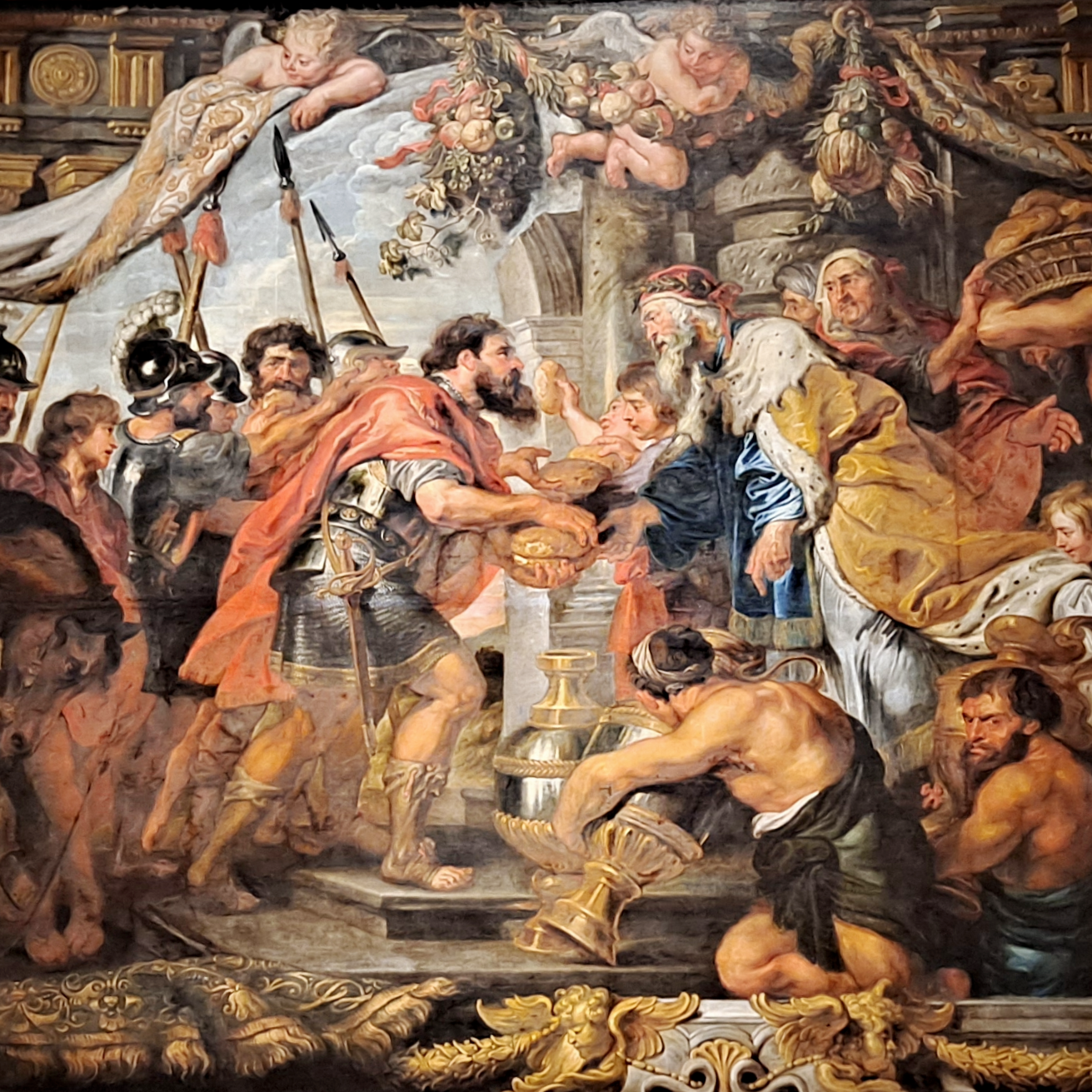
After his return from the defeat of Chedorlaomer and the kings who were with him, the king of Sodom went out to meet him at the Valley of Shaveh (that is, the King’s Valley). And King Melchizedek of Salem brought out bread and wine; he was priest of God Most High. He blessed him and said, “Blessed be Abram by God Most High, maker of heaven and earth; and blessed be God Most High, who has delivered your enemies into your hand!” And Abram gave him one tenth of everything.
Then the king of Sodom said to Abram, “Give me the persons, but take the goods for yourself.” But Abram said to the king of Sodom, “I have sworn to the Lord, God Most High, maker of heaven and earth, that I would not take a thread or a sandal-thong or anything that is yours, so that you might not say, ‘I have made Abram rich.’ I will take nothing but what the young men have eaten, and the share of the men who went with me—Aner, Eshcol, and Mamre. Let them take their share.”