In this blog, we'll focus on the working being done at Sligo Presbyterian Church, Sligo, Pennsylvania. We'll also look at what's happening in Sligo, Rimersburg, Clarion, and all the other communities served by our congregation.
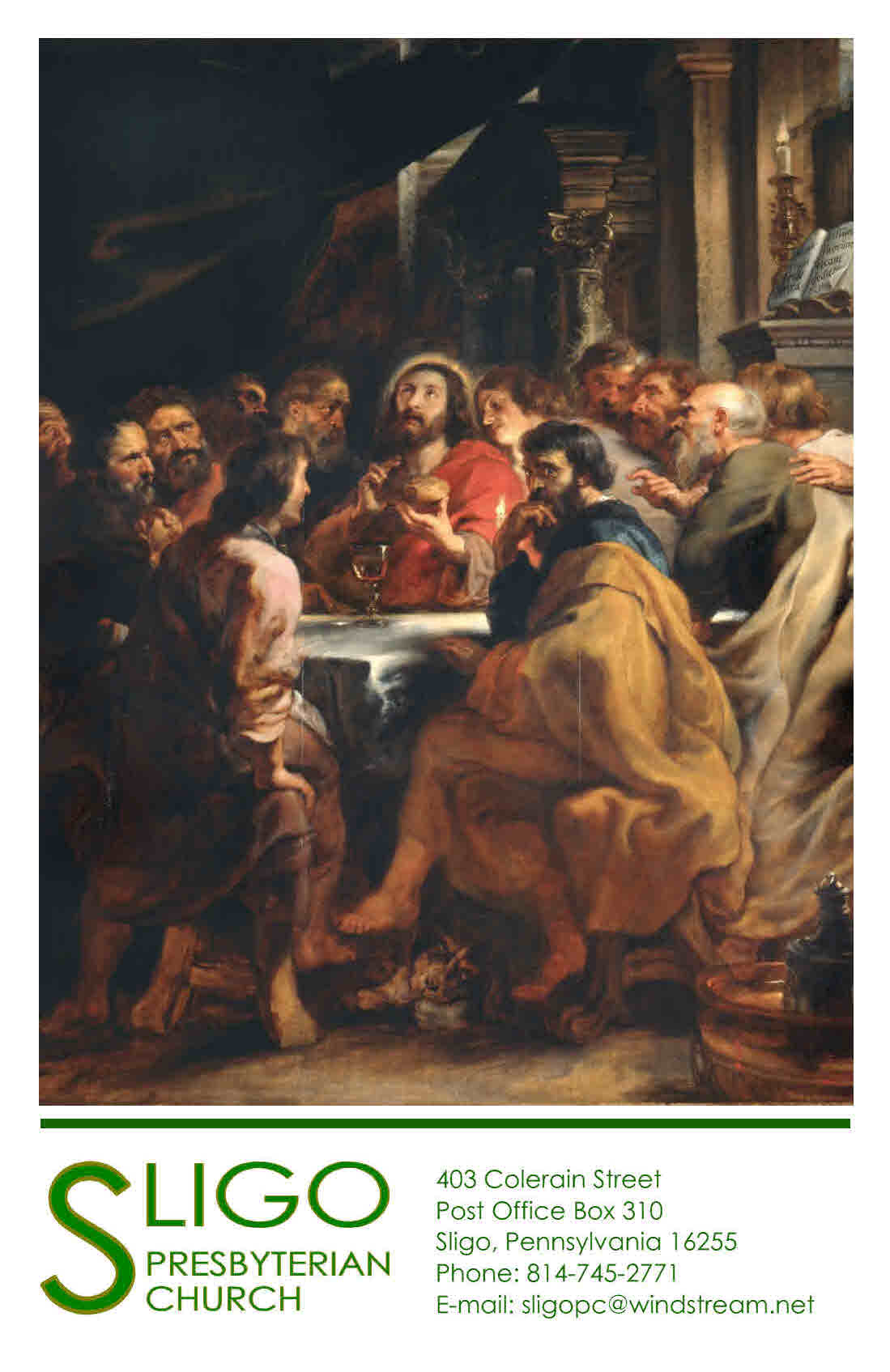
On Thursday, April 14, 2022, we remembered the last meal Jesus had with his disciples by sharing a Love Feast. The service will begin at 6:00 p.m. in the Fellowship Hall. We shared a simple meal as well as the sacrament of Holy Communion.
Below is a copy of the bulletin and recording of the service.
Sunday, March 20, we continued our sermon series for Lent entitled “His Last Week: The Last Seven Days in the Life of Jesus.” As we prepare ourselves to celebrate the resurrection, we're looking at the following six events in Jesus's last week here on earth and consider how each can shape what we believe and how we live right here and now.
March 6 – The Entry (Luke 19:28-40)
March 13 – The Cleansing (Luke 19:41-48)
March 20 – The Meal (Luke 22:7-23)
March 27 – The Prayer (Luke 22:39-46)
April 3 – The Trial (Luke 22:66 – 23:12)
April 10 – The Cross (Luke 23:26-49)
During this third message, we used Luke 22:7-23 to discuss Jesus's last meal with his disciples.
During the season on Lent, the congregation of Sligo Presbyterian Church will move thought a sermon series entitled “His Last Week: The Last Seven Days in the Life of Jesus.” As we prepare ourselves to celebrate the resurrection, we're looking at the following six events in Jesus's last week here on earth and consider how each can shape what we believe and how we live right here and now.
March 6 – The Entry (Luke 19:28-40)
March 13 – The Cleansing (Luke 19:41-48)
March 20 – The Meal (Luke 22:7-23)
March 27 – The Prayer (Luke 22:39-46)
April 3 – The Trial (Luke 22:66 – 23:12)
April 10 – The Cross (Luke 23:26-49)
During this third message, we used Luke 22:7-23 to discuss the last meal Jesus shared with his disciples.
The day had come for the Festival of Thin Bread, and it was time to kill the Passover lambs. So Jesus said to Peter and John, “Go and prepare the Passover meal for us to eat.”
But they asked, “Where do you want us to prepare it?”
Jesus told them, “As you go into the city, you will meet a man carrying a jar of water. Follow him into the house and say to the owner, ‘Our teacher wants to know where he can eat the Passover meal with his disciples.’ The owner will take you upstairs and show you a large room ready for you to use. Prepare the meal there.”
Peter and John left. They found everything just as Jesus had told them, and they prepared the Passover meal.
When the time came for Jesus and the apostles to eat, he said to them, “I have very much wanted to eat this Passover meal with you before I suffer. I tell you that I will not eat another Passover meal until it is finally eaten in God’s kingdom.”
Jesus took a cup of wine in his hands and gave thanks to God. Then he told the apostles, “Take this wine and share it with each other. I tell you that I will not drink any more wine until God’s kingdom comes.”
Jesus took some bread in his hands and gave thanks for it. He broke the bread and handed it to his apostles. Then he said,
“This is my body, which is given for you. Eat this as a way of remembering me!”
After the meal he took another cup of wine in his hands. Then he said, “This is my blood. It is poured out for you, and with it God makes his new agreement. The one who will betray me is here at the table with me! The Son of Man will die in the way that has been decided for him, but it will be terrible for the one who betrays him!”
Then the apostles started arguing about who would ever do such a thing.
The Meal
You may not remember this, but during the message last week, I said something about how we really shouldn’t be surprised that it snowed a week ago Saturday simply because Punxsutawney Phil saw his shadow on February 2. Well, after the service, as I was shaking hands, someone said that she thought it was crazy that we put so much stock in the opinion of a rodent. But you know, maybe her opinion has changed, given the weather we’ve had over the last few days. But again, that shouldn’t be a surprise either. You see, as of last Sunday, only a little over five weeks had passed since February 2, but today, we’re just over the six-week mark. And how many weeks of winter were we supposed to have? Now, I don’t know about y’all, but right now, I have a whole new appreciation for groundhog meteorological insight.
But be-that-as-it-may, this morning we’re at the third week in a series we started on the first Sunday in Lent. You see, during the services leading up to Easter, we’re using the Gospel of Luke to look at seven events that took place during Jesus’s last week on earth. And we started by talking about his triumphal entry into Jerusalem, something we generally consider on Palm Sunday. And during that message, we focused on how Jesus told the Pharisees that, “If [his disciples] keep quiet, these stones will start shouting.” [Luke 19:40b, CEV] You see, we took these words and talked about how they might help us experience some peace and comfort as well as some freedom and confidence, especially when we’re feeling overwhelmed. And then last week, we focused on the cleansing of the Temple, but also on how Jesus wept over Jerusalem and how he used the Temple as a place to teach, reminding us that Jesus feels compassion and that he takes action and that he offers direction, three things that might come in handy when we’re facing problems and pain. Now that’s where we’ve been.
And this morning we’re going to look at a third event in Jesus’s last seven days, and now I’m talking about the meal, you know, the last supper he shared with his disciples. And again, as we’ve done during the first two messages, we’re going to look at something in the account that’s unique in the Gospel of Luke. You see, all in four gospels, Jesus prepared and shared a meal with his apostles and in all four, he predicted that he was going to be betrayed and in all four, he broke the bread and passed around the cup, something that we do every time we celebrate communion. Only in Luke, well, there’s a little twist. You see, while in Matthew, Mark and John there’s only one cup mentioned, in Luke’s account, there are t wo: one that was shared before the bread and the other that was shared after. And I’ll tell you, that’s going to be our focus this morning. You see, we’re going to look at what Jesus said during this meal as described by the Evangelist Luke. And then we’re going to take those words and apply them to our lives. And you know, when we do, I think Jesus offers us a new way to look at the future and the past and the present, something that I believe can really help us as we move forward and look back and live right now. And like I said, in my opinion, we can find all three in how Luke described what happened at the meal.
For example, first, based on what he said in these verses, I believe Jesus offers us hope as we move into the future. In other words, according to Luke, Jesus gives us a promise that, regardless of what’s happening all around us, we can be confident that human history just doesn’t have the last word. And like I said, I think we can see that right here in this passage. Just listen to what Luke wrote:
When the time came for Jesus and the apostles to eat, he said to them, “I have very much wanted to eat this Passover meal with you before I suffer. I tell you that I will not eat another Passover meal until it is finally eaten in God’s kingdom.”
Jesus took a cup of wine in his hands and gave thanks to God. Then he told the apostles, “Take this wine and share it with each other. I tell you that I will not drink any more wine until God’s kingdom comes.” [Luke 22:14-18, CEV]
Now that’s what he said. Just think about what it means. In spite of the fact that Jesus was well-aware that he was going to suffer and die, he wanted his disciples to know that, not only was he coming back with the arrival of God’s kingdom, but that those sitting around the table would be there with him.
Of course, for anybody who’s been reading Luke’s gospel, man, this wasn’t a surprise. I mean, in the last chapter Jesus said,
Strange things will happen to the sun, moon, and stars. The nations on earth will be afraid of the roaring sea and tides, and they won’t know what to do. People will be so frightened that they will faint because of what is happening to the world. Every power in the sky will be shaken. Then the Son of Man will be seen, coming in a cloud with great power and glory. When all of this starts happening, stand up straight and be brave. You will soon be set free. [Luke 21:25-28, CEV]
You see, as we consider what he said during the meal, Jesus’s vision of the future seems pretty clear.
And I’ll tell you, I think this is something we all need to remember, and I’ll tell you why. You see, I believe it’s really easy to become consumed by all the bad things that are happening in our world now-a-days. I mean, give me a break, it’s certainly not difficult to be overwhelmed by wars and conflict and hatred, by pandemics and disease and death, and by addictions and poverty and abuse. Man, this stuff is all around us; therefore, I don’t think we could miss it if we tried. But right there’s the problem; if we’re not careful, all this garbage can distract us from the reality that Jesus wanted his disciples then and now to see when he said, “Take this wine and share it with each other. I tell you that I will not drink any more wine until God’s kingdom comes.” [Luke 22:17b-18, CEV] You see, at that meal, I think Jesus offers us hope as we move into the future. And that’s one.
And second, I believe he also offers us forgiveness as we look at the past. In other words, when he shared the bread with his disciples, he was giving them a reason to look at who they were and what he’d done in a new and different way. I mean, just think about what happened after he passed around the first cup:
Jesus took some bread in his hands and gave thanks for it. He broke the bread and handed it to his apostles. Then he said, “This is my body, which is given for you. Eat this as a way of remembering me!” [Luke 22:19, CEV]
Now that’s what he said.
Of course, we all know what he was talking about. His body was given for us when he was nailed to the cross, right? And you know, for Luke, it was through that event that forgiveness flowed out to the world. I mean, just listen to how he described the crucifixion, something we’ll look at in about three weeks.
Two criminals were led out to be put to death with Jesus. When the soldiers came to the place called “The Skull,” they nailed Jesus to a cross. They also nailed the two criminals to crosses, one on each side of Jesus.
Jesus said, “Father, forgive these people! They don’t know what they’re doing.”
While the crowd stood there watching Jesus, the soldiers gambled for his clothes. The leaders insulted him by saying, “He saved others. Now he should save himself, if he really is God’s chosen Messiah!” [Luke 23:32-35, CEV]
I’m telling you, for Luke, the cross was all about forgiveness.
And you know, this is something that I think we also need to remember, especially when we’re looking at our past. You know, yesterday I ran across a quote from the American novelist, Philip Roth. He wrote, “Old age isn’t a battle; old age is a massacre.” Now, I don’t think that’s entirely true. But you know, at least for me, one of the downsides of getting older is looking back and remembering all those things that I regret doing or saying and all those people that I’ve hurt or disappointed and all those reasons I have for feeling some guilt and remorse. And you know, if that’s not bad enough, it sure seems like, as every day passes, I make a few more mistakes that I could have avoided and offer a few more comments that I thought were more funny than they actually were and avoid a few more situations where I might have made a difference but didn’t. I guess having some regrets and guilt, well, that just might be the cost of living. But you know, before those feelings become like anchors, I think it’s really important for us to remember that Jesus said to all his disciples, including us, “This is my body, which is given for you. Eat this as a way of remembering me!” [Luke 22:19b, CEV] You see, at this meal, I think Jesus offers us forgiveness as we look at the past. And that’s two.
And third, along with hope and forgiveness, I believe Jesus offers us peace as we live in the present. And you know, I think that’s actually related to our view of both the future and the past. Remember, “After the meal he took another cup of wine in his hands. Then he said, ‘This is my blood. It is poured out for you, and with it God makes his new agreement.’” [Luke 22:20, CEV] Now that’s what he said.
And even though Luke alludes to this new agreement a couple of times in Acts, I think the writer of the Letter to the Hebrews was clear about its nature when he wrote this:
According to the Law of Moses, those people who become unclean are not fit to worship God. Yet they will be considered clean, if they are sprinkled with the blood of goats and bulls and with the ashes of a sacrificed calf. But Christ was sinless, and he offered himself as an eternal and spiritual sacrifice to God. That’s why his blood is much more powerful and makes our consciences clear. Now we can serve the living God and no longer do things that lead to death.
Christ died to rescue those who had sinned and broken the old agreement. Now he brings his chosen ones a new agreement with its guarantee of God’s eternal blessings! In fact, making an agreement of this kind is like writing a will. This is because the one who makes the will must die before it is of any use. In other words, a will doesn’t go into effect as long as the one who made it is still alive. [Hebrews 9:13-17, CEV]
You see, according to what Jesus said to his disciples when he held up this cup, he was saying that through his blood, God was making a new agreement, a covenant with them.
And I’ll tell you, what applied to them also applies to us. In other words, through that same blood, we have a new relationship with God. And so, when we feel consumed by all the mess that’s happening around us, not only can we feel hope, confident that the future is in the hands of God, we can also experience a sense of security, believing that the one who ultimately controls our destiny, man, he wants to be in a relationship with us right here and right now. And when we feel weighed down by a bunch of regrets and guilt that a lot of folks carry around all the time, not only can we feel forgiveness, confident that our sins died with Christ on the cross, we can also experience a sense of tranquility, assured that in spite of all our mistakes, God loves us and as Paul wrote, “Nothing in all creation can separate us from God’s love for us in Christ Jesus our Lord!” [Romans 8:39b, CEV] And this is something we can believe, because Jesus said to his disciples, “This is my blood. It is poured out for you, and with it God makes his new agreement.”[Luke 22:20b, CEV] You see, at this meal, I think Jesus offers us peace as we live in the present. And that’s three.
And I’ll tell you, this is something I think we need to remember whenever we gather around the table to celebrate communion or think about the Last Supper. You see, when we focus on the account offered by Luke, I believe the words spoken by Jesus in this passage offer us hope as we move into the future and forgiveness as we look at the past and peace as we live in the present. You see, this is what we can take from the meal Jesus shared with his disciples.
On Wednesday mornings beginning at 10:30 a.m., your friends and neighbors at Sligo Presbyterian Church gather to discuss our faith in Jesus Christ. Currently, we're using the Gospel of Mark as our guide. Pastor Rudiger is leading the discussion and everyone is invited. We’ll be covering the following topics:
Session 1: Setting the Stage (Mark 1:1-13)
Session 2: Good Times, Good Times (Mark 1:14-45)
Session 3: Grey Clouds (Mark 2:1–3:6)
Session 4: Sharing the Message (Mark 3:7–4:34)
Session 5: It’s a Miracle (Mark 4:35–5:43)
Session 6: Taking Sides (Mark 6:1-29)
Session 7: More of the Same (Mark 6:30–7:23)
Session 8: “You Are the Christ” (Mark 7:24–8:30)
Session 9: The Rest of the Story (Mark 8:31–9:29)
Session 10: Not Their Best (Mark 9:30–10:31)
Session 11: More of the Same (Mark 10:32-52)
Session 12: Coming in for a Landing (Mark 11:1-33)
Session 13: In Contrast (Mark 12:1-44)
Session 14: What's Coming (Mark 13:1-37)
Session 15: Beginning to Spiral (Mark 14:1-42)
Session 16: Son of God (Mark 14:43-15:47)
Session 17: “for” (Mark 16:1-8)
During our fifteenth session, Mark describes the Jesus's last supper with his disciples and his prayer in Gethsemane. The passage is below:
Mark 14:1-42
It was two days before the Passover and the festival of Unleavened Bread. The chief priests and the scribes were looking for a way to arrest Jesus by stealth and kill him; for they said, “Not during the festival, or there may be a riot among the people.”
While he was at Bethany in the house of Simon the leper, as he sat at the table, a woman came with an alabaster jar of very costly ointment of nard, and she broke open the jar and poured the ointment on his head. But some were there who said to one another in anger, “Why was the ointment wasted in this way? For this ointment could have been sold for more than three hundred denarii, and the money given to the poor.” And they scolded her. But Jesus said, “Let her alone; why do you trouble her? She has performed a good service for me. For you always have the poor with you, and you can show kindness to them whenever you wish; but you will not always have me. She has done what she could; she has anointed my body beforehand for its burial. Truly I tell you, wherever the good news is proclaimed in the whole world, what she has done will be told in remembrance of her.”
Then Judas Iscariot, who was one of the twelve, went to the chief priests in order to betray him to them. When they heard it, they were greatly pleased, and promised to give him money. So he began to look for an opportunity to betray him.
On the first day of Unleavened Bread, when the Passover lamb is sacrificed, his disciples said to him, “Where do you want us to go and make the preparations for you to eat the Passover?” So he sent two of his disciples, saying to them, “Go into the city, and a man carrying a jar of water will meet you; follow him, and wherever he enters, say to the owner of the house, ‘The Teacher asks, Where is my guest room where I may eat the Passover with my disciples?’ He will show you a large room upstairs, furnished and ready. Make preparations for us there.” So the disciples set out and went to the city, and found everything as he had told them; and they prepared the Passover meal.
When it was evening, he came with the twelve. And when they had taken their places and were eating, Jesus said, “Truly I tell you, one of you will betray me, one who is eating with me.” They began to be distressed and to say to him one after another, “Surely, not I?” He said to them, “It is one of the twelve, one who is dipping bread into the bowl with me. For the Son of Man goes as it is written of him, but woe to that one by whom the Son of Man is betrayed! It would have been better for that one not to have been born.”
While they were eating, he took a loaf of bread, and after blessing it he broke it, gave it to them, and said, “Take; this is my body.” Then he took a cup, and after giving thanks he gave it to them, and all of them drank from it. He said to them, “This is my blood of the covenant, which is poured out for many. Truly I tell you, I will never again drink of the fruit of the vine until that day when I drink it new in the kingdom of God.”
When they had sung the hymn, they went out to the Mount of Olives. And Jesus said to them, “You will all become deserters; for it is written,
‘I will strike the shepherd,
and the sheep will be scattered.’
But after I am raised up, I will go before you to Galilee.” Peter said to him, “Even though all become deserters, I will not.” Jesus said to him, “Truly I tell you, this day, this very night, before the cock crows twice, you will deny me three times.” But he said vehemently, “Even though I must die with you, I will not deny you.” And all of them said the same.
They went to a place called Gethsemane; and he said to his disciples, “Sit here while I pray.” He took with him Peter and James and John, and began to be distressed and agitated. And he said to them, “I am deeply grieved, even to death; remain here, and keep awake.” And going a little farther, he threw himself on the ground and prayed that, if it were possible, the hour might pass from him. He said, “Abba, Father, for you all things are possible; remove this cup from me; yet, not what I want, but what you want.” He came and found them sleeping; and he said to Peter, “Simon, are you asleep? Could you not keep awake one hour? Keep awake and pray that you may not come into the time of trial; the spirit indeed is willing, but the flesh is weak.” And again he went away and prayed, saying the same words. And once more he came and found them sleeping, for their eyes were very heavy; and they did not know what to say to him. He came a third time and said to them, “Are you still sleeping and taking your rest? Enough! The hour has come; the Son of Man is betrayed into the hands of sinners. Get up, let us be going. See, my betrayer is at hand.”