Showing posts with label Sarah. Show all posts

Tuesday, July 4, 2023

The Sligo Presbyterian Church Celebration Service - Sunday, July 2, 2023

We're going to spend the summer of 2023 with the Patriarchs. During eleven worship services, beginning on Father's Day, we'll use passages from the book of Genesis to look at Abraham, Isaac, Jacob, and Joseph, focusing on how the Lord was consistently and actively involved in their lives. And by the end of the summer, we should have a better understanding of the one whom they followed and on how that same God can lead us. During this series, we'll look at the stories and passages below:

  • June 18 - The Lord Chooses Abram (Genesis 12:1-9)
  • June 25 - The Lord Promises Abraham a Son (Genesis 18:1-15)
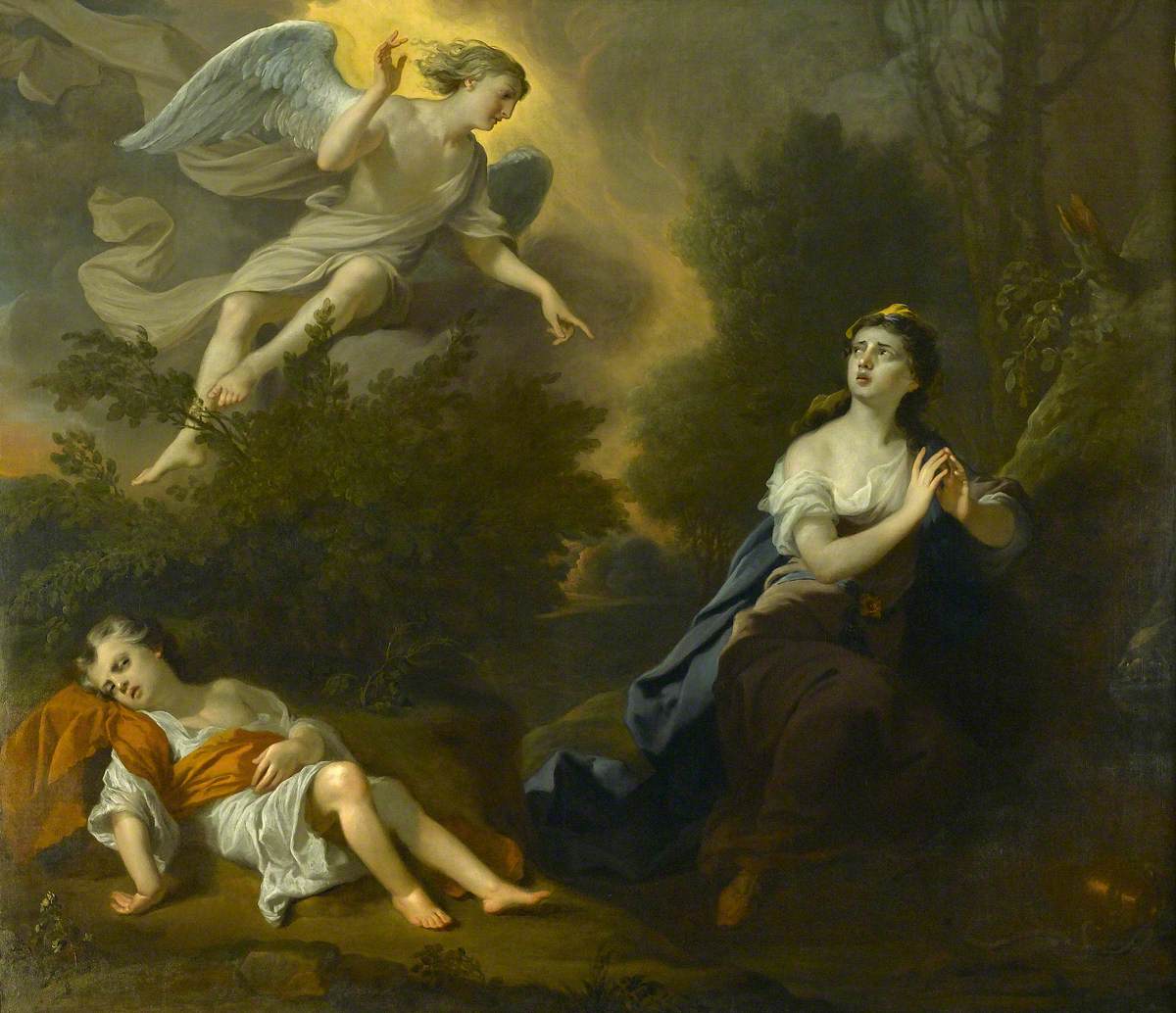
  • July 2 - Abraham Sends Hagar and Ishmael Away (Genesis 21:8-21)
  • July 9 - The Lord Tests Abraham (Genesis 22:1-14)
  • July 16 - Abrahams Finds Isaac a Wife (Genesis 24:34-38, 42-49)
  • July 23 - Jacob and Esau (Genesis 25:19-34)
  • July 30 - Jacob's Dream at Bethel (Genesis 28:10-19a)
  • August 6 - Jacob with Leah and Rachel (Genesis 29:15-28)
  • August 13 - Jacob Becomes Israel (Genesis 32:22-31)
  • August 20 - Joseph and His Brothers (Genesis 37:1-4, 12-28)
  • August 27 - Joseph Tells His Brothers Who He Is (Genesis 45:1-15)
On Sunday, the message focused on what we can learn from Abraham sending Hagar and Ishmael away, Genesis 21:8-21. A video of the service, a recording of the sermon and copy of the bulletin are below. You can stream the service by going to the Sligo Presbyterian Church YouTube Channel at 10:00 a.m.


Sunday's Message - The Patriarchs: Encountering the God of Abraham, Isaac, Jacob, and Joseph (Abraham Sends Hagar and Ishmael Away)

We're going to spend the summer of 2023 with the Patriarchs. During eleven worship services, beginning on Father's Day, we'll use passages from the book of Genesis to look at Abraham, Isaac, Jacob, and Joseph, focusing on how the Lord was consistently and actively involved in their lives. And by the end of the summer, we should have a better understanding of the one whom they followed and on how that same God can lead us. During this series, we'll look at the stories and passages below:

  • June 18 - The Lord Chooses Abram (Genesis 12:1-9)
  • June 25 - The Lord Promises Abraham a Son (Genesis 18:1-15)
  • July 2 - Abraham Sends Hagar and Ishmael Away (Genesis 21:8-21)
  • July 9 - The Lord Tests Abraham (Genesis 22:1-14)
  • July 16 - Abrahams Finds Isaac a Wife (Genesis 24:34-38, 42-49)
  • July 23 - Jacob and Esau (Genesis 25:19-34)
  • July 30 - Jacob's Dream at Bethel (Genesis 28:10-19a)
  • August 6 - Jacob with Leah and Rachel (Genesis 29:15-28)
  • August 13 - Jacob Becomes Israel (Genesis 32:22-31)
  • August 20 - Joseph and His Brothers (Genesis 37:1-4, 12-28)
  • August 27 - Joseph Tells His Brothers Who He Is (Genesis 45:1-15)
On Sunday, the message focused on what we can learn from Abraham sending Hagar and Ishmael away, Genesis 21:8-21. A recording and copy of the sermon are below. You can stream the service by going to the Sligo Presbyterian Church YouTube Channel at 10:00 a.m.


Well, in a couple of days, we’ll be celebrating Independence Day, although, to be completely honest, the Declaration was officially approved by Congress on July 2 and only signed on July 4. But be that as it may, it’s the fourth that sort of stuck as “the day.” And even though it may have drifted away from the kind of solemn ceremony our founders might have  envisioned; it’s still a day to celebrate not only our national past but also what it means to be an American right now. In other words, it’s still a big deal. And so I’m glad y’all have decided to spend a little of your long weekend to come here this morning.

And I’ll tell you, based on what we’re going to be talking about, I think it’ll be worth it, especially if you’ve ever been frustrated or worried by something that’s come up in your life or if you’ve ever been looking down the barrel of some real disappointment that you’ve had to face or some difficult decision that you’ll have to make. You see, that’s what we’ll be talking about this morning, as we continue to focus on the Patriarchs in Genesis. Of course, to this point, we’ve already looked at how the Lord chose Abram to carry the promise and on how God called and Abram responded. And then last week, we looked at a story in which the Lord promised both Abraham and Sarah a son, and we focused on what the promise was and why Abraham could trust it. Now that’s what we’ve already done. And in each one of our discussions, we’ve taken what happened in the passage and applied it to ourselves. 

And this morning, we’re going to do the same sort of thing with another story about Abraham and Sarah, one about how Abraham sent Hagar and his own son Ishmael away.  You see, we’re going to take that story and we’re going to talk about what happened and how God responded to Abraham and ultimately why Abraham could trust God. And then we’re going to take it and apply it to our own stories. And hopefully, by the end of the message, we’ll understand something that I think Abraham understood; that when we face difficulties in our lives, we can trust that God will take care of us.

And like I said, I think this was exactly what happened in our story from Genesis 21. You see, right at the beginning, there was a problem. According to Genesis,

The time came when Sarah no longer had to nurse Isaac, and on that day Abraham gave a big feast.

One day, Sarah noticed Hagar’s son Ishmael playing, and she said to Abraham, “Get rid of that Egyptian slave woman and her son! I don’t want him to inherit anything. It should all go to my son.” 

Abraham was worried about Ishmael. [Genesis 21:8-11, CEV]

Now that’s what happened. And although it would be really easy to dump on Sarah and to view her as jealous and petty, the situation was actually a whole lot more complicated. You see, as we talked about last week, the promise God made to Abraham, man, it was going to involve Sarah’s son. And even though Ishmael was the result of her trying to make Abraham a daddy by having him hook up with her Egyptian maid, Hagar, it was Isaac, the son of Sarah, who would be the next Patriarch, the father of many descendants and the founder of this great nation promised by God. And you know, right there was the problem. Sarah knew it was God’s will that Isaac receive her husband’s inheritance, but as long as Ishmael was around, he was entitled to a share, especially given the fact that he was the older of the two. And so, for Isaac to get everything he was entitled to get, Ishmael had to go. And I’ll tell you, Abraham must have known this too, because God had done almost all his talking with him. You see, for the promise to be fulfilled, Abraham knew that Sarah was right. And yet, Ishmael was still his son, and so he worried about what would happen to the boy and to his mother. Now, in a nutshell, that was the problem. 

And I’ll tell you, how God responded, well, I think that was really important. You see, in the face of this harsh reality, God offered Abraham comfort, comfort he could trust. Just listen to what it says in Genesis:

But God said, “Abraham, don’t worry about your slave woman and the boy. Just do what Sarah tells you. Isaac will inherit your family name, but the son of the slave woman is also your son, and I will make his descendants into a great nation.” [Genesis 21:12-13, CEV]

Now that’s what the Lord said. In other words, he offered Abraham two things. First, God gave him a command that was incredibly simple and straightforward but which was nearly impossible for Abraham to actually do; “...God said, ‘Abraham, don’t worry about your slave woman and the boy.’” [Genesis 21:12a, CEV] I’ll tell you, God could have just as well have told Abraham not to think about a purple monkey. Nobody can turn off worry like water from a spigot. But right here, God did something more that made not worrying a possibility. After giving the command and telling Abraham to do what Sarah wanted because Isaac had to be the sole heir, God made Abraham a promise. And that’s the second thing God did. You see, because Ishmael was also his son, God was also going to make him the father of a great nation too. And even though it wasn’t going to be the one that God promised when he first chose Abraham back in chapter twelve, it was still going to be important. Now that’s how God responded to this worried father. God offered Abraham comfort, didn’t he?  

But of course, none of this would be worth a hill of beans, if God didn’t give Abraham a good reason to trust, you know, to believe what God had said. You see, to be seen as trustworthy, God would need to keep his word, wouldn’t he? And as a spoiler alert, let me tell you, that was exactly what he did. Just listen to the rest of the story:

Early the next morning Abraham gave Hagar an animal skin full of water and some bread. Then he put the boy on her shoulder and sent them away.

They wandered around in the desert near Beersheba, and after they had run out of water, Hagar put her son under a bush. Then she sat down a long way off, because she could not bear to watch him die. And she cried bitterly.

When God heard the boy crying, the angel of God called out to Hagar from heaven and said, “Hagar, why are you worried? Don’t be afraid. I have heard your son crying. Help him up and hold his hand, because I will make him the father of a great nation.” Then God let her see a well. So she went to the well and filled the skin with water, then gave some to her son.

God blessed Ishmael, and as the boy grew older, he became an expert at hunting with his bow and arrows. He lived in the Paran Desert, and his mother chose an Egyptian woman for him to marry. [Genesis 21:14-21, CEV]

Now that’s what it says. You see, in the short run, God saved Hagar and Ishmael. And in the long run, God made Ishmael a great nation. As a matter of fact, according to what it says a little later in Genesis, Ishmael will have twelve sons, each of whom will be a tribal chief. And I’ll tell you, when Abraham died, both Isaac and Ishmael buried him east of Hebron, in a cave Abraham had bought from the Hittites after Sarah passed. You see, in the face of this problem, God offered comfort and he kept his word. Now that’s what he did for Abraham in this story.

And I’ll tell you, I think he does the same thing for us. I mean, just think about what happens in our stories. Man, whether we like it or not, we all face problems. Like I said a few minutes ago, from time to time, we’re all going to face real disappointments and to be forced to make difficult decisions. And I think we all know that, just because it may be unavoidable or even the result of doing what’s right, that doesn’t make it easy. You see, when you get right down to it, life is tough and living can be hard. But that really shouldn’t be a surprise. My goodness, remember Peter wrote this in his first letter:

Dear friends, don’t be surprised or shocked that you are going through testing that is like walking through fire. Be glad for the chance to suffer as Christ suffered. It will prepare you for even greater happiness when he makes his glorious return. [1 Peter 4:12-13, CEV]

In fact, Jesus was very clear that following him would actually make life even harder. Before his crucifixion, this was what he told his disciples:

If the people of this world hate you, just remember that they hated me first. If you belonged to the world, its people would love you. But you don’t belong to the world. I have chosen you to leave the world behind, and this is why its people hate you. Remember how I told you that servants are not greater than their master. So if people mistreat me, they will mistreat you. If they do what I say, they will do what you say. [John 15:18-20, CEV]

Now that’s what Jesus Christ himself said; therefore, I think we can expect to face this kind of stuff ourselves. In other words, just like Abraham, we all face problems every now-and-then.

But I’ll tell you, also like him, God comforts us. You see, that’s how he responds to our frustrations and worries, our real disappointments and difficult decisions. I mean, as he did with Abraham, he also tells us not to worry, something Jesus taught when he said this:

I tell you not to worry about your life. Don’t worry about having something to eat, drink, or wear. Isn’t life more than food or clothing? Look at the birds in the sky! They don’t plant or harvest. They don’t even store grain in barns. Yet your Father in heaven takes care of them. Aren’t you worth much more than birds?

Can worry make you live longer? Why worry about clothes? Look how the wild flowers grow. They don’t work hard to make their clothes. But I tell you that Solomon with all his wealth wasn’t as well clothed as one of them. God gives such beauty to everything that grows in the fields, even though it is here today and thrown into a fire tomorrow. God will surely do even more for you! Why do you have such little faith? [Matthew 5:25-30, CEV]

You see, according to Jesus worry is just a waste of time and energy. And as the Apostle Paul wrote to the Philippians:

Don’t worry about anything, but pray about everything. With thankful hearts offer up your prayers and requests to God. Then, because you belong to Christ Jesus, God will bless you with peace that no one can completely understand. And this peace will control the way you think and feel. [Philippians 4:6-7, CEV]

You see, in the face of our problems, this is how God responds. Just like he did with Abraham, he offers us comfort. 

And I’ll tell you, this is something that we can believe; because we can trust that God keeps his word. Man, he kept it when Abraham was worried about the future of his son and, brothers and sisters, he keeps it with us. For example, we can trust that God is with us right this minute, something that we’re going to remember and celebrate when we gather around the Lord’s Table and share with one another the bread and the cup. And when we roll up our sleeves and get to work, he’s also with us, something Jesus promised his disciples when he said this:

I have been given all authority in heaven and on earth! Go to the people of all nations and make them my disciples. Baptize them in the name of the Father, the Son, and the Holy Spirit, and teach them to do everything I have told you. I will be with you always, even until the end of the world. [Matthew 28:18b-20, CEV]

Now this is what Jesus said, and this we can believe. But maybe even more than just that, we can also trust that this presence and this acceptance and this love is greater than ourselves. In other words, it’s not something that we can screw up. It’s like what Paul wrote to the Romans:

All of us have sinned and fallen short of God’s glory. But God treats us much better than we deserve, and because of Christ Jesus, he freely accepts us and sets us free from our sins. God sent Christ to be our sacrifice. Christ offered his life’s blood, so by faith in him we could come to God. And God did this to show that in the past he was right to be patient and forgive sinners. This also shows that God is right when he accepts people who have faith in Jesus. [Romans 3:23-26, CEV]

You see, in the face of the problems, this is why we can trust the comfort we’ve been offered. It’s because, just like he did for Abraham, God keeps his word.

Now in a couple of days, we’re going to celebrate the Fourth of July. But I’ll tell you, regardless of what we actually do, I think we all know that, every now-and-then, we’re all going to be frustrated and worried by some of the stuff that comes up in our own lives. And from time to time, we’ll all have to face some real disappointments and to make some difficult decisions. These are some of the problems involved in just plain living. But I’ll tell you, when they do, let’s remember this story from Genesis. I mean, let’s remember what happened and how God responded and why Abraham could trust. And then, let’s remember that, when we face difficulties in our lives, we can trust that God will take care of us, because that’s exactly what God did, when Abraham sent Hagar and Ishmael away.

Wednesday, June 28, 2023

The Sligo Presbyterian Church Celebration Service - Sunday, June 25, 2023

We're going to spend the summer of 2023 with the Patriarchs. During eleven worship services, beginning on Father's Day, we'll use passages from the book of Genesis to look at Abraham, Isaac, Jacob, and Joseph, focusing on how the Lord was consistently and actively involved in their lives. And by the end of the summer, we should have a better understanding of the one whom they followed and on how that same God can lead us. During this series, we'll look at the stories and passages below:

  • June 18 - The Lord Chooses Abram (Genesis 12:1-9)
  • June 25 - The Lord Promises Abraham a Son (Genesis 18:1-15)
  • July 2 - Abraham Sends Hagar and Ishmael Away (Genesis 21:8-21)
  • July 9 - The Lord Tests Abraham (Genesis 22:1-14)
  • July 16 - Abrahams Finds Isaac a Wife (Genesis 24:34-38, 42-49)
  • July 23 - Jacob and Esau (Genesis 25:19-34)
  • July 30 - Jacob's Dream at Bethel (Genesis 28:10-19a)
  • August 6 - Jacob with Leah and Rachel (Genesis 29:15-28)
  • August 13 - Jacob Becomes Israel (Genesis 32:22-31)
  • August 20 - Joseph and His Brothers (Genesis 37:1-4, 12-28)
  • August 27 - Joseph Tells His Brothers Who He Is (Genesis 45:1-15)
On Sunday, the service focused on what we can learn from the Lord choosing Abram, Genesis 12:1-9. We also had our annual church picnic at the Union Park Pool. Recordings the service and the sermon, some pictures from the event and a copy of the bulletin are below. We thank our deacons for their involvement in the picnic. You can stream the service next Sunday by going to the Sligo Presbyterian Church YouTube Channel at 10:00 a.m.


Tuesday, June 27, 2023

Sunday's Message - The Patriarchs: Encountering the God of Abraham, Isaac, Jacob, and Joseph (The Lord Promises Abraham a Son)

We're going to spend the summer of 2023 with the Patriarchs. During eleven worship services, beginning on Father's Day, we'll use passages from the book of Genesis to look at Abraham, Isaac, Jacob, and Joseph, focusing on how the Lord was consistently and actively involved in their lives. And by the end of the summer, we should have a better understanding of the one whom they followed and on how that same God can lead us. During this series, we'll look at the stories and passages below:

  • June 18 - The Lord Chooses Abram (Genesis 12:1-9)
  • June 25 - The Lord Promises Abraham a Son (Genesis 18:1-15)
  • July 2 - Abraham Sends Hagar and Ishmael Away (Genesis 21:8-21)
  • July 9 - The Lord Tests Abraham (Genesis 22:1-14)
  • July 16 - Abrahams Finds Isaac a Wife (Genesis 24:34-38, 42-49)
  • July 23 - Jacob and Esau (Genesis 25:19-34)
  • July 30 - Jacob's Dream at Bethel (Genesis 28:10-19a)
  • August 6 - Jacob with Leah and Rachel (Genesis 29:15-28)
  • August 13 - Jacob Becomes Israel (Genesis 32:22-31)
  • August 20 - Joseph and His Brothers (Genesis 37:1-4, 12-28)
  • August 27 - Joseph Tells His Brothers Who He Is (Genesis 45:1-15)
On Sunday, the message focused on what we can learn from the Lord promising that Abraham and Sarah would have a son, Genesis 18:1-15. A recording and copy of the sermon are below. You can stream the service by going to the Sligo Presbyterian Church YouTube Channel at 10:00 a.m.


Well, here we are. We’re away from our church buildings. The temperature is just about perfect. And there’s all kinds of food just waiting to be consumed; therefore, the faster I preach, the sooner we’ll eat. Today is nearly perfect for a church picnic, isn’t it? But you know, that really wasn’t the case about three days ago. I mean, according to the weather report I saw on my phone, there was a real chance that we’d be dodging raindrops and splashing around in puddles. I mean, that was a distinct possibility. And I’ll tell you, that really presented me with a dilemma: should I pray that God delay the rain until after we’re finished, knowing full well that, if he didn’t, I’m going to be discouraged, but you know, if he did, I’ve got to believe that changing weather patterns for the entire world just to accommodate a church picnic in Sligo, Pennsylvania, man, that might have a few consequences a whole lot greater than some slightly soggy buns, hot dog buns. Of course, having said that, I think we all know that God never promised us dry picnics, regardless of what we choose to think or to do.

And I’ll tell you, that’s what we’re going to talk about this morning. Now, in case some of y’all don’t know this, last week, on Father’s Day, we started a sermon series dealing with the Patriarchs, you know who I’m talking about: Abraham and Isaac and Jacob and of course his twelve boys. And during our first message, we talked about how God called and Abram responded, something that I believe God also does to us and that we can do for him. Now that was the message last week.

And this morning, we’re going to look at another story related to Abraham, this time, one that centers on God promising that Abraham and his wife Sarah would become parents, you know, that they would have a son, something that would be absolutely essential if some of the other promises God had made were ever going to happen, you know like how Abraham would be the father of a whole bunch of descendants and how he was going to the founder of a great nation. You see, we’re going to take another passage from the Book of Genesis, and we’re going to look at what God actually promised to this patriarch and why Abraham could trust that it would be kept. And then, we’re going to take what happened back then and apply it to ourselves. And hopefully, by the time we’ve got a hot dog in one hand and a chicken leg in the other, we’ll have a better understanding of what God promises us right here and why we can take him at his word right now.

And I’ll tell you, it all starts with this story from Genesis. And since we’re not in the building; therefore, we don’t have the verses on the screen, you can find the passage on the back of one of the flyers in your bulletin. Now, the story begins with a little bit of context, doesn’t it?

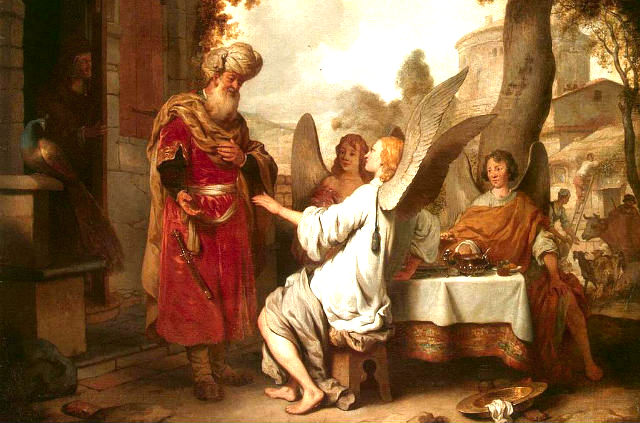
One hot summer afternoon while Abraham was sitting by the entrance to his tent near the sacred trees of Mamre, the Lord appeared to him. Abraham looked up and saw three men standing nearby. He quickly ran to meet them, bowed with his face to the ground, and said, “Please come to my home where I can serve you. I’ll have some water brought, so you can wash your feet, then you can rest under a tree. Let me get you some food to give you strength before you leave. I would be honored to serve you.”

“Thank you very much,” they answered. “We accept your offer.”

Abraham went quickly to his tent and said to Sarah, “Hurry! Get a large sack of flour and make some bread.” After saying this, he rushed off to his herd of cattle and picked out one of the best calves, which his servant quickly prepared. He then served his guests some yogurt and milk together with the meat. [Genesis 18:1-8a, CEV]

Now that’s how the writer set the scene. And with that done, he really got down to the nitty gritty, you know, the focus of this part of the story. He wrote,

While they were eating, he stood near them under the tree, and they asked, “Where’s your wife Sarah?”

“She is right there in the tent,” Abraham answered.

One of the guests was the Lord, and he said, “I’ll come back about this time next year, and when I do, Sarah will already have a son.” [Genesis 18:8b-10a, CEV]

Now that was what the Lord said. Of course, this wasn’t really a surprise. You see, he was simply restating a promise that he’d already made to Abraham. I mean, just listen to what happened back in chapter 15:

Later the Lord spoke to Abram in a vision, “Abram, don’t be afraid! I will protect you and reward you greatly.”

But Abram answered, “Lord All-Powerful, you have given me everything I could ask for, except children. And when I die, Eliezer of Damascus will get all I own. You have not given me any children, and this servant of mine will inherit everything.”

The Lord replied, “No, he won’t! You will have a son of your own, and everything you have will be his.” [Genesis 15:1-4, CEV]

And so, there you have it; Abraham and Sarah were going to have a son. That’s what God promised.

And I’ll tell you, I think we can get a pretty good idea about why he could trust that it was going to happen based on what followed. Just listen:

Sarah was behind Abraham, listening at the entrance to the tent. Abraham and Sarah were very old, and Sarah was well past the age for having children. So she laughed and said to herself, “Now that I am worn out and my husband is old, will I really know such happiness?” 

The Lord asked Abraham, “Why did Sarah laugh? Does she doubt that she can have a child in her old age? I am the Lord! There is nothing too difficult for me. I’ll come back next year at the time I promised, and Sarah will already have a son.”

Sarah was so frightened that she lied and said, “I didn’t laugh.”

“Yes, you did!” he answered. [Genesis 18:10b-15, CEV]

Now that’s what happened, and I’ll tell you, I think this is really important. You see, God was going to fulfill his promise. Sarah was going to have a son. Abraham was going to be a father, but not because of them. I mean, it wasn’t because they deserved it or because they were faithful or because they were paragons of virtue. Man, they were really old. And when Sarah heard the Lord, she laughed, because what was promised, man, it just sounded ridiculous. And as the cherry on top of the sundae, when face to face with the Lord God, the creator of the universe, Sarah lied because she was scared. No sir, if it had been about them, I think God would have found another couple that was a little more serious and that placed a higher emphasis on telling the truth. No, the Lord was going to keep his word, not because of them, but because of him: because of who he was and what he’d already said and done. And in my opinion, that’s why Abraham could trust in what was promised. 

And you know, I think that applies to us just like it did to Abraham and Sarah. You see, God has made promises to us, hasn’t he? For example, he’s promised to protect us, something that I think the prophet Isaiah knew all about when he wrote this people:

Don’t be afraid. I am with you.
Don’t tremble with fear.
    I am your God.
I will make you strong,
as I protect you with my arm
    and give you victories. [Isaiah 41:10, CEV]

And a little later, when he said,

When you cross deep rivers,
I will be with you,
    and you won’t drown.
When you walk through fire,
you won’t be burned
    or scorched by the flames. [Isaiah 43:2, CEV]

Now that’s one thing he’s promised, but the Lord also promised to help us as we move into the future. I mean, according to Jeremiah,

I will bless you with a future filled with hope — a future of success, not of suffering. You will turn back to me and ask for help, and I will answer your prayers. [Jeremiah 29:11-12, CEV]

And Isaiah wrote,

The Lord gives strength
    to those who are weary.
Even young people get tired,
    then stumble and fall.
But those who trust the Lord
    will find new strength.
They will be strong like eagles
    soaring upward on wings;
they will walk and run
    without getting tired. [Isaiah 40:29-31, CEV]

Now this is something else God has promised. But let’s get real, no matter how great his protection and guidance may be, man, it fades when compared with the promise Jesus offered to Nicodemus and through him, to us, when he said: 

And the Son of Man must be lifted up, just as the metal snake was lifted up by Moses in the desert. Then everyone who has faith in the Son of Man will have eternal life.

God loved the people of this world so much that he gave his only Son, so that everyone who has faith in him will have eternal life and never really die. God did not send his Son into the world to condemn its people. He sent him to save them! [John 3:14-17, CEV]

I’m telling you, just like the Lord promised Abraham and Sarah a son, this is what he’s promised to us.

And why can we trust him? Why can we believe that God’s going to keep his word? Why can we have faith that his protection and his guidance and his salvation is going to happen? Well, I’m going to tell you, right here and now, I don’t think it’s because of us: you know, because we’re so deserving and we’re so faithful and we’re so righteous. And if we have any illusions that it really is about us, just listen to what Paul wrote to the Romans. 

The Scriptures tell us,

“No one is acceptable to God!
Not one of them understands
    or even searches for God.
They have all turned away
    and are worthless.
There isn’t one person
    who does right. [Romans 3:10-12, CEV]

And a little later,

All of us have sinned and fallen short of God’s glory. [Romans 3:23, CEV]

Now that’s what he wrote. Not exactly the kind of thing a guy wants to see in a Father’s Day card. And by the way, when he wrote “no one” and “all” and “us,” I think that’s exactly what he meant. I’m telling you, it’s not about us.

Instead, it’s about him. It’s about God. You see, I believe we can have faith in his word, because of who he is, something that the writer of the Lamentations understood when he wrote this:

The Lord’s kindness never fails!
If he had not been merciful,
    we would have been destroyed. 
The Lord can always be trusted
    to show mercy each morning.
Deep in my heart I say,
“The Lord is all I need;
    I can depend on him!” [Lamentations 3:22-24, CEV]

That’s who God is; therefore, we can trust in his promises.And we can trust in his promises because of what he does. but that’s not the only reason. We can also trust because of what he does. Remember, how Paul kind of trashed humanity in his letter to the Romans. Well, after describing just how bad they were and the rotten stuff they’d done, just listen to what else he wrote:

But God treats us much better than we deserve, and because of Christ Jesus, he freely accepts us and sets us free from our sins. God sent Christ to be our sacrifice. Christ offered his life’s blood, so by faith in him we could come to God. And God did this to show that in the past he was right to be patient and forgive sinners. This also shows that God is right when he accepts people who have faith in Jesus. [Romans 3:24-26, CEV]

Now this is one who was faithful to Abraham and Sarah and who is faithful to us even when we’re less than faithful ourselves. And I’ll tell you, that’s why we can trust in his promises.

Now, yesterday, when it was getting all overcast, I’ve got to admit, I said a little prayer, asking God to hold off on the rain until, maybe two o-clock this afternoon, and I did it even though I knew I was risking either personal disappointment or a global climatic catastrophe. Of course, since I don’t believe that God ever promised not to rain on our picnics, I was pretty sure that God’s will was going to be done whether I liked it or not. But you know, even though God never promised to keep our buns dry, he has made some promises to us, promises that we can trust, but not because of us, rather, because of him: because of who he is and what he’s done. And this is something we can know, because God promised Abraham a son. 

Wednesday, April 19, 2023

In the Beginning: A Journey through Genesis - The Child of the Promise (Genesis 21:1 – 23:20)

The Book of Genesis establishes the foundation on which the Bible rests. It offers us insight into the nature of both God and humanity, and it begins a story of promise and hope that will culminate in the coming of Jesus. Over sixteen weeks, we’ll study the Genesis, focusing on the following:

During our eighth discussion in this series, we looked at Genesis 21:1 – 23:20. The passage is below:

Genesis 21:1 – 23:20

The Lord dealt with Sarah as he had said, and the Lord did for Sarah as he had promised. Sarah conceived and bore Abraham a son in his old age, at the time of which God had spoken to him. Abraham gave the name Isaac to his son whom Sarah bore him. And Abraham circumcised his son Isaac when he was eight days old, as God had commanded him. Abraham was a hundred years old when his son Isaac was born to him. Now Sarah said, “God has brought laughter for me; everyone who hears will laugh with me.” And she said, “Who would ever have said to Abraham that Sarah would nurse children? Yet I have borne him a son in his old age.” The child grew, and was weaned; and Abraham made a great feast on the day that Isaac was weaned.

But Sarah saw the son of Hagar the Egyptian, whom she had borne to Abraham, playing with her son Isaac. So she said to Abraham, “Cast out this slave woman with her son; for the son of this slave woman shall not inherit along with my son Isaac.” The matter was very distressing to Abraham on account of his son. But God said to Abraham, “Do not be distressed because of the boy and because of your slave woman; whatever Sarah says to you, do as she tells you, for it is through Isaac that offspring shall be named for you. As for the son of the slave woman, I will make a nation of him also, because he is your offspring.”

So Abraham rose early in the morning, and took bread and a skin of water, and gave it to Hagar, putting it on her shoulder, along with the child, and sent her away. And she departed, and wandered about in the wilderness of Beer-sheba. When the water in the skin was gone, she cast the child under one of the bushes. Then she went and sat down opposite him a good way off, about the distance of a bowshot; for she said, “Do not let me look on the death of the child.” And as she sat opposite him, she lifted up her voice and wept. And God heard the voice of the boy; and the angel of God called to Hagar from heaven, and said to her, “What troubles you, Hagar? Do not be afraid; for God has heard the voice of the boy where he is. Come, lift up the boy and hold him fast with your hand, for I will make a great nation of him.” Then God opened her eyes and she saw a well of water. She went, and filled the skin with water, and gave the boy a drink. God was with the boy, and he grew up; he lived in the wilderness, and became an expert with the bow. He lived in the wilderness of Paran; and his mother got a wife for him from the land of Egypt.

At that time Abimelech, with Phicol the commander of his army, said to Abraham, “God is with you in all that you do; now therefore swear to me here by God that you will not deal falsely with me or with my offspring or with my posterity, but as I have dealt loyally with you, you will deal with me and with the land where you have resided as an alien.” And Abraham said, “I swear it.” When Abraham complained to Abimelech about a well of water that Abimelech’s servants had seized, Abimelech said, “I do not know who has done this; you did not tell me, and I have not heard of it until today.” So Abraham took sheep and oxen and gave them to Abimelech, and the two men made a covenant. Abraham set apart seven ewe lambs of the flock. And Abimelech said to Abraham, “What is the meaning of these seven ewe lambs that you have set apart?” He said, “These seven ewe lambs you shall accept from my hand, in order that you may be a witness for me that I dug this well.” Therefore that place was called Beer-sheba; because there both of them swore an oath. When they had made a covenant at Beer-sheba, Abimelech, with Phicol the commander of his army, left and returned to the land of the Philistines.

Abraham planted a tamarisk tree in Beer-sheba, and called there on the name of the Lord, the Everlasting God. And Abraham resided as an alien many days in the land of the Philistines.

After these things God tested Abraham. He said to him, “Abraham!” And he said, “Here I am.” He said, “Take your son, your only son Isaac, whom you love, and go to the land of Moriah, and offer him there as a burnt offering on one of the mountains that I shall show you.”

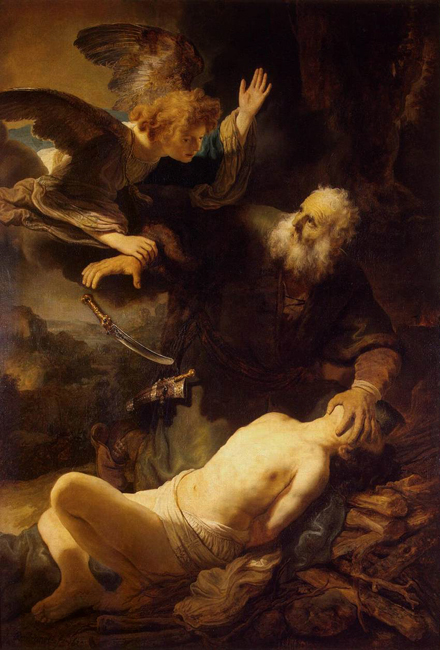
So Abraham rose early in the morning, saddled his donkey, and took two of his young men with him, and his son Isaac; he cut the wood for the burnt offering, and set out and went to the place in the distance that God had shown him. On the third day Abraham looked up and saw the place far away. Then Abraham said to his young men, “Stay here with the donkey; the boy and I will go over there; we will worship, and then we will come back to you.” Abraham took the wood of the burnt offering and laid it on his son Isaac, and he himself carried the fire and the knife. So the two of them walked on together. Isaac said to his father Abraham, “Father!” And he said, “Here I am, my son.” He said, “The fire and the wood are here, but where is the lamb for a burnt offering?” Abraham said, “God himself will provide the lamb for a burnt offering, my son.” So the two of them walked on together. When they came to the place that God had shown him, Abraham built an altar there and laid the wood in order. He bound his son Isaac, and laid him on the altar, on top of the wood. Then Abraham reached out his hand and took the knife to kill his son.

But the angel of the Lord called to him from heaven, and said, “Abraham, Abraham!” And he said, “Here I am.” He said, “Do not lay your hand on the boy or do anything to him; for now I know that you fear God, since you have not withheld your son, your only son, from me.” And Abraham looked up and saw a ram, caught in a thicket by its horns. Abraham went and took the ram and offered it up as a burnt offering instead of his son. So Abraham called that place “The Lord will provide”; as it is said to this day, “On the mount of the Lord it shall be provided.”

The angel of the Lord called to Abraham a second time from heaven, and said, “By myself I have sworn, says the Lord: Because you have done this, and have not withheld your son, your only son, I will indeed bless you, and I will make your offspring as numerous as the stars of heaven and as the sand that is on the seashore. And your offspring shall possess the gate of their enemies, and by your offspring shall all the nations of the earth gain blessing for themselves, because you have obeyed my voice.” So Abraham returned to his young men, and they arose and went together to Beer-sheba; and Abraham lived at Beer-sheba.

Now after these things it was told Abraham, “Milcah also has borne children, to your brother Nahor: Uz the firstborn, Buz his brother, Kemuel the father of Aram, Chesed, Hazo, Pildash, Jidlaph, and Bethuel.” Bethuel became the father of Rebekah. These eight Milcah bore to Nahor, Abraham’s brother. Moreover, his concubine, whose name was Reumah, bore Tebah, Gaham, Tahash, and Maacah.

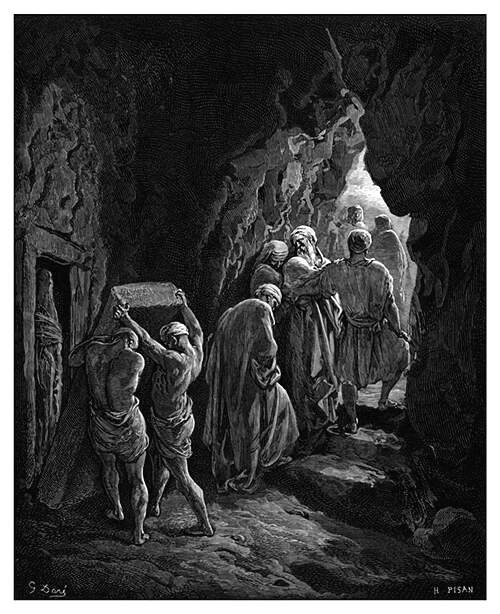
Sarah lived one hundred twenty-seven years; this was the length of Sarah’s life. And Sarah died at Kiriath-arba (that is, Hebron) in the land of Canaan; and Abraham went in to mourn for Sarah and to weep for her.

Abraham rose up from beside his dead, and said to the Hittites, “I am a stranger and an alien residing among you; give me property among you for a burying place, so that I may bury my dead out of my sight.” The Hittites answered Abraham, “Hear us, my lord; you are a mighty prince among us. Bury your dead in the choicest of our burial places; none of us will withhold from you any burial ground for burying your dead.” Abraham rose and bowed to the Hittites, the people of the land. He said to them, “If you are willing that I should bury my dead out of my sight, hear me, and entreat for me Ephron son of Zohar, so that he may give me the cave of Machpelah, which he owns; it is at the end of his field. For the full price let him give it to me in your presence as a possession for a burying place.” Now Ephron was sitting among the Hittites; and Ephron the Hittite answered Abraham in the hearing of the Hittites, of all who went in at the gate of his city, “No, my lord, hear me; I give you the field, and I give you the cave that is in it; in the presence of my people I give it to you; bury your dead.” Then Abraham bowed down before the people of the land. He said to Ephron in the hearing of the people of the land, “If you only will listen to me! I will give the price of the field; accept it from me, so that I may bury my dead there.” Ephron answered Abraham, “My lord, listen to me; a piece of land worth four hundred shekels of silver—what is that between you and me? Bury your dead.”

Abraham agreed with Ephron; and Abraham weighed out for Ephron the silver that he had named in the hearing of the Hittites, four hundred shekels of silver, according to the weights current among the merchants. So the field of Ephron in Machpelah, which was to the east of Mamre, the field with the cave that was in it and all the trees that were in the field, throughout its whole area, passed to Abraham as a possession in the presence of the Hittites, in the presence of all who went in at the gate of his city. After this, Abraham buried Sarah his wife in the cave of the field of Machpelah facing Mamre (that is, Hebron) in the land of Canaan. The field and the cave that is in it passed from the Hittites into Abraham’s possession as a burying place.
Bible Readings for September 19, 2026

Study, Learn and Grow: Bible Readings for September 19, 2026 :   Let's read the Bible together in the next year. Today, our passages ar...