Showing posts with label God and His Rebellious Children: A Study of First and Second Kings. Show all posts

Wednesday, October 2, 2024

God and His Rebellious Children: A Study of First and Second Kings (The End - 2 Kings 23:31–25:30)

As we enter the narrative offered in the books of the Kings, the nation of Israel is at the peak of its power and influence. By the end of the story, the children of God have become a captive people, living far from the land promised to Abraham, conquered by Joshua and ruled by David. Join us as we explore Israel’s decline and fall and God’s relationship with his rebellious children. During this series, we’ll consider the following:

During our  last session, we discussed the fall Judah (2 Kings 23:31–25:30). Below is a recording of our discussion and the passage we discussed.


2 Kings 23:31–25:30 [New Revised Standard Version]

Jehoahaz was twenty-three years old when he began to reign; he reigned three months in Jerusalem. His mother’s name was Hamutal daughter of Jeremiah of Libnah. He did what was evil in the sight of the Lord, just as his ancestors had done. Pharaoh Neco confined him at Riblah in the land of Hamath, so that he might not reign in Jerusalem, and imposed tribute on the land of one hundred talents of silver and a talent of gold. Pharaoh Neco made Eliakim son of Josiah king in place of his father Josiah, and changed his name to Jehoiakim. But he took Jehoahaz away; he came to Egypt, and died there. Jehoiakim gave the silver and the gold to Pharaoh, but he taxed the land in order to meet Pharaoh’s demand for money. He exacted the silver and the gold from the people of the land, from all according to their assessment, to give it to Pharaoh Neco. Jehoiakim was twenty-five years old when he began to reign; he reigned eleven years in Jerusalem. His mother’s name was Zebidah daughter of Pedaiah of Rumah. He did what was evil in the sight of the Lord, just as all his ancestors had done.

In his days King Nebuchadnezzar of Babylon came up; Jehoiakim became his servant for three years; then he turned and rebelled against him. The Lord sent against him bands of the Chaldeans, bands of the Arameans, bands of the Moabites, and bands of the Ammonites; he sent them against Judah to destroy it, according to the word of the Lord that he spoke by his servants the prophets. Surely this came upon Judah at the command of the Lord, to remove them out of his sight, for the sins of Manasseh, for all that he had committed, and also for the innocent blood that he had shed; for he filled Jerusalem with innocent blood, and the Lord was not willing to pardon. Now the rest of the deeds of Jehoiakim, and all that he did, are they not written in the Book of the Annals of the Kings of Judah? So Jehoiakim slept with his ancestors; then his son Jehoiachin succeeded him. The king of Egypt did not come again out of his land, for the king of Babylon had taken over all that belonged to the king of Egypt from the Wadi of Egypt to the River Euphrates.

Jehoiachin was eighteen years old when he began to reign; he reigned three months in Jerusalem. His mother’s name was Nehushta daughter of Elnathan of Jerusalem. He did what was evil in the sight of the Lord, just as his father had done. At that time the servants of King Nebuchadnezzar of Babylon came up to Jerusalem, and the city was besieged. King Nebuchadnezzar of Babylon came to the city, while his servants were besieging it; King Jehoiachin of Judah gave himself up to the king of Babylon, himself, his mother, his servants, his officers, and his palace officials. The king of Babylon took him prisoner in the eighth year of his reign. He carried off all the treasures of the house of the Lord, and the treasures of the king’s house; he cut in pieces all the vessels of gold in the temple of the Lord, which King Solomon of Israel had made, all this as the Lord had foretold. He carried away all Jerusalem, all the officials, all the warriors, ten thousand captives, all the artisans and the smiths; no one remained, except the poorest people of the land. He carried away Jehoiachin to Babylon; the king’s mother, the king’s wives, his officials, and the elite of the land, he took into captivity from Jerusalem to Babylon. The king of Babylon brought captive to Babylon all the men of valor, seven thousand, the artisans and the smiths, one thousand, all of them strong and fit for war. The king of Babylon made Mattaniah, Jehoiachin’s uncle, king in his place, and changed his name to Zedekiah. Zedekiah was twenty-one years old when he began to reign; he reigned eleven years in Jerusalem. His mother’s name was Hamutal daughter of Jeremiah of Libnah. He did what was evil in the sight of the Lord, just as Jehoiakim had done. Indeed, Jerusalem and Judah so angered the Lord that he expelled them from his presence. Zedekiah rebelled against the king of Babylon.

And in the ninth year of his reign, in the tenth month, on the tenth day of the month, King Nebuchadnezzar of Babylon came with all his army against Jerusalem, and laid siege to it; they built siegeworks against it all around. So the city was besieged until the eleventh year of King Zedekiah. On the ninth day of the fourth month the famine became so severe in the city that there was no food for the people of the land. Then a breach was made in the city wall; the king with all the soldiers fled by night by the way of the gate between the two walls, by the king’s garden, though the Chaldeans were all around the city. They went in the direction of the Arabah. But the army of the Chaldeans pursued the king, and overtook him in the plains of Jericho; all his army was scattered, deserting him. Then they captured the king and brought him up to the king of Babylon at Riblah, who passed sentence on him. They slaughtered the sons of Zedekiah before his eyes, then put out the eyes of Zedekiah; they bound him in fetters and took him to Babylon.

In the fifth month, on the seventh day of the month—which was the nineteenth year of King Nebuchadnezzar, king of Babylon—Nebuzaradan, the captain of the bodyguard, a servant of the king of Babylon, came to Jerusalem. He burned the house of the Lord, the king’s house, and all the houses of Jerusalem; every great house he burned down. All the army of the Chaldeans who were with the captain of the guard broke down the walls around Jerusalem. Nebuzaradan the captain of the guard carried into exile the rest of the people who were left in the city and the deserters who had defected to the king of Babylon—all the rest of the population. But the captain of the guard left some of the poorest people of the land to be vinedressers and tillers of the soil. The bronze pillars that were in the house of the Lord, as well as the stands and the bronze sea that were in the house of the Lord, the Chaldeans broke in pieces, and carried the bronze to Babylon. They took away the pots, the shovels, the snuffers, the dishes for incense, and all the bronze vessels used in the temple service, as well as the firepans and the basins. What was made of gold the captain of the guard took away for the gold, and what was made of silver, for the silver. As for the two pillars, the one sea, and the stands, which Solomon had made for the house of the Lord, the bronze of all these vessels was beyond weighing. The height of the one pillar was eighteen cubits, and on it was a bronze capital; the height of the capital was three cubits; latticework and pomegranates, all of bronze, were on the capital all around. The second pillar had the same, with the latticework. The captain of the guard took the chief priest Seraiah, the second priest Zephaniah, and the three guardians of the threshold; from the city he took an officer who had been in command of the soldiers, and five men of the king’s council who were found in the city; the secretary who was the commander of the army who mustered the people of the land; and sixty men of the people of the land who were found in the city. Nebuzaradan the captain of the guard took them, and brought them to the king of Babylon at Riblah. The king of Babylon struck them down and put them to death at Riblah in the land of Hamath. So Judah went into exile out of its land.

He appointed Gedaliah son of Ahikam son of Shaphan as governor over the people who remained in the land of Judah, whom King Nebuchadnezzar of Babylon had left. Now when all the captains of the forces and their men heard that the king of Babylon had appointed Gedaliah as governor, they came with their men to Gedaliah at Mizpah, namely, Ishmael son of Nethaniah, Johanan son of Kareah, Seraiah son of Tanhumeth the Netophathite, and Jaazaniah son of the Maacathite. Gedaliah swore to them and their men, saying, “Do not be afraid because of the Chaldean officials; live in the land, serve the king of Babylon, and it shall be well with you.” But in the seventh month, Ishmael son of Nethaniah son of Elishama, of the royal family, came with ten men; they struck down Gedaliah so that he died, along with the Judeans and Chaldeans who were with him at Mizpah. Then all the people, high and low and the captains of the forces set out and went to Egypt; for they were afraid of the Chaldeans. In the thirty-seventh year of the exile of King Jehoiachin of Judah, in the twelfth month, on the twenty-seventh day of the month, King Evil-merodach of Babylon, in the year that he began to reign, released King Jehoiachin of Judah from prison; he spoke kindly to him, and gave him a seat above the other seats of the kings who were with him in Babylon. So Jehoiachin put aside his prison clothes. Every day of his life he dined regularly in the king’s presence. For his allowance, a regular allowance was given him by the king, a portion every day, as long as he lived.

Wednesday, September 25, 2024

God and His Rebellious Children: A Study of First and Second Kings (The Josianic Reformation - 2 Kings 22:1–23:30)

As we enter the narrative offered in the books of the Kings, the nation of Israel is at the peak of its power and influence. By the end of the story, the children of God have become a captive people, living far from the land promised to Abraham, conquered by Joshua and ruled by David. Join us as we explore Israel’s decline and fall and God’s relationship with his rebellious children. During this series, we’ll consider the following:

During our sixteenth session, we discussed the reforms made by King Josiah (2 Kings 22:1–23:30). Below is a recording of our discussion and the passage we discussed.


2 Kings 22:1–23:30 [New Revised Standard Version]

Josiah was eight years old when he began to reign; he reigned thirty-one years in Jerusalem. His mother’s name was Jedidah daughter of Adaiah of Bozkath. He did what was right in the sight of the Lord, and walked in all the way of his father David; he did not turn aside to the right or to the left. In the eighteenth year of King Josiah, the king sent Shaphan son of Azaliah, son of Meshullam, the secretary, to the house of the Lord, saying, “Go up to the high priest Hilkiah, and have him count the entire sum of the money that has been brought into the house of the Lord, which the keepers of the threshold have collected from the people; let it be given into the hand of the workers who have the oversight of the house of the Lord; let them give it to the workers who are at the house of the Lord, repairing the house, that is, to the carpenters, to the builders, to the masons; and let them use it to buy timber and quarried stone to repair the house. But no accounting shall be asked from them for the money that is delivered into their hand, for they deal honestly.” The high priest Hilkiah said to Shaphan the secretary, “I have found the book of the law in the house of the Lord.” When Hilkiah gave the book to Shaphan, he read it. Then Shaphan the secretary came to the king, and reported to the king, “Your servants have emptied out the money that was found in the house, and have delivered it into the hand of the workers who have oversight of the house of the Lord.” Shaphan the secretary informed the king, “The priest Hilkiah has given me a book.” Shaphan then read it aloud to the king.

When the king heard the words of the book of the law, he tore his clothes. Then the king commanded the priest Hilkiah, Ahikam son of Shaphan, Achbor son of Micaiah, Shaphan the secretary, and the king’s servant Asaiah, saying, “Go, inquire of the Lord for me, for the people, and for all Judah, concerning the words of this book that has been found; for great is the wrath of the Lord that is kindled against us, because our ancestors did not obey the words of this book, to do according to all that is written concerning us.” So the priest Hilkiah, Ahikam, Achbor, Shaphan, and Asaiah went to the prophetess Huldah the wife of Shallum son of Tikvah, son of Harhas, keeper of the wardrobe; she resided in Jerusalem in the Second Quarter, where they consulted her. She declared to them, “Thus says the Lord, the God of Israel: Tell the man who sent you to me, Thus says the Lord, I will indeed bring disaster on this place and on its inhabitants—all the words of the book that the king of Judah has read. Because they have abandoned me and have made offerings to other gods, so that they have provoked me to anger with all the work of their hands, therefore my wrath will be kindled against this place, and it will not be quenched. But as to the king of Judah, who sent you to inquire of the Lord, thus shall you say to him, Thus says the Lord, the God of Israel: Regarding the words that you have heard, because your heart was penitent, and you humbled yourself before the Lord, when you heard how I spoke against this place, and against its inhabitants, that they should become a desolation and a curse, and because you have torn your clothes and wept before me, I also have heard you, says the Lord. Therefore, I will gather you to your ancestors, and you shall be gathered to your grave in peace; your eyes shall not see all the disaster that I will bring on this place.” They took the message back to the king.

Then the king directed that all the elders of Judah and Jerusalem should be gathered to him. The king went up to the house of the Lord, and with him went all the people of Judah, all the inhabitants of Jerusalem, the priests, the prophets, and all the people, both small and great; he read in their hearing all the words of the book of the covenant that had been found in the house of the Lord. The king stood by the pillar and made a covenant before the Lord, to follow the Lord, keeping his commandments, his decrees, and his statutes, with all his heart and all his soul, to perform the words of this covenant that were written in this book. All the people joined in the covenant.

The king commanded the high priest Hilkiah, the priests of the second order, and the guardians of the threshold, to bring out of the temple of the Lord all the vessels made for Baal, for Asherah, and for all the host of heaven; he burned them outside Jerusalem in the fields of the Kidron, and carried their ashes to Bethel. He deposed the idolatrous priests whom the kings of Judah had ordained to make offerings in the high places at the cities of Judah and around Jerusalem; those also who made offerings to Baal, to the sun, the moon, the constellations, and all the host of the heavens. He brought out the image of Asherah from the house of the Lord, outside Jerusalem, to the Wadi Kidron, burned it at the Wadi Kidron, beat it to dust and threw the dust of it upon the graves of the common people. He broke down the houses of the male temple prostitutes that were in the house of the Lord, where the women did weaving for Asherah. He brought all the priests out of the towns of Judah, and defiled the high places where the priests had made offerings, from Geba to Beer-sheba; he broke down the high places of the gates that were at the entrance of the gate of Joshua the governor of the city, which were on the left at the gate of the city. The priests of the high places, however, did not come up to the altar of the Lord in Jerusalem, but ate unleavened bread among their kindred. He defiled Topheth, which is in the valley of Ben-hinnom, so that no one would make a son or a daughter pass through fire as an offering to Molech. He removed the horses that the kings of Judah had dedicated to the sun, at the entrance to the house of the Lord, by the chamber of the eunuch Nathan-melech, which was in the precincts; then he burned the chariots of the sun with fire. The altars on the roof of the upper chamber of Ahaz, which the kings of Judah had made, and the altars that Manasseh had made in the two courts of the house of the Lord, he pulled down from there and broke in pieces, and threw the rubble into the Wadi Kidron. The king defiled the high places that were east of Jerusalem, to the south of the Mount of Destruction, which King Solomon of Israel had built for Astarte the abomination of the Sidonians, for Chemosh the abomination of Moab, and for Milcom the abomination of the Ammonites. He broke the pillars in pieces, cut down the sacred poles, and covered the sites with human bones. Moreover, the altar at Bethel, the high place erected by Jeroboam son of Nebat, who caused Israel to sin—he pulled down that altar along with the high place. He burned the high place, crushing it to dust; he also burned the sacred pole. As Josiah turned, he saw the tombs there on the mount; and he sent and took the bones out of the tombs, and burned them on the altar, and defiled it, according to the word of the Lord that the man of God proclaimed, when Jeroboam stood by the altar at the festival; he turned and looked up at the tomb of the man of God who had predicted these things. Then he said, “What is that monument that I see?” The people of the city told him, “It is the tomb of the man of God who came from Judah and predicted these things that you have done against the altar at Bethel.” He said, “Let him rest; let no one move his bones.” So they let his bones alone, with the bones of the prophet who came out of Samaria. Moreover, Josiah removed all the shrines of the high places that were in the towns of Samaria, which kings of Israel had made, provoking the Lord to anger; he did to them just as he had done at Bethel. He slaughtered on the altars all the priests of the high places who were there, and burned human bones on them. Then he returned to Jerusalem. The king commanded all the people, “Keep the passover to the Lord your God as prescribed in this book of the covenant.” No such passover had been kept since the days of the judges who judged Israel, or during all the days of the kings of Israel or of the kings of Judah; but in the eighteenth year of King Josiah this passover was kept to the Lord in Jerusalem. Moreover Josiah put away the mediums, wizards, teraphim, idols, and all the abominations that were seen in the land of Judah and in Jerusalem, so that he established the words of the law that were written in the book that the priest Hilkiah had found in the house of the Lord.

Before him there was no king like him, who turned to the Lord with all his heart, with all his soul, and with all his might, according to all the law of Moses; nor did any like him arise after him. Still the Lord did not turn from the fierceness of his great wrath, by which his anger was kindled against Judah, because of all the provocations with which Manasseh had provoked him. The Lord said, “I will remove Judah also out of my sight, as I have removed Israel; and I will reject this city that I have chosen, Jerusalem, and the house of which I said, My name shall be there.” Now the rest of the acts of Josiah, and all that he did, are they not written in the Book of the Annals of the Kings of Judah? In his days Pharaoh Neco king of Egypt went up to the king of Assyria to the river Euphrates. King Josiah went to meet him; but when Pharaoh Neco met him at Megiddo, he killed him. His servants carried him dead in a chariot from Megiddo, brought him to Jerusalem, and buried him in his own tomb. The people of the land took Jehoahaz son of Josiah, anointed him, and made him king in place of his father.

Wednesday, September 18, 2024

God and His Rebellious Children: A Study of First and Second Kings (Hezekiah and Manasseh - 2 Kings 18:1–21:26)

As we enter the narrative offered in the books of the Kings, the nation of Israel is at the peak of its power and influence. By the end of the story, the children of God have become a captive people, living far from the land promised to Abraham, conquered by Joshua and ruled by David. Join us as we explore Israel’s decline and fall and God’s relationship with his rebellious children. During this series, we’ll consider the following:

During our fourteenth session, we discussed King Hezekiah and King Manasseh (2 Kings 18:1–21:26). Below is a recording of our discussion and the passage we discussed. 


2 Kings 18:1–21:26 [New Revised Standard Version]

In the third year of King Hoshea son of Elah of Israel, Hezekiah son of King Ahaz of Judah began to reign. He was twenty-five years old when he began to reign; he reigned twenty-nine years in Jerusalem. His mother’s name was Abi daughter of Zechariah. He did what was right in the sight of the Lord just as his ancestor David had done. He removed the high places, broke down the pillars, and cut down the sacred pole. He broke in pieces the bronze serpent that Moses had made, for until those days the people of Israel had made offerings to it; it was called Nehushtan. He trusted in the Lord the God of Israel; so that there was no one like him among all the kings of Judah after him, or among those who were before him. For he held fast to the Lord; he did not depart from following him but kept the commandments that the Lord commanded Moses. The Lord was with him; wherever he went, he prospered. He rebelled against the king of Assyria and would not serve him. He attacked the Philistines as far as Gaza and its territory, from watchtower to fortified city.

In the fourth year of King Hezekiah, which was the seventh year of King Hoshea son of Elah of Israel, King Shalmaneser of Assyria came up against Samaria, besieged it, and at the end of three years, took it. In the sixth year of Hezekiah, which was the ninth year of King Hoshea of Israel, Samaria was taken. The king of Assyria carried the Israelites away to Assyria, settled them in Halah, on the Habor, the river of Gozan, and in the cities of the Medes, because they did not obey the voice of the Lord their God but transgressed his covenant—all that Moses the servant of the Lord had commanded; they neither listened nor obeyed. In the fourteenth year of King Hezekiah, King Sennacherib of Assyria came up against all the fortified cities of Judah and captured them. King Hezekiah of Judah sent to the king of Assyria at Lachish, saying, “I have done wrong; withdraw from me; whatever you impose on me I will bear.” The king of Assyria demanded of King Hezekiah of Judah three hundred talents of silver and thirty talents of gold. Hezekiah gave him all the silver that was found in the house of the Lord and in the treasuries of the king’s house. At that time Hezekiah stripped the gold from the doors of the temple of the Lord, and from the doorposts that King Hezekiah of Judah had overlaid and gave it to the king of Assyria.

The king of Assyria sent the Tartan, the Rab-saris, and the Rabshakeh with a great army from Lachish to King Hezekiah at Jerusalem. They went up and came to Jerusalem. When they arrived, they came and stood by the conduit of the upper pool, which is on the highway to the Fuller’s Field. When they called for the king, there came out to them Eliakim son of Hilkiah, who was in charge of the palace, and Shebnah the secretary, and Joah son of Asaph, the recorder. The Rabshakeh said to them, “Say to Hezekiah: Thus says the great king, the king of Assyria: On what do you base this confidence of yours? Do you think that mere words are strategy and power for war? On whom do you now rely, that you have rebelled against me? See, you are relying now on Egypt, that broken reed of a staff, which will pierce the hand of anyone who leans on it. Such is Pharaoh king of Egypt to all who rely on him. But if you say to me, ‘We rely on the Lord our God,’ is it not he whose high places and altars Hezekiah has removed, saying to Judah and to Jerusalem, ‘You shall worship before this altar in Jerusalem’? Come now, make a wager with my master the king of Assyria: I will give you two thousand horses, if you are able on your part to set riders on them. How then can you repulse a single captain among the least of my master’s servants, when you rely on Egypt for chariots and for horsemen? Moreover, is it without the Lord that I have come up against this place to destroy it? The Lord said to me, Go up against this land, and destroy it.” Then Eliakim son of Hilkiah, and Shebnah, and Joah said to the Rabshakeh, “Please speak to your servants in the Aramaic language, for we understand it; do not speak to us in the language of Judah within the hearing of the people who are on the wall.” But the Rabshakeh said to them, “Has my master sent me to speak these words to your master and to you, and not to the people sitting on the wall, who are doomed with you to eat their own dung and to drink their own urine?” Then the Rabshakeh stood and called out in a loud voice in the language of Judah, “Hear the word of the great king, the king of Assyria! Thus says the king: ‘Do not let Hezekiah deceive you, for he will not be able to deliver you out of my hand. Do not let Hezekiah make you rely on the Lord by saying, The Lord will surely deliver us, and this city will not be given into the hand of the king of Assyria.’ Do not listen to Hezekiah; for thus says the king of Assyria: ‘Make your peace with me and come out to me; then every one of you will eat from your own vine and your own fig tree, and drink water from your own cistern, until I come and take you away to a land like your own land, a land of grain and wine, a land of bread and vineyards, a land of olive oil and honey, that you may live and not die. Do not listen to Hezekiah when he misleads you by saying, The Lord will deliver us. Has any of the gods of the nations ever delivered its land out of the hand of the king of Assyria? Where are the gods of Hamath and Arpad? Where are the gods of Sepharvaim, Hena, and Ivvah? Have they delivered Samaria out of my hand? Who among all the gods of the countries have delivered their countries out of my hand, that the Lord should deliver Jerusalem out of my hand?’” But the people were silent and answered him not a word, for the king’s command was, “Do not answer him.” Then Eliakim son of Hilkiah, who was in charge of the palace, and Shebna the secretary, and Joah son of Asaph, the recorder, came to Hezekiah with their clothes torn and told him the words of the Rabshakeh.
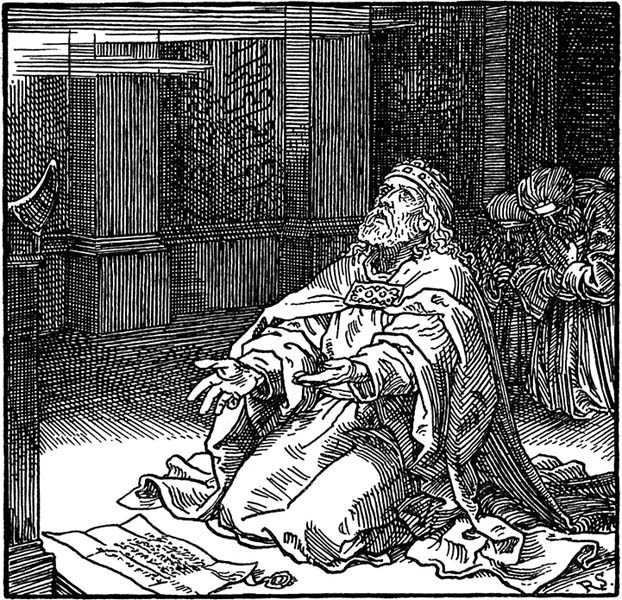
When King Hezekiah heard it, he tore his clothes, covered himself with sackcloth, and went into the house of the Lord. And he sent Eliakim, who was in charge of the palace, and Shebna the secretary, and the senior priests, covered with sackcloth, to the prophet Isaiah son of Amoz. They said to him, “Thus says Hezekiah, This day is a day of distress, of rebuke, and of disgrace; children have come to the birth, and there is no strength to bring them forth. It may be that the Lord your God heard all the words of the Rabshakeh, whom his master the king of Assyria has sent to mock the living God, and will rebuke the words that the Lord your God has heard; therefore lift up your prayer for the remnant that is left.” When the servants of King Hezekiah came to Isaiah, Isaiah said to them, “Say to your master, ‘Thus says the Lord: Do not be afraid because of the words that you have heard, with which the servants of the king of Assyria have reviled me. I myself will put a spirit in him, so that he shall hear a rumor and return to his own land; I will cause him to fall by the sword in his own land.’”

The Rabshakeh returned, and found the king of Assyria fighting against Libnah; for he had heard that the king had left Lachish. When the king heard concerning King Tirhakah of Ethiopia, “See, he has set out to fight against you,” he sent messengers again to Hezekiah, saying, “Thus shall you speak to King Hezekiah of Judah: Do not let your God on whom you rely deceive you by promising that Jerusalem will not be given into the hand of the king of Assyria. See, you have heard what the kings of Assyria have done to all lands, destroying them utterly. Shall you be delivered? Have the gods of the nations delivered them, the nations that my predecessors destroyed, Gozan, Haran, Rezeph, and the people of Eden who were in Telassar? Where is the king of Hamath, the king of Arpad, the king of the city of Sepharvaim, the king of Hena, or the king of Ivvah?” Hezekiah received the letter from the hand of the messengers and read it; then Hezekiah went up to the house of the Lord and spread it before the Lord. And Hezekiah prayed before the Lord, and said: “O Lord the God of Israel, who are enthroned above the cherubim, you are God, you alone, of all the kingdoms of the earth; you have made heaven and earth. Incline your ear, O Lord, and hear; open your eyes, O Lord, and see; hear the words of Sennacherib, which he has sent to mock the living God. Truly, O Lord, the kings of Assyria have laid waste the nations and their lands, and have hurled their gods into the fire, though they were no gods but the work of human hands—wood and stone—and so they were destroyed. So now, O Lord our God, save us, I pray you, from his hand, so that all the kingdoms of the earth may know that you, O Lord, are God alone.”

Then Isaiah son of Amoz sent to Hezekiah, saying, “Thus says the Lord, the God of Israel: I have heard your prayer to me about King Sennacherib of Assyria. This is the word that the Lord has spoken concerning him: She despises you, she scorns you— virgin daughter Zion; she tosses her head—behind your back, daughter Jerusalem. Whom have you mocked and reviled? Against whom have you raised your voice and haughtily lifted your eyes? Against the Holy One of Israel! By your messengers you have mocked the Lord, and you have said, ‘With my many chariots I have gone up the heights of the mountains, to the far recesses of Lebanon; I felled its tallest cedars, its choicest cypresses; I entered its farthest retreat, its densest forest. I dug wells and drank foreign waters, I dried up with the sole of my foot all the streams of Egypt.’ Have you not heard that I determined it long ago? I planned from days of old what now I bring to pass, that you should make fortified cities crash into heaps of ruins, while their inhabitants, shorn of strength, are dismayed and confounded; they have become like plants of the field and like tender grass, like grass on the housetops, blighted before it is grown. “But I know your rising and your sitting, your going out and coming in, and your raging against me. Because you have raged against me and your arrogance has come to my ears, I will put my hook in your nose and my bit in your mouth; I will turn you back on the way by which you came. “And this shall be the sign for you: This year you shall eat what grows of itself, and in the second year what springs from that; then in the third year sow, reap, plant vineyards, and eat their fruit. The surviving remnant of the house of Judah shall again take root downward, and bear fruit upward; for from Jerusalem a remnant shall go out, and from Mount Zion a band of survivors. The zeal of the Lord of hosts will do this. “Therefore thus says the Lord concerning the king of Assyria: He shall not come into this city, shoot an arrow there, come before it with a shield, or cast up a siege-ramp against it. By the way that he came, by the same he shall return; he shall not come into this city, says the Lord. For I will defend this city to save it, for my own sake and for the sake of my servant David.”

That very night the angel of the Lord set out and struck down one hundred eighty-five thousand in the camp of the Assyrians; when morning dawned, they were all dead bodies. Then King Sennacherib of Assyria left, went home, and lived at Nineveh. As he was worshiping in the house of his god Nisroch, his sons Adrammelech and Sharezer killed him with the sword, and they escaped into the land of Ararat. His son Esar-haddon succeeded him.
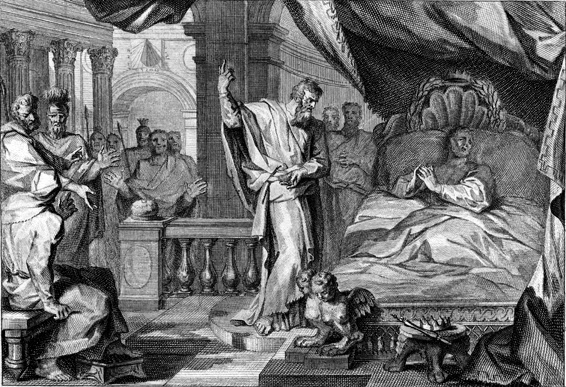
In those days Hezekiah became sick and was at the point of death. The prophet Isaiah son of Amoz came to him, and said to him, “Thus says the Lord: Set your house in order, for you shall die; you shall not recover.” Then Hezekiah turned his face to the wall and prayed to the Lord: “Remember now, O Lord, I implore you, how I have walked before you in faithfulness with a whole heart, and have done what is good in your sight.” Hezekiah wept bitterly. Before Isaiah had gone out of the middle court, the word of the Lord came to him: “Turn back, and say to Hezekiah prince of my people, Thus says the Lord, the God of your ancestor David: I have heard your prayer, I have seen your tears; indeed, I will heal you; on the third day you shall go up to the house of the Lord. I will add fifteen years to your life. I will deliver you and this city out of the hand of the king of Assyria; I will defend this city for my own sake and for my servant David’s sake.” Then Isaiah said, “Bring a lump of figs. Let them take it and apply it to the boil, so that he may recover.” Hezekiah said to Isaiah, “What shall be the sign that the Lord will heal me, and that I shall go up to the house of the Lord on the third day?” Isaiah said, “This is the sign to you from the Lord, that the Lord will do the thing that he has promised: the shadow has now advanced ten intervals; shall it retreat ten intervals?” Hezekiah answered, “It is normal for the shadow to lengthen ten intervals; rather let the shadow retreat ten intervals.” The prophet Isaiah cried to the Lord; and he brought the shadow back the ten intervals, by which the sun had declined on the dial of Ahaz.

At that time King Merodach-baladan son of Baladan of Babylon sent envoys with letters and a present to Hezekiah, for he had heard that Hezekiah had been sick. Hezekiah welcomed them; he showed them all his treasure house, the silver, the gold, the spices, the precious oil, his armory, all that was found in his storehouses; there was nothing in his house or in all his realm that Hezekiah did not show them. Then the prophet Isaiah came to King Hezekiah, and said to him, “What did these men say? From where did they come to you?” Hezekiah answered, “They have come from a far country, from Babylon.” He said, “What have they seen in your house?” Hezekiah answered, “They have seen all that is in my house; there is nothing in my storehouses that I did not show them.” Then Isaiah said to Hezekiah, “Hear the word of the Lord: Days are coming when all that is in your house, and that which your ancestors have stored up until this day, shall be carried to Babylon; nothing shall be left, says the Lord. Some of your own sons who are born to you shall be taken away; they shall be eunuchs in the palace of the king of Babylon.” Then Hezekiah said to Isaiah, “The word of the Lord that you have spoken is good.” For he thought, “Why not, if there will be peace and security in my days?” The rest of the deeds of Hezekiah, all his power, how he made the pool and the conduit and brought water into the city, are they not written in the Book of the Annals of the Kings of Judah? Hezekiah slept with his ancestors; and his son Manasseh succeeded him.

Manasseh was twelve years old when he began to reign; he reigned fifty-five years in Jerusalem. His mother’s name was Hephzibah. He did what was evil in the sight of the Lord, following the abominable practices of the nations that the Lord drove out before the people of Israel. For he rebuilt the high places that his father Hezekiah had destroyed; he erected altars for Baal, made a sacred pole, as King Ahab of Israel had done, worshiped all the host of heaven, and served them. He built altars in the house of the Lord, of which the Lord had said, “In Jerusalem I will put my name.” He built altars for all the host of heaven in the two courts of the house of the Lord. He made his son pass through fire; he practiced soothsaying and augury, and dealt with mediums and with wizards. He did much evil in the sight of the Lord, provoking him to anger. The carved image of Asherah that he had made he set in the house of which the Lord said to David and to his son Solomon, “In this house, and in Jerusalem, which I have chosen out of all the tribes of Israel, I will put my name forever; I will not cause the feet of Israel to wander any more out of the land that I gave to their ancestors, if only they will be careful to do according to all that I have commanded them, and according to all the law that my servant Moses commanded them.” But they did not listen; Manasseh misled them to do more evil than the nations had done that the Lord destroyed before the people of Israel.

The Lord said by his servants the prophets, “Because King Manasseh of Judah has committed these abominations, has done things more wicked than all that the Amorites did, who were before him, and has caused Judah also to sin with his idols; therefore thus says the Lord, the God of Israel, I am bringing upon Jerusalem and Judah such evil that the ears of everyone who hears of it will tingle. I will stretch over Jerusalem the measuring line for Samaria, and the plummet for the house of Ahab; I will wipe Jerusalem as one wipes a dish, wiping it and turning it upside down. I will cast off the remnant of my heritage, and give them into the hand of their enemies; they shall become a prey and a spoil to all their enemies, because they have done what is evil in my sight and have provoked me to anger, since the day their ancestors came out of Egypt, even to this day.” Moreover Manasseh shed very much innocent blood, until he had filled Jerusalem from one end to another, besides the sin that he caused Judah to sin so that they did what was evil in the sight of the Lord. Now the rest of the acts of Manasseh, all that he did, and the sin that he committed, are they not written in the Book of the Annals of the Kings of Judah? Manasseh slept with his ancestors, and was buried in the garden of his house, in the garden of Uzza. His son Amon succeeded him.

Amon was twenty-two years old when he began to reign; he reigned two years in Jerusalem. His mother’s name was Meshullemeth daughter of Haruz of Jotbah. He did what was evil in the sight of the Lord, as his father Manasseh had done. He walked in all the way in which his father walked, served the idols that his father served, and worshiped them; he abandoned the Lord, the God of his ancestors, and did not walk in the way of the Lord. The servants of Amon conspired against him, and killed the king in his house. But the people of the land killed all those who had conspired against King Amon, and the people of the land made his son Josiah king in place of him. Now the rest of the acts of Amon that he did, are they not written in the Book of the Annals of the Kings of Judah? He was buried in his tomb in the garden of Uzza; then his son Josiah succeeded him.

Wednesday, September 4, 2024

God and His Rebellious Children: A Study of First and Second Kings (The Dynasty of Jehu - 2 Kings 13:1–15:7)

As we enter the narrative offered in the books of the Kings, the nation of Israel is at the peak of its power and influence. By the end of the story, the children of God have become a captive people, living far from the land promised to Abraham, conquered by Joshua and ruled by David. Join us as we explore Israel’s decline and fall and God’s relationship with his rebellious children. During this series, we’ll consider the following:

During our thirteenth session, we discussed the dynasty of Jehu (2 Kings 13:1–15:7). Below is a recording of our discussion and the passage we discussed. 


2 Kings 13:1–15:7 [New Revised Standard Version]

In the twenty-third year of King Joash son of Ahaziah of Judah, Jehoahaz son of Jehu began to reign over Israel in Samaria; he reigned seventeen years. He did what was evil in the sight of the Lord, and followed the sins of Jeroboam son of Nebat, which he caused Israel to sin; he did not depart from them. The anger of the Lord was kindled against Israel, so that he gave them repeatedly into the hand of King Hazael of Aram, then into the hand of Ben-hadad son of Hazael. But Jehoahaz entreated the Lord, and the Lord heeded him; for he saw the oppression of Israel, how the king of Aram oppressed them. Therefore the Lord gave Israel a savior, so that they escaped from the hand of the Arameans; and the people of Israel lived in their homes as formerly. Nevertheless they did not depart from the sins of the house of Jeroboam, which he caused Israel to sin, but walked in them; the sacred pole also remained in Samaria. So Jehoahaz was left with an army of not more than fifty horsemen, ten chariots and ten thousand footmen; for the king of Aram had destroyed them and made them like the dust at threshing. Now the rest of the acts of Jehoahaz and all that he did, including his might, are they not written in the Book of the Annals of the Kings of Israel? So Jehoahaz slept with his ancestors, and they buried him in Samaria; then his son Joash succeeded him.

In the thirty-seventh year of King Joash of Judah, Jehoash son of Jehoahaz began to reign over Israel in Samaria; he reigned sixteen years. He also did what was evil in the sight of the Lord; he did not depart from all the sins of Jeroboam son of Nebat, which he caused Israel to sin, but he walked in them. Now the rest of the acts of Joash, and all that he did, as well as the might with which he fought against King Amaziah of Judah, are they not written in the Book of the Annals of the Kings of Israel? So Joash slept with his ancestors, and Jeroboam sat upon his throne; Joash was buried in Samaria with the kings of Israel. Now when Elisha had fallen sick with the illness of which he was to die, King Joash of Israel went down to him, and wept before him, crying, “My father, my father! The chariots of Israel and its horsemen!” Elisha said to him, “Take a bow and arrows”; so he took a bow and arrows. Then he said to the king of Israel, “Draw the bow”; and he drew it. Elisha laid his hands on the king’s hands. Then he said, “Open the window eastward”; and he opened it. Elisha said, “Shoot”; and he shot. Then he said, “The Lord’s arrow of victory, the arrow of victory over Aram! For you shall fight the Arameans in Aphek until you have made an end of them.” He continued, “Take the arrows”; and he took them. He said to the king of Israel, “Strike the ground with them”; he struck three times, and stopped. Then the man of God was angry with him, and said, “You should have struck five or six times; then you would have struck down Aram until you had made an end of it, but now you will strike down Aram only three times.”

So Elisha died, and they buried him. Now bands of Moabites used to invade the land in the spring of the year. As a man was being buried, a marauding band was seen and the man was thrown into the grave of Elisha; as soon as the man touched the bones of Elisha, he came to life and stood on his feet. Now King Hazael of Aram oppressed Israel all the days of Jehoahaz. But the Lord was gracious to them and had compassion on them; he turned toward them, because of his covenant with Abraham, Isaac, and Jacob, and would not destroy them; nor has he banished them from his presence until now. When King Hazael of Aram died, his son Ben-hadad succeeded him. Then Jehoash son of Jehoahaz took again from Ben-hadad son of Hazael the towns that he had taken from his father Jehoahaz in war. Three times Joash defeated him and recovered the towns of Israel.

In the second year of King Joash son of Joahaz of Israel, King Amaziah son of Joash of Judah, began to reign. He was twenty-five years old when he began to reign, and he reigned twenty-nine years in Jerusalem. His mother’s name was Jehoaddin of Jerusalem. He did what was right in the sight of the Lord, yet not like his ancestor David; in all things he did as his father Joash had done. But the high places were not removed; the people still sacrificed and made offerings on the high places. As soon as the royal power was firmly in his hand he killed his servants who had murdered his father the king. But he did not put to death the children of the murderers; according to what is written in the book of the law of Moses, where the Lord commanded, “The parents shall not be put to death for the children, or the children be put to death for the parents; but all shall be put to death for their own sins.” He killed ten thousand Edomites in the Valley of Salt and took Sela by storm; he called it Jokthe-el, which is its name to this day.

Then Amaziah sent messengers to King Jehoash son of Jehoahaz, son of Jehu, of Israel, saying, “Come, let us look one another in the face.” King Jehoash of Israel sent word to King Amaziah of Judah, “A thorn bush on Lebanon sent to a cedar on Lebanon, saying, ‘Give your daughter to my son for a wife’; but a wild animal of Lebanon passed by and trampled down the thorn bush. You have indeed defeated Edom, and your heart has lifted you up. Be content with your glory, and stay at home; for why should you provoke trouble so that you fall, you and Judah with you?” But Amaziah would not listen. So King Jehoash of Israel went up; he and King Amaziah of Judah faced one another in battle at Beth-shemesh, which belongs to Judah. Judah was defeated by Israel; everyone fled home. King Jehoash of Israel captured King Amaziah of Judah son of Jehoash, son of Ahaziah, at Beth-shemesh; he came to Jerusalem, and broke down the wall of Jerusalem from the Ephraim Gate to the Corner Gate, a distance of four hundred cubits. He seized all the gold and silver, and all the vessels that were found in the house of the Lord and in the treasuries of the king’s house, as well as hostages; then he returned to Samaria.

Now the rest of the acts that Jehoash did, his might, and how he fought with King Amaziah of Judah, are they not written in the Book of the Annals of the Kings of Israel? Jehoash slept with his ancestors, and was buried in Samaria with the kings of Israel; then his son Jeroboam succeeded him. King Amaziah son of Joash of Judah lived fifteen years after the death of King Jehoash son of Jehoahaz of Israel. Now the rest of the deeds of Amaziah, are they not written in the Book of the Annals of the Kings of Judah? They made a conspiracy against him in Jerusalem, and he fled to Lachish. But they sent after him to Lachish, and killed him there. They brought him on horses; he was buried in Jerusalem with his ancestors in the city of David. All the people of Judah took Azariah, who was sixteen years old, and made him king to succeed his father Amaziah. He rebuilt Elath and restored it to Judah, after King Amaziah slept with his ancestors.

In the fifteenth year of King Amaziah son of Joash of Judah, King Jeroboam son of Joash of Israel began to reign in Samaria; he reigned forty-one years. He did what was evil in the sight of the Lord; he did not depart from all the sins of Jeroboam son of Nebat, which he caused Israel to sin. He restored the border of Israel from Lebo-hamath as far as the Sea of the Arabah, according to the word of the Lord, the God of Israel, which he spoke by his servant Jonah son of Amittai, the prophet, who was from Gath-hepher. For the Lord saw that the distress of Israel was very bitter; there was no one left, bond or free, and no one to help Israel. But the Lord had not said that he would blot out the name of Israel from under heaven, so he saved them by the hand of Jeroboam son of Joash. Now the rest of the acts of Jeroboam, and all that he did, and his might, how he fought, and how he recovered for Israel Damascus and Hamath, which had belonged to Judah, are they not written in the Book of the Annals of the Kings of Israel? Jeroboam slept with his ancestors, the kings of Israel; his son Zechariah succeeded him.

In the twenty-seventh year of King Jeroboam of Israel King Azariah son of Amaziah of Judah began to reign. He was sixteen years old when he began to reign, and he reigned fifty-two years in Jerusalem. His mother’s name was Jecoliah of Jerusalem. He did what was right in the sight of the Lord, just as his father Amaziah had done. Nevertheless the high places were not taken away; the people still sacrificed and made offerings on the high places. The Lord struck the king, so that he was leprous to the day of his death, and lived in a separate house. Jotham the king’s son was in charge of the palace, governing the people of the land. Now the rest of the acts of Azariah, and all that he did, are they not written in the Book of the Annals of the Kings of Judah? Azariah slept with his ancestors; they buried him with his ancestors in the city of David; his son Jotham succeeded him.

Wednesday, August 28, 2024

God and His Rebellious Children: A Study of First and Second Kings (Jehu and Joash - 2 Kings 9:1–12:21)

As we enter the narrative offered in the books of the Kings, the nation of Israel is at the peak of its power and influence. By the end of the story, the children of God have become a captive people, living far from the land promised to Abraham, conquered by Joshua and ruled by David. Join us as we explore Israel’s decline and fall and God’s relationship with his rebellious children. During this series, we’ll consider the following:

During our twelfth session, we discussed Jehu and Joash (2 Kings 9:1–12:21). Below is a recording of our discussion and the passage we discussed. 


2 Kings 9:1–12:21 [New Revised Standard Version]

Then the prophet Elisha called a member of the company of prophets and said to him, “Gird up your loins; take this flask of oil in your hand, and go to Ramoth-gilead. When you arrive, look there for Jehu son of Jehoshaphat, son of Nimshi; go in and get him to leave his companions, and take him into an inner chamber. Then take the flask of oil, pour it on his head, and say, ‘Thus says the Lord: I anoint you king over Israel.’ Then open the door and flee; do not linger.” So the young man, the young prophet, went to Ramoth-gilead. He arrived while the commanders of the army were in council, and he announced, “I have a message for you, commander.” “For which one of us?” asked Jehu. “For you, commander.” So Jehu got up and went inside; the young man poured the oil on his head, saying to him, “Thus says the Lord the God of Israel: I anoint you king over the people of the Lord, over Israel. You shall strike down the house of your master Ahab, so that I may avenge on Jezebel the blood of my servants the prophets, and the blood of all the servants of the Lord. For the whole house of Ahab shall perish; I will cut off from Ahab every male, bond or free, in Israel. I will make the house of Ahab like the house of Jeroboam son of Nebat, and like the house of Baasha son of Ahijah. The dogs shall eat Jezebel in the territory of Jezreel, and no one shall bury her.” Then he opened the door and fled.

When Jehu came back to his master’s officers, they said to him, “Is everything all right? Why did that madman come to you?” He answered them, “You know the sort and how they babble.” They said, “Liar! Come on, tell us!” So he said, “This is just what he said to me: ‘Thus says the Lord, I anoint you king over Israel.’” Then hurriedly they all took their cloaks and spread them for him on the bare steps; and they blew the trumpet, and proclaimed, “Jehu is king.” Thus Jehu son of Jehoshaphat son of Nimshi conspired against Joram. Joram with all Israel had been on guard at Ramoth-gilead against King Hazael of Aram; but King Joram had returned to be healed in Jezreel of the wounds that the Arameans had inflicted on him, when he fought against King Hazael of Aram. So Jehu said, “If this is your wish, then let no one slip out of the city to go and tell the news in Jezreel.”

Then Jehu mounted his chariot and went to Jezreel, where Joram was lying ill. King Ahaziah of Judah had come down to visit Joram. In Jezreel, the sentinel standing on the tower spied the company of Jehu arriving, and said, “I see a company.” Joram said, “Take a horseman; send him to meet them, and let him say, ‘Is it peace?’” So the horseman went to meet him; he said, “Thus says the king, ‘Is it peace?’” Jehu responded, “What have you to do with peace? Fall in behind me.” The sentinel reported, saying, “The messenger reached them, but he is not coming back.” Then he sent out a second horseman, who came to them and said, “Thus says the king, ‘Is it peace?’” Jehu answered, “What have you to do with peace? Fall in behind me.” Again the sentinel reported, “He reached them, but he is not coming back. It looks like the driving of Jehu son of Nimshi; for he drives like a maniac.” Joram said, “Get ready.” And they got his chariot ready. Then King Joram of Israel and King Ahaziah of Judah set out, each in his chariot, and went to meet Jehu; they met him at the property of Naboth the Jezreelite. When Joram saw Jehu, he said, “Is it peace, Jehu?” He answered, “What peace can there be, so long as the many whoredoms and sorceries of your mother Jezebel continue?” Then Joram reined about and fled, saying to Ahaziah, “Treason, Ahaziah!” Jehu drew his bow with all his strength, and shot Joram between the shoulders, so that the arrow pierced his heart; and he sank in his chariot. Jehu said to his aide Bidkar, “Lift him out, and throw him on the plot of ground belonging to Naboth the Jezreelite; for remember, when you and I rode side by side behind his father Ahab how the Lord uttered this oracle against him: ‘For the blood of Naboth and for the blood of his children that I saw yesterday, says the Lord, I swear I will repay you on this very plot of ground.’ Now therefore lift him out and throw him on the plot of ground, in accordance with the word of the Lord.” When King Ahaziah of Judah saw this, he fled in the direction of Beth-haggan. Jehu pursued him, saying, “Shoot him also!” And they shot him in the chariot at the ascent to Gur, which is by Ibleam. Then he fled to Megiddo, and died there. His officers carried him in a chariot to Jerusalem, and buried him in his tomb with his ancestors in the city of David. In the eleventh year of Joram son of Ahab, Ahaziah began to reign over Judah.

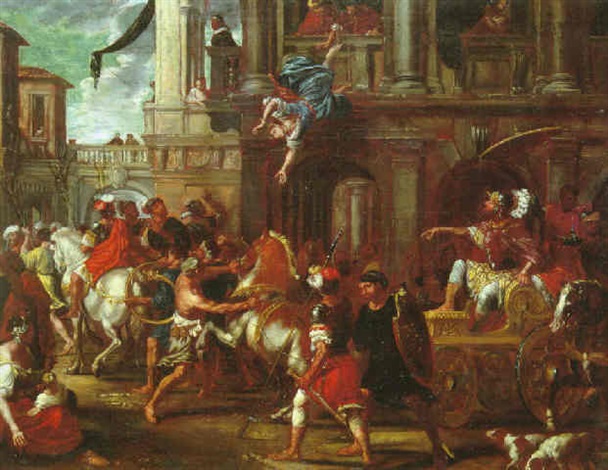
When Jehu came to Jezreel, Jezebel heard of it; she painted her eyes, and adorned her head, and looked out of the window. As Jehu entered the gate, she said, “Is it peace, Zimri, murderer of your master?” He looked up to the window and said, “Who is on my side? Who?” Two or three eunuchs looked out at him. He said, “Throw her down.” So they threw her down; some of her blood spattered on the wall and on the horses, which trampled on her. Then he went in and ate and drank; he said, “See to that cursed woman and bury her; for she is a king’s daughter.” But when they went to bury her, they found no more of her than the skull and the feet and the palms of her hands. When they came back and told him, he said, “This is the word of the Lord, which he spoke by his servant Elijah the Tishbite, ‘In the territory of Jezreel the dogs shall eat the flesh of Jezebel; the corpse of Jezebel shall be like dung on the field in the territory of Jezreel, so that no one can say, This is Jezebel.’”

Now Ahab had seventy sons in Samaria. So Jehu wrote letters and sent them to Samaria, to the rulers of Jezreel, to the elders, and to the guardians of the sons of Ahab, saying, “Since your master’s sons are with you and you have at your disposal chariots and horses, a fortified city, and weapons, select the son of your master who is the best qualified, set him on his father’s throne, and fight for your master’s house.” But they were utterly terrified and said, “Look, two kings could not withstand him; how then can we stand?” So the steward of the palace, and the governor of the city, along with the elders and the guardians, sent word to Jehu: “We are your servants; we will do anything you say. We will not make anyone king; do whatever you think right.” Then he wrote them a second letter, saying, “If you are on my side, and if you are ready to obey me, take the heads of your master’s sons and come to me at Jezreel tomorrow at this time.” Now the king’s sons, seventy persons, were with the leaders of the city, who were charged with their upbringing. When the letter reached them, they took the king’s sons and killed them, seventy persons; they put their heads in baskets and sent them to him at Jezreel. When the messenger came and told him, “They have brought the heads of the king’s sons,” he said, “Lay them in two heaps at the entrance of the gate until the morning.” Then in the morning when he went out, he stood and said to all the people, “You are innocent. It was I who conspired against my master and killed him; but who struck down all these? Know then that there shall fall to the earth nothing of the word of the Lord, which the Lord spoke concerning the house of Ahab; for the Lord has done what he said through his servant Elijah.” So Jehu killed all who were left of the house of Ahab in Jezreel, all his leaders, close friends, and priests, until he left him no survivor. Then he set out and went to Samaria. On the way, when he was at Beth-eked of the Shepherds, Jehu met relatives of King Ahaziah of Judah and said, “Who are you?” They answered, “We are kin of Ahaziah; we have come down to visit the royal princes and the sons of the queen mother.” He said, “Take them alive.” They took them alive, and slaughtered them at the pit of Beth-eked, forty-two in all; he spared none of them.

When he left there, he met Jehonadab son of Rechab coming to meet him; he greeted him, and said to him, “Is your heart as true to mine as mine is to yours?” Jehonadab answered, “It is.” Jehu said, “If it is, give me your hand.” So he gave him his hand. Jehu took him up with him into the chariot. He said, “Come with me, and see my zeal for the Lord.” So he had him ride in his chariot. When he came to Samaria, he killed all who were left to Ahab in Samaria, until he had wiped them out, according to the word of the Lord that he spoke to Elijah. Then Jehu assembled all the people and said to them, “Ahab offered Baal small service; but Jehu will offer much more. Now therefore summon to me all the prophets of Baal, all his worshipers, and all his priests; let none be missing, for I have a great sacrifice to offer to Baal; whoever is missing shall not live.” But Jehu was acting with cunning in order to destroy the worshipers of Baal. Jehu decreed, “Sanctify a solemn assembly for Baal.” So they proclaimed it. Jehu sent word throughout all Israel; all the worshipers of Baal came, so that there was no one left who did not come. They entered the temple of Baal, until the temple of Baal was filled from wall to wall. He said to the keeper of the wardrobe, “Bring out the vestments for all the worshipers of Baal.” So he brought out the vestments for them. Then Jehu entered the temple of Baal with Jehonadab son of Rechab; he said to the worshipers of Baal, “Search and see that there is no worshiper of the Lord here among you, but only worshipers of Baal.” Then they proceeded to offer sacrifices and burnt offerings. Now Jehu had stationed eighty men outside, saying, “Whoever allows any of those to escape whom I deliver into your hands shall forfeit his life.” As soon as he had finished presenting the burnt offering, Jehu said to the guards and to the officers, “Come in and kill them; let no one escape.” So they put them to the sword. The guards and the officers threw them out, and then went into the citadel of the temple of Baal. They brought out the pillar that was in the temple of Baal, and burned it. Then they demolished the pillar of Baal, and destroyed the temple of Baal, and made it a latrine to this day. Thus Jehu wiped out Baal from Israel.

But Jehu did not turn aside from the sins of Jeroboam son of Nebat, which he caused Israel to commit—the golden calves that were in Bethel and in Dan. The Lord said to Jehu, “Because you have done well in carrying out what I consider right, and in accordance with all that was in my heart have dealt with the house of Ahab, your sons of the fourth generation shall sit on the throne of Israel.” But Jehu was not careful to follow the law of the Lord the God of Israel with all his heart; he did not turn from the sins of Jeroboam, which he caused Israel to commit. In those days the Lord began to trim off parts of Israel. Hazael defeated them throughout the territory of Israel: from the Jordan eastward, all the land of Gilead, the Gadites, the Reubenites, and the Manassites, from Aroer, which is by the Wadi Arnon, that is, Gilead and Bashan. Now the rest of the acts of Jehu, all that he did, and all his power, are they not written in the Book of the Annals of the Kings of Israel? So Jehu slept with his ancestors, and they buried him in Samaria. His son Jehoahaz succeeded him. The time that Jehu reigned over Israel in Samaria was twenty-eight years.

Now when Athaliah, Ahaziah’s mother, saw that her son was dead, she set about to destroy all the royal family. But Jehosheba, King Joram’s daughter, Ahaziah’s sister, took Joash son of Ahaziah, and stole him away from among the king’s children who were about to be killed; she put him and his nurse in a bedroom. Thus she hid him from Athaliah, so that he was not killed; he remained with her six years, hidden in the house of the Lord, while Athaliah reigned over the land.

But in the seventh year Jehoiada summoned the captains of the Carites and of the guards and had them come to him in the house of the Lord. He made a covenant with them and put them under oath in the house of the Lord; then he showed them the king’s son. He commanded them, “This is what you are to do: one-third of you, those who go off duty on the sabbath and guard the king’s house (another third being at the gate Sur and a third at the gate behind the guards), shall guard the palace; and your two divisions that come on duty in force on the sabbath and guard the house of the Lord shall surround the king, each with weapons in hand; and whoever approaches the ranks is to be killed. Be with the king in his comings and goings.” The captains did according to all that the priest Jehoiada commanded; each brought his men who were to go off duty on the sabbath, with those who were to come on duty on the sabbath, and came to the priest Jehoiada. The priest delivered to the captains the spears and shields that had been King David’s, which were in the house of the Lord; the guards stood, every man with his weapons in his hand, from the south side of the house to the north side of the house, around the altar and the house, to guard the king on every side. Then he brought out the king’s son, put the crown on him, and gave him the covenant; they proclaimed him king, and anointed him; they clapped their hands and shouted, “Long live the king!”

When Athaliah heard the noise of the guard and of the people, she went into the house of the Lord to the people; when she looked, there was the king standing by the pillar, according to custom, with the captains and the trumpeters beside the king, and all the people of the land rejoicing and blowing trumpets. Athaliah tore her clothes and cried, “Treason! Treason!” Then the priest Jehoiada commanded the captains who were set over the army, “Bring her out between the ranks, and kill with the sword anyone who follows her.” For the priest said, “Let her not be killed in the house of the Lord.” So they laid hands on her; she went through the horses’ entrance to the king’s house, and there she was put to death.

Jehoiada made a covenant between the Lord and the king and people, that they should be the Lord’s people; also between the king and the people. Then all the people of the land went to the house of Baal, and tore it down; his altars and his images they broke in pieces, and they killed Mattan, the priest of Baal, before the altars. The priest posted guards over the house of the Lord. He took the captains, the Carites, the guards, and all the people of the land; then they brought the king down from the house of the Lord, marching through the gate of the guards to the king’s house. He took his seat on the throne of the kings. So all the people of the land rejoiced; and the city was quiet after Athaliah had been killed with the sword at the king’s house. Jehoash was seven years old when he began to reign.

In the seventh year of Jehu, Jehoash began to reign; he reigned forty years in Jerusalem. His mother’s name was Zibiah of Beer-sheba. Jehoash did what was right in the sight of the Lord all his days, because the priest Jehoiada instructed him. Nevertheless the high places were not taken away; the people continued to sacrifice and make offerings on the high places.

Jehoash said to the priests, “All the money offered as sacred donations that is brought into the house of the Lord, the money for which each person is assessed—the money from the assessment of persons—and the money from the voluntary offerings brought into the house of the Lord, let the priests receive from each of the donors; and let them repair the house wherever any need of repairs is discovered.” But by the twenty-third year of King Jehoash the priests had made no repairs on the house. Therefore King Jehoash summoned the priest Jehoiada with the other priests and said to them, “Why are you not repairing the house? Now therefore do not accept any more money from your donors but hand it over for the repair of the house.” So the priests agreed that they would neither accept more money from the people nor repair the house. Then the priest Jehoiada took a chest, made a hole in its lid, and set it beside the altar on the right side as one entered the house of the Lord; the priests who guarded the threshold put in it all the money that was brought into the house of the Lord. Whenever they saw that there was a great deal of money in the chest, the king’s secretary and the high priest went up, counted the money that was found in the house of the Lord, and tied it up in bags. They would give the money that was weighed out into the hands of the workers who had the oversight of the house of the Lord; then they paid it out to the carpenters and the builders who worked on the house of the Lord, to the masons and the stonecutters, as well as to buy timber and quarried stone for making repairs on the house of the Lord, as well as for any outlay for repairs of the house. But for the house of the Lord no basins of silver, snuffers, bowls, trumpets, or any vessels of gold, or of silver, were made from the money that was brought into the house of the Lord, for that was given to the workers who were repairing the house of the Lord with it. They did not ask an accounting from those into whose hand they delivered the money to pay out to the workers, for they dealt honestly. The money from the guilt offerings and the money from the sin offerings was not brought into the house of the Lord; it belonged to the priests.

At that time King Hazael of Aram went up, fought against Gath, and took it. But when Hazael set his face to go up against Jerusalem, King Jehoash of Judah took all the votive gifts that Jehoshaphat, Jehoram, and Ahaziah, his ancestors, the kings of Judah, had dedicated, as well as his own votive gifts, all the gold that was found in the treasuries of the house of the Lord and of the king’s house, and sent these to King Hazael of Aram. Then Hazael withdrew from Jerusalem. Now the rest of the acts of Joash, and all that he did, are they not written in the Book of the Annals of the Kings of Judah? His servants arose, devised a conspiracy, and killed Joash in the house of Millo, on the way that goes down to Silla. It was Jozacar son of Shimeath and Jehozabad son of Shomer, his servants, who struck him down, so that he died. He was buried with his ancestors in the city of David; then his son Amaziah succeeded him.

Bible Readings for October 12, 2026

Study, Learn and Grow: Bible Readings for October 12, 2026 :   Let's read the Bible together in the next year. Today, our passages are ...