Showing posts with label Rebekah. Show all posts

Tuesday, July 18, 2023

Sunday's Message - The Patriarchs: Encountering the God of Abraham, Isaac, Jacob, and Joseph (Abraham's Servant Finds Isaac a Wife)

We're going to spend the summer of 2023 with the Patriarchs. During eleven worship services, beginning on Father's Day, we'll use passages from the book of Genesis to look at Abraham, Isaac, Jacob, and Joseph, focusing on how the Lord was consistently and actively involved in their lives. And by the end of the summer, we should have a better understanding of the one whom they followed and on how that same God can lead us. During this series, we'll look at the stories and passages below:

On Sunday, the message focused on what we can learn from Abraham's Servant Finds Isaac a Wife, Genesis 24:34-38, 42-49. A recording and copy of the sermon are below. You can stream the service by going to the Sligo Presbyterian Church YouTube Channel at 10:00 a.m.


I think I have a new appreciation of prayer. But before I say anything else, let me be clear, I’ve always believed that prayer is important, and it’s been a part of my life for as long as I can remember. Still, given some of the things that have happened in the last month or so (and I’m not talking about the bat in the house), I think my understanding of what prayer is and does, well, I think it’s grown a little bit; imagine that. Now, to be completely honest, the issues that have put me on my knees recently aren’t really all that dramatic or profound. And I’ll tell you, I know they can’t compare with some of the stuff that other folks are struggling through, and I’m talking about folks right here this morning. But you know, these issues have been important enough, at least to me, that I find myself doing more than a politician may have in mind when he looks into the camera and says, “Those families are in my prayers.” What I’m talking about is a whole lot more personal than a line in the press conference.

And I’ll tell you, that’s one of the reasons I’ve been looking forward to preaching the passage we have this morning, you know, the one about Abraham’s servant finding a wife for Isaac. Of course, that’s not to say that the other four stories we’ve already talked about aren’t important, because I think they certainly are. I mean, when we talked about how God called Abram and how he responded, well, that gave us the opportunity to think about how we’ve been called and how we can respond. And when we looked at how God promised a child to Abraham and Sarah, that gave us the chance to think about what God has promised to us and how he’ll keep those promises even when our response is less than perfect. And then we considered how Abraham sent away Hagar and his son Ishmael, a story that reminds us that even though there are times when we have to make difficult, even painful decisions, we can still trust in God’s mercy and compassion. And then, last week, we focused on how God commanded Abraham to sacrifice Isaac and based on that, how we can actually do what God has commanded us to do, namely to love one another as we’ve been loved and we can do it, trusting that God will give us the opportunity and ability we’re going to need. Now, like I said, all those stories are important, at least, they are for me.

And in fact, having said that, when compared to a father sending one son into the wilderness and laying his half-brother on an altar, what we’re looking at today may seem like small potatoes. I mean, on the surface, all we’ll talk about this morning is Abraham’s servant telling the story of what happened to him as he was trying to find a wife for Isaac. That’s it. Still, when we take a look at what he faced and what he did and what happened in the end and then apply all that to ourselves, I think we can find some pretty solid direction as we try to figure what we can do in the face of tough situations, and I’m talking about the kind of stuff I’ve been thinking and worrying about over these last few weeks and the kind of issues with which some of y’all may be struggling right this minute. Now that’s going to be our focus for the next ten minutes or so.

And like I said, it all comes from the story about Abraham’s servant finding a wife for Isaac. I mean, at the very beginning; this patriarchal employee faced a tough situation. Just listen to what it says in Genesis, and remember, this is the servant retelling the story himself:

The servant explained:

I am Abraham’s servant. The Lord has been good to my master and has made him very rich. He has given him many sheep, goats, cattle, camels, and donkeys, as well as a lot of silver and gold, and many slaves. Sarah, my master’s wife, didn’t have any children until she was very old. Then she had a son, and my master has given him everything. I solemnly promised my master that I would do what he said. And he told me, “Don’t choose a wife for my son from the women in this and of Canaan. Instead, go back to the land where I was born and find a wife for my son from among my relatives.” [Genesis 24:34-38, CEV]

Now that was the situation faced by the servant. And to call it overwhelming and confusing, man, I think that would be an understatement. Good night nurse, we’re talking about finding a wife for this miracle child, the son of a guy whom God had really blessed and a woman who’d experienced a truly miraculous birth. And he’s your boss, for crying out loud! Talk about pressure. And while there sure seemed to be a lot of focus on the what, there’s not very much on the how. I mean, exactly how was he supposed to find this bride from among Abraham’s relatives and how exactly was he supposed to persuade her to get on a camel and head west. As he described his mission, this servant was in a tough spot, wasn’t he?

And I’ll tell you, that’s why I think what he decided to do is so important. You see, as soon as he got to the neighborhood, before he did anything, the servant prayed. Now, this was how, in his own words, he described it:

When I came to the well today, I silently prayed, “You, Lord, are the God my master Abraham worships, so please lead me to a wife for his son while I am here at the well. When a young woman comes out to get water, I’ll ask her to give me a drink. If she gives me a drink and offers to get some water for my camels, I’ll know she is the one you have chosen.” [Genesis 24:42-44, CEV]

Now that was what he did. In other words, before mapping out a strategy or throwing up his hands, Abraham’s servant went to God in prayer. And I want you to notice that, as he prayed, two things happened. I mean, first, his focus narrowed, because that’s what happens when you make a request to the one who is both the Lord and God. And then second, his vision sharpened. You see, as he was talking with the Lord God, he not only expressed what he needed but also how he might know that it had happened. You see, the girl of his master’s dreams would be the one who would show kindness to a stranger when asked. Now, that’s what the servant prayed.

And I’ll tell you, after he’d finished, at that point, he was able to move forward and complete this overwhelming and confusing job he’d been given. Again, in his own words, this was what he said:
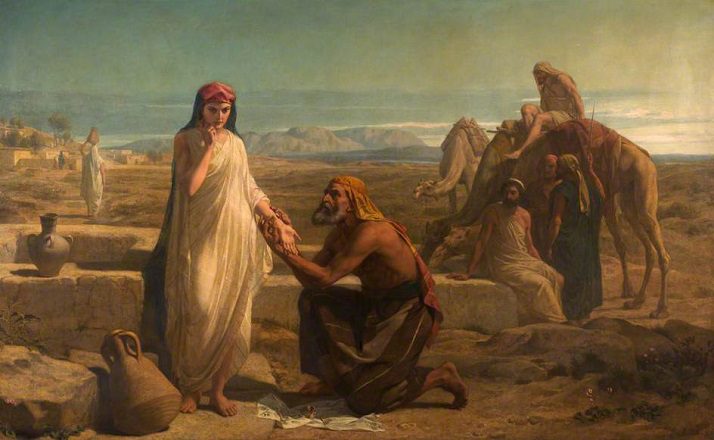
Even before I had finished praying, Rebekah came by with a water jar on her shoulder. When she had filled the jar, I asked her for a drink. She quickly lowered the jar from her shoulder and said, “Have a drink. Then I’ll get water for your camels.” So I drank, and after that she got some water for my camels. I asked her who her father was, and she answered, “My father is Bethuel the son of Nahor and Milcah.” At once I put the ring in her nose and the bracelets on her arms. Then I bowed my head and gave thanks to the God my master Abraham worships. The Lord had led me straight to my master’s relatives, and I had found a wife for his son.

Now please tell me if you are willing to do the right thing for my master. Will you treat him fairly, or do I have to look for another young woman? [Genesis 24:45-49, CEV]

Now that’s what happened. You see, with his focus narrowed and his vision sharpened, now he was able to see God at work, pointing him toward the woman who would be the mother of the next patriarch, you know, the son of Isaac. And finally, he was able to do what he’d been instructed to do, you know, to find this matchless match for his master’s son. Now, that’s the story in a nutshell.

And I’ve got to tell y’all, I really think this speaks to us right here and right now. For example, just like the servant, we face tough situations in our lives, don’t we? Even though I doubt that any of us will ever be told to find a spouse for our boss, often the kind of stuff we face is far more personal and frankly far more difficult. But you know, even though the details may be different, I believe the feelings those situations may trigger are pretty much the same. For example, I think we can also feel overwhelmed, not unlike what Job felt when he said this to God: 

I am sick of life!
And from my deep despair,
    I complain to you, my God.
Don’t just condemn me!
    Point out my sin.
Why do you take such delight
in destroying those you created
    and in smiling on sinners?
Do you look at things
    the way we humans do? [Job 10:1-4, CEV]

I’ll tell you, I think it’s easy to become overwhelmed, just like it’s easy to also feel confused, and I’m talking about confused as to why this is happening and what we should do about it, something that the prophet Habakkuk must have experienced when he approached God with this:

Our Lord, how long must I beg
for your help
    before you listen?
How long before you save us
    from all this violence?
Why do you make me watch
    such terrible injustice?
Why do you allow violence,
lawlessness, crime, and cruelty
    to spread everywhere?
Laws cannot be enforced;
    justice is always the loser;
criminals crowd out honest people
    and twist the laws around. [Habakkuk 10:2-4, CEV]

You see, whether it involves a concern for ourselves or for others, an issue that’s physical or emotional, enduring a painful loss or an unexpected burden, I think, from time to time, we all face tough situations.

But you know, when that happens, I think we can do the exact same thing the servant did. You see, like him, we can pray. We can bundle up all those concerns and those issues, all the losses and the burdens, I’m talking about all that stuff that overwhelms and confuses, and we can take them to God. And I’ll tell you, when we do that, when we decide to approach him with all our problems and pain, I think we’re going to find that our focus will narrow. As a matter of fact, I believe it’ll zero in like a laser beam on the same one to whom Abraham’s servant directed his prayers and the psalmist directed his when he prayed,

I come to you, Lord,
for protection.
    Don’t let me be ashamed.
Do as you have promised
    and rescue me.
Listen to my prayer
    and hurry to save me.
Be my mighty rock 
and the fortress
    where I am safe.

You, Lord God,
are my mighty rock
    and my fortress.
Lead me and guide me,
so that your name
    will be honored.
Protect me from hidden traps
    and keep me safe.
You are faithful,
and I trust you
    because you rescued me. [Psalm 31:1-5, CEV]

You see, when we make the decision to approach God in prayer, I think we’ll find that our focus won’t be scattered all over the place, instead, it’ll be narrowed to the one who can offer help. But that’s not all that’ll happen. I’ll tell you, as our focus narrows, I also believe our vision will sharpen. You see, as we talk with God, I think we’ll find a sense of clarity we may have lacked before. In other words, we’ll have a better understanding of where we need to be and how we might get there, a place that I believe the Apostle Paul reached when he wrote this to the Philippians:

I pray that your love will keep on growing and you will fully know and understand how to make the right choices. Then you will still be pure and innocent when Christ returns. And until that day, Jesus Christ will keep you busy doing good deeds that bring glory and praise to God. [Philippians 1:9-10, CEV]

You see, as we face tough situations, I think our focus can narrow and our vision can sharpen.  Man, this can happen when we pray.

And I’ll tell you, the reason for doing this is just as important for us as it was for Abraham’s servant. You see, I believe the focus and vision that we receive when we pray enables us to move forward and to confront all those overwhelming and confusing situations we face. For example, as it did for the servant, prayer opens our eyes so that we can see God at work, actively moving in our world. And even though it may not always be in the way we expect or even want, God’s presence can be just as real for us as it was for him. As Paul wrote to the Romans,

All of our thoughts are known to God. He can understand what is in the mind of the Spirit, as the Spirit prays for God’s people. We know that God is always at work for the good of everyone who loves him. They are the ones God has chosen for his purpose, and he has always known who his chosen ones would be. He had decided to let them become like his own Son, so his Son would be the first of many children. [Romans 8:27-29, CEV]

I believe that’s going to happen. And you know, because we’ll be able to see God working all around us, we’ll also be able to do what God has called us to do. In other words, regardless of what we might be facing, prayer enables us to face those situations as people who are filled with that same Spirit. Again, according to Paul, this time in his letter to the Galatians:

God’s Spirit makes us loving, happy, peaceful, patient, kind, good, faithful, gentle, and self-controlled. There is no law against behaving in any of these ways. [Galatians 5:22-23, CEV]

You see, I believe this is going to happen, when we pray. I mean, just like it did for Abraham’s servant, we’ll be able to move forward.

As I said a little while ago, over the last few weeks, I think I’ve come to a new appreciation of prayer, but not as a way to change God’s mind; rather, as an offering that helps us better understand and accept God’s will. And I think we can see that reflected in the story we read this morning. You see, as we consider what the servant faced and what he did and what happened at the end, I think we’re actually a lot like him. I mean, we also face tough situations, situations that feel both overwhelming and confusing. And in the face of those situations, we can also pray, something that will narrow our focus and sharpen our vision. And finally, with that focus and vision, we’ll be able to move forward, because prayer enables us to see God at work and to do what he’s called us to do. Now I think this is what prayer offered then and offers now. And we can believe this because we’ve heard the story of Abraham’s servant finding Isaac a wife.

Wednesday, April 26, 2023

In the Beginning: A Journey through Genesis - Isaac and Rebekah (Genesis 24:1 – 25:18)

The Book of Genesis establishes the foundation on which the Bible rests. It offers us insight into the nature of both God and humanity, and it begins a story of promise and hope that will culminate in the coming of Jesus. Over sixteen weeks, we’ll study the Genesis, focusing on the following:

During our ninth discussion in this series, we looked at Genesis 24:1 – 25:18. The passage is below:

Genesis 24:1 – 25:18

Now Abraham was old, well advanced in years; and the Lord had blessed Abraham in all things. Abraham said to his servant, the oldest of his house, who had charge of all that he had, “Put your hand under my thigh and I will make you swear by the Lord, the God of heaven and earth, that you will not get a wife for my son from the daughters of the Canaanites, among whom I live, but will go to my country and to my kindred and get a wife for my son Isaac.” The servant said to him, “Perhaps the woman may not be willing to follow me to this land; must I then take your son back to the land from which you came?” Abraham said to him, “See to it that you do not take my son back there. The Lord, the God of heaven, who took me from my father’s house and from the land of my birth, and who spoke to me and swore to me, ‘To your offspring I will give this land,’ he will send his angel before you, and you shall take a wife for my son from there. But if the woman is not willing to follow you, then you will be free from this oath of mine; only you must not take my son back there.” So the servant put his hand under the thigh of Abraham his master and swore to him concerning this matter.

Then the servant took ten of his master’s camels and departed, taking all kinds of choice gifts from his master; and he set out and went to Aram-naharaim, to the city of Nahor. He made the camels kneel down outside the city by the well of water; it was toward evening, the time when women go out to draw water. And he said, “O Lord, God of my master Abraham, please grant me success today and show steadfast love to my master Abraham. I am standing here by the spring of water, and the daughters of the townspeople are coming out to draw water. Let the girl to whom I shall say, ‘Please offer your jar that I may drink,’ and who shall say, ‘Drink, and I will water your camels’ —let her be the one whom you have appointed for your servant Isaac. By this I shall know that you have shown steadfast love to my master.” Before he had finished speaking, there was Rebekah, who was born to Bethuel son of Milcah, the wife of Nahor, Abraham’s brother, coming out with her water jar on her shoulder. The girl was very fair to look upon, a virgin, whom no man had known. She went down to the spring, filled her jar, and came up. Then the servant ran to meet her and said, “Please let me sip a little water from your jar.” “Drink, my lord,” she said, and quickly lowered her jar upon her hand and gave him a drink. When she had finished giving him a drink, she said, “I will draw for your camels also, until they have finished drinking.” So she quickly emptied her jar into the trough and ran again to the well to draw, and she drew for all his camels. The man gazed at her in silence to learn whether or not the Lord had made his journey successful. When the camels had finished drinking, the man took a gold nose-ring weighing a half shekel, and two bracelets for her arms weighing ten gold shekels, and said, “Tell me whose daughter you are. Is there room in your father’s house for us to spend the night?” She said to him, “I am the daughter of Bethuel son of Milcah, whom she bore to Nahor.” She added, “We have plenty of straw and fodder and a place to spend the night.” The man bowed his head and worshiped the Lord and said, “Blessed be the Lord, the God of my master Abraham, who has not forsaken his steadfast love and his faithfulness toward my master. As for me, the Lord has led me on the way to the house of my master’s kin.” Then the girl ran and told her mother’s household about these things.

Rebekah had a brother whose name was Laban; and Laban ran out to the man, to the spring. As soon as he had seen the nose-ring, and the bracelets on his sister’s arms, and when he heard the words of his sister Rebekah, “Thus the man spoke to me,” he went to the man; and there he was, standing by the camels at the spring. He said, “Come in, O blessed of the Lord. Why do you stand outside when I have prepared the house and a place for the camels?” So the man came into the house; and Laban unloaded the camels, and gave him straw and fodder for the camels, and water to wash his feet and the feet of the men who were with him. Then food was set before him to eat; but he said, “I will not eat until I have told my errand.” He said, “Speak on.” So he said, “I am Abraham’s servant. The Lord has greatly blessed my master, and he has become wealthy; he has given him flocks and herds, silver and gold, male and female slaves, camels and donkeys. And Sarah my master’s wife bore a son to my master when she was old; and he has given him all that he has. My master made me swear, saying, ‘You shall not take a wife for my son from the daughters of the Canaanites, in whose land I live; but you shall go to my father’s house, to my kindred, and get a wife for my son.’ I said to my master, ‘Perhaps the woman will not follow me.’ But he said to me, ‘The Lord, before whom I walk, will send his angel with you and make your way successful. You shall get a wife for my son from my kindred, from my father’s house. Then you will be free from my oath, when you come to my kindred; even if they will not give her to you, you will be free from my oath.’ “I came today to the spring, and said, ‘O Lord, the God of my master Abraham, if now you will only make successful the way I am going! I am standing here by the spring of water; let the young woman who comes out to draw, to whom I shall say, “Please give me a little water from your jar to drink,” and who will say to me, “Drink, and I will draw for your camels also” —let her be the woman whom the Lord has appointed for my master’s son.’ “Before I had finished speaking in my heart, there was Rebekah coming out with her water jar on her shoulder; and she went down to the spring, and drew. I said to her, ‘Please let me drink.’ She quickly let down her jar from her shoulder, and said, ‘Drink, and I will also water your camels.’ So I drank, and she also watered the camels. Then I asked her, ‘Whose daughter are you?’ She said, ‘The daughter of Bethuel, Nahor’s son, whom Milcah bore to him.’ So I put the ring on her nose, and the bracelets on her arms. Then I bowed my head and worshiped the Lord, and blessed the Lord, the God of my master Abraham, who had led me by the right way to obtain the daughter of my master’s kinsman for his son. Now then, if you will deal loyally and truly with my master, tell me; and if not, tell me, so that I may turn either to the right hand or to the left.” Then Laban and Bethuel answered, “The thing comes from the Lord; we cannot speak to you anything bad or good. Look, Rebekah is before you, take her and go, and let her be the wife of your master’s son, as the Lord has spoken.” When Abraham’s servant heard their words, he bowed himself to the ground before the Lord. And the servant brought out jewelry of silver and of gold, and garments, and gave them to Rebekah; he also gave to her brother and to her mother costly ornaments.

Then he and the men who were with him ate and drank, and they spent the night there. When they rose in the morning, he said, “Send me back to my master.” Her brother and her mother said, “Let the girl remain with us a while, at least ten days; after that she may go.” But he said to them, “Do not delay me, since the Lord has made my journey successful; let me go that I may go to my master.” They said, “We will call the girl, and ask her.” And they called Rebekah, and said to her, “Will you go with this man?” She said, “I will.” So they sent away their sister Rebekah and her nurse along with Abraham’s servant and his men. And they blessed Rebekah and said to her, “May you, our sister, become thousands of myriads; may your offspring gain possession of the gates of their foes.” Then Rebekah and her maids rose up, mounted the camels, and followed the man; thus the servant took Rebekah, and went his way.

Now Isaac had come from Beer-lahai-roi, and was settled in the Negeb. Isaac went out in the evening to walk in the field; and looking up, he saw camels coming. And Rebekah looked up, and when she saw Isaac, she slipped quickly from the camel, and said to the servant, “Who is the man over there, walking in the field to meet us?” The servant said, “It is my master.” So she took her veil and covered herself. And the servant told Isaac all the things that he had done. Then Isaac brought her into his mother Sarah’s tent. He took Rebekah, and she became his wife; and he loved her. So Isaac was comforted after his mother’s death.

Abraham took another wife, whose name was Keturah. She bore him Zimran, Jokshan, Medan, Midian, Ishbak, and Shuah. Jokshan was the father of Sheba and Dedan. The sons of Dedan were Asshurim, Letushim, and Leummim. The sons of Midian were Ephah, Epher, Hanoch, Abida, and Eldaah. All these were the children of Keturah. Abraham gave all he had to Isaac. But to the sons of his concubines Abraham gave gifts, while he was still living, and he sent them away from his son Isaac, eastward to the east country. This is the length of Abraham’s life, one hundred seventy-five years. Abraham breathed his last and died in a good old age, an old man and full of years, and was gathered to his people. His sons Isaac and Ishmael buried him in the cave of Machpelah, in the field of Ephron son of Zohar the Hittite, east of Mamre, the field that Abraham purchased from the Hittites. There Abraham was buried, with his wife Sarah.

After the death of Abraham God blessed his son Isaac. And Isaac settled at Beer-lahai-roi. These are the descendants of Ishmael, Abraham’s son, whom Hagar the Egyptian, Sarah’s slave-girl, bore to Abraham. These are the names of the sons of Ishmael, named in the order of their birth: Nebaioth, the firstborn of Ishmael; and Kedar, Adbeel, Mibsam, Mishma, Dumah, Massa, Hadad, Tema, Jetur, Naphish, and Kedemah. These are the sons of Ishmael and these are their names, by their villages and by their encampments, twelve princes according to their tribes. (This is the length of the life of Ishmael, one hundred thirty-seven years; he breathed his last and died, and was gathered to his people.) They settled from Havilah to Shur, which is opposite Egypt in the direction of Assyria; he settled down alongside of all his people.

Bible Readings for September 5, 2026

Study, Learn and Grow: Bible Readings for September 5, 2026 : Let's read the Bible together in the next year. Today, our passages are ...