In this blog, we'll focus on the working being done at Sligo Presbyterian Church, Sligo, Pennsylvania. We'll also look at what's happening in Sligo, Rimersburg, Clarion, and all the other communities served by our congregation.
Jesus left the temple and was walking away when his disciples came up to him to call his attention to its buildings. “Do you see all these things?” he asked. “Truly I tell you, not one stone here will be left on another; every one will be thrown down.”
As Jesus was sitting on the Mount of Olives, the disciples came to him privately. “Tell us,” they said, “when will this happen, and what will be the sign of your coming and of the end of the age?”
Jesus answered: “Watch out that no one deceives you. For many will come in my name, claiming, ‘I am the Messiah,’ and will deceive many. You will hear of wars and rumors of wars, but see to it that you are not alarmed. Such things must happen, but the end is still to come. Nation will rise against nation, and kingdom against kingdom. There will be famines and earthquakes in various places. All these are the beginning of birth pains.
“Then you will be handed over to be persecuted and put to death, and you will be hated by all nations because of me. At that time many will turn away from the faith and will betray and hate each other, and many false prophets will appear and deceive many people. Because of the increase of wickedness, the love of most will grow cold, but the one who stands firm to the end will be saved. And this gospel of the kingdom will be preached in the whole world as a testimony to all nations, and then the end will come.
Every year Jesus’ parents went to Jerusalem for the Festival of the Passover. When he was twelve years old, they went up to the festival, according to the custom. After the festival was over, while his parents were returning home, the boy Jesus stayed behind in Jerusalem, but they were unaware of it. Thinking he was in their company, they traveled on for a day. Then they began looking for him among their relatives and friends. When they did not find him, they went back to Jerusalem to look for him. After three days they found him in the temple courts, sitting among the teachers, listening to them and asking them questions. Everyone who heard him was amazed at his understanding and his answers. When his parents saw him, they were astonished. His mother said to him, “Son, why have you treated us like this? Your father and I have been anxiously searching for you.”
“Why were you searching for me?” he asked. “Didn’t you know I had to be in my Father’s house?” But they did not understand what he was saying to them.
Then he went down to Nazareth with them and was obedient to them. But his mother treasured all these things in her heart. And Jesus grew in wisdom and stature, and in favor with God and man.
According to the Second Book of the Kings, the Babylonians conquered the city of David and moved the people of Judah into captivity. But that’s not the end of the story. Under the leadership of Ezra and Nehemiah, God led his people from their exile, back to the Promised Land. To better understand this wonderful story of renewal and restoration, we’ll follow the outline below:
Session 7 - The People Renewed (Nehemiah 7:4–10:39)
Session 8 - The Community Restored (Nehemiah 11:1–13:31)
During our second session, we discussed the restoration of the Temple (Ezra 5:1–6:22). Below is a recording of our discussion and the passage we discussed.
Now the prophets, Haggai and Zechariah son of Iddo, prophesied to the Jews who were in Judah and Jerusalem, in the name of the God of Israel who was over them. Then Zerubbabel son of Shealtiel and Jeshua son of Jozadak set out to rebuild the house of God in Jerusalem; and with them were the prophets of God, helping them.
At the same time Tattenai the governor of the province Beyond the River and Shethar-bozenai and their associates came to them and spoke to them thus, “Who gave you a decree to build this house and to finish this structure?” They also asked them this, “What are the names of the men who are building this building?” But the eye of their God was upon the elders of the Jews, and they did not stop them until a report reached Darius and then answer was returned by letter in reply to it. The copy of the letter that Tattenai the governor of the province Beyond the River and Shethar-bozenai and his associates the envoys who were in the province Beyond the River sent to King Darius; they sent him a report, in which was written as follows: “To Darius the king, all peace! May it be known to the king that we went to the province of Judah, to the house of the great God. It is being built of hewn stone, and timber is laid in the walls; this work is being done diligently and prospers in their hands. Then we spoke to those elders and asked them, ‘Who gave you a decree to build this house and to finish this structure?’ We also asked them their names, for your information, so that we might write down the names of the men at their head. This was their reply to us: ‘We are the servants of the God of heaven and earth, and we are rebuilding the house that was built many years ago, which a great king of Israel built and finished. But because our ancestors had angered the God of heaven, he gave them into the hand of King Nebuchadnezzar of Babylon, the Chaldean, who destroyed this house and carried away the people to Babylonia. However, King Cyrus of Babylon, in the first year of his reign, made a decree that this house of God should be rebuilt. Moreover, the gold and silver vessels of the house of God, which Nebuchadnezzar had taken out of the temple in Jerusalem and had brought into the temple of Babylon, these King Cyrus took out of the temple of Babylon, and they were delivered to a man named Sheshbazzar, whom he had made governor. He said to him, “Take these vessels; go and put them in the temple in Jerusalem, and let the house of God be rebuilt on its site.” Then this Sheshbazzar came and laid the foundations of the house of God in Jerusalem; and from that time until now it has been under construction, and it is not yet finished.’ And now, if it seems good to the king, have a search made in the royal archives there in Babylon, to see whether a decree was issued by King Cyrus for the rebuilding of this house of God in Jerusalem. Let the king send us his pleasure in this matter.”
Then King Darius made a decree, and they searched the archives where the documents were stored in Babylon. But it was in Ecbatana, the capital in the province of Media, that a scroll was found on which this was written: “A record. In the first year of his reign, King Cyrus issued a decree: Concerning the house of God at Jerusalem, let the house be rebuilt, the place where sacrifices are offered and burnt offerings are brought; its height shall be sixty cubits and its width sixty cubits, with three courses of hewn stones and one course of timber; let the cost be paid from the royal treasury. Moreover, let the gold and silver vessels of the house of God, which Nebuchadnezzar took out of the temple in Jerusalem and brought to Babylon, be restored and brought back to the temple in Jerusalem, each to its place; you shall put them in the house of God.” “Now you, Tattenai, governor of the province Beyond the River, Shethar-bozenai, and you, their associates, the envoys in the province Beyond the River, keep away; let the work on this house of God alone; let the governor of the Jews and the elders of the Jews rebuild this house of God on its site. Moreover I make a decree regarding what you shall do for these elders of the Jews for the rebuilding of this house of God: the cost is to be paid to these people, in full and without delay, from the royal revenue, the tribute of the province Beyond the River. Whatever is needed—young bulls, rams, or sheep for burnt offerings to the God of heaven, wheat, salt, wine, or oil, as the priests in Jerusalem require—let that be given to them day by day without fail, so that they may offer pleasing sacrifices to the God of heaven, and pray for the life of the king and his children. Furthermore I decree that if anyone alters this edict, a beam shall be pulled out of the house of the perpetrator, who then shall be impaled on it. The house shall be made a dunghill. May the God who has established his name there overthrow any king or people that shall put forth a hand to alter this, or to destroy this house of God in Jerusalem. I, Darius, make a decree; let it be done with all diligence.”
Then, according to the word sent by King Darius, Tattenai, the governor of the province Beyond the River, Shethar-bozenai, and their associates did with all diligence what King Darius had ordered. So the elders of the Jews built and prospered, through the prophesying of the prophet Haggai and Zechariah son of Iddo. They finished their building by command of the God of Israel and by decree of Cyrus, Darius, and King Artaxerxes of Persia; and this house was finished on the third day of the month of Adar, in the sixth year of the reign of King Darius. The people of Israel, the priests and the Levites, and the rest of the returned exiles, celebrated the dedication of this house of God with joy. They offered at the dedication of this house of God one hundred bulls, two hundred rams, four hundred lambs, and as a sin offering for all Israel, twelve male goats, according to the number of the tribes of Israel. Then they set the priests in their divisions and the Levites in their courses for the service of God at Jerusalem, as it is written in the book of Moses. On the fourteenth day of the first month the returned exiles kept the passover. For both the priests and the Levites had purified themselves; all of them were clean. So they killed the passover lamb for all the returned exiles, for their fellow priests, and for themselves. It was eaten by the people of Israel who had returned from exile, and also by all who had joined them and separated themselves from the pollutions of the nations of the land to worship the Lord, the God of Israel. With joy they celebrated the festival of unleavened bread seven days; for the Lord had made them joyful, and had turned the heart of the king of Assyria to them, so that he aided them in the work on the house of God, the God of Israel.
As we enter the narrative offered in the books of the Kings, the nation of Israel is at the peak of its power and influence. By the end of the story, the children of God have become a captive people, living far from the land promised to Abraham, conquered by Joshua and ruled by David. Join us as we explore Israel’s decline and fall and God’s relationship with his rebellious children. During this series, we’ll consider the following:
Session 10 - Elisha’s Life and Ministry (2 Kings 3:1–5:27)
Session 11 - Elisha and the King (2 Kings 6:1–8:29)
Session 12 - Jehu and Joash (2 Kings 9:1–12:21)
Session 13 - The Dynasty of Jehu (2 Kings 13:1–15:7)
Session 14 - The Fall of Israel (2 Kings 15:8–17:41)
Session 15 - Hezekiah and Manasseh (2 Kings 18:1–21:26)
Session 16 - The Josianic Reformation (2 Kings 22:1–23:30)
Session 17 - The End (2 Kings 23:31–25:30)
During our third session, we discussed Solomon's Temple (1 Kings 6:1–8:66). Below is a recording of our discussion and the passage we discussed.
1 Kings 6:1–8:66 [New Revised Standard Version]
In the four hundred eightieth year after the Israelites came out of the land of Egypt, in the fourth year of Solomon’s reign over Israel, in the month of Ziv, which is the second month, he began to build the house of the Lord. The house that King Solomon built for the Lord was sixty cubits long, twenty cubits wide, and thirty cubits high. The vestibule in front of the nave of the house was twenty cubits wide, across the width of the house. Its depth was ten cubits in front of the house. For the house he made windows with recessed frames. He also built a structure against the wall of the house, running around the walls of the house, both the nave and the inner sanctuary; and he made side chambers all around. The lowest story was five cubits wide, the middle one was six cubits wide, and the third was seven cubits wide; for around the outside of the house he made offsets on the wall in order that the supporting beams should not be inserted into the walls of the house. The house was built with stone finished at the quarry, so that neither hammer nor ax nor any tool of iron was heard in the temple while it was being built. The entrance for the middle story was on the south side of the house: one went up by winding stairs to the middle story, and from the middle story to the third. So he built the house, and finished it; he roofed the house with beams and planks of cedar. He built the structure against the whole house, each story five cubits high, and it was joined to the house with timbers of cedar.
Now the word of the Lord came to Solomon, “Concerning this house that you are building, if you will walk in my statutes, obey my ordinances, and keep all my commandments by walking in them, then I will establish my promise with you, which I made to your father David. I will dwell among the children of Israel, and will not forsake my people Israel.” So Solomon built the house, and finished it.
He lined the walls of the house on the inside with boards of cedar; from the floor of the house to the rafters of the ceiling, he covered them on the inside with wood; and he covered the floor of the house with boards of cypress. He built twenty cubits of the rear of the house with boards of cedar from the floor to the rafters, and he built this within as an inner sanctuary, as the most holy place. The house, that is, the nave in front of the inner sanctuary, was forty cubits long. The cedar within the house had carvings of gourds and open flowers; all was cedar, no stone was seen. The inner sanctuary he prepared in the innermost part of the house, to set there the ark of the covenant of the Lord. The interior of the inner sanctuary was twenty cubits long, twenty cubits wide, and twenty cubits high; he overlaid it with pure gold. He also overlaid the altar with cedar. Solomon overlaid the inside of the house with pure gold, then he drew chains of gold across, in front of the inner sanctuary, and overlaid it with gold. Next he overlaid the whole house with gold, in order that the whole house might be perfect; even the whole altar that belonged to the inner sanctuary he overlaid with gold. In the inner sanctuary he made two cherubim of olivewood, each ten cubits high. Five cubits was the length of one wing of the cherub, and five cubits the length of the other wing of the cherub; it was ten cubits from the tip of one wing to the tip of the other. The other cherub also measured ten cubits; both cherubim had the same measure and the same form. The height of one cherub was ten cubits, and so was that of the other cherub. He put the cherubim in the innermost part of the house; the wings of the cherubim were spread out so that a wing of one was touching the one wall, and a wing of the other cherub was touching the other wall; their other wings toward the center of the house were touching wing to wing. He also overlaid the cherubim with gold. He carved the walls of the house all around about with carved engravings of cherubim, palm trees, and open flowers, in the inner and outer rooms. The floor of the house he overlaid with gold, in the inner and outer rooms. For the entrance to the inner sanctuary he made doors of olivewood; the lintel and the doorposts were five-sided. He covered the two doors of olivewood with carvings of cherubim, palm trees, and open flowers; he overlaid them with gold, and spread gold on the cherubim and on the palm trees. So also he made for the entrance to the nave doorposts of olivewood, four-sided each, and two doors of cypress wood; the two leaves of the one door were folding, and the two leaves of the other door were folding. He carved cherubim, palm trees, and open flowers, overlaying them with gold evenly applied upon the carved work. He built the inner court with three courses of dressed stone to one course of cedar beams. In the fourth year the foundation of the house of the Lord was laid, in the month of Ziv. In the eleventh year, in the month of Bul, which is the eighth month, the house was finished in all its parts, and according to all its specifications. He was seven years in building it.
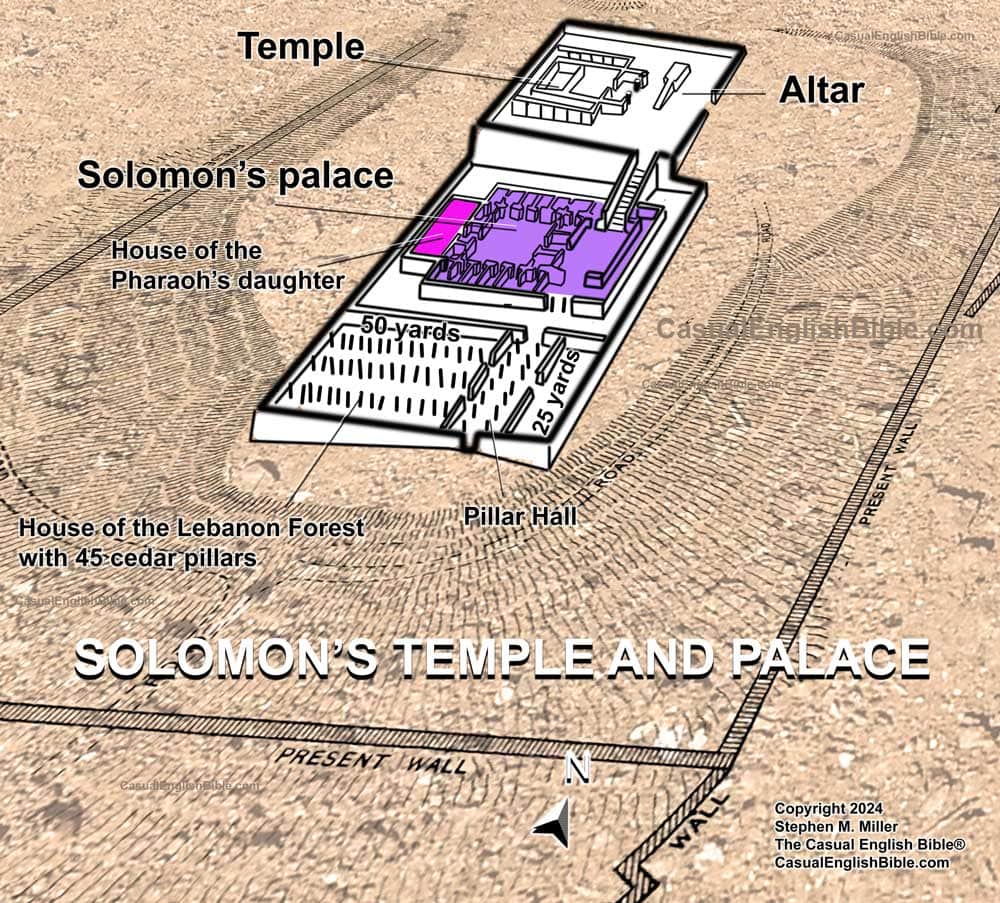
Solomon was building his own house thirteen years, and he finished his entire house. He built the House of the Forest of the Lebanon one hundred cubits long, fifty cubits wide, and thirty cubits high, built on four rows of cedar pillars, with cedar beams on the pillars. It was roofed with cedar on the forty-five rafters, fifteen in each row, which were on the pillars. There were window frames in the three rows, facing each other in the three rows. All the doorways and doorposts had four-sided frames, opposite, facing each other in the three rows. He made the Hall of Pillars fifty cubits long and thirty cubits wide. There was a porch in front with pillars, and a canopy in front of them. He made the Hall of the Throne where he was to pronounce judgment, the Hall of Justice, covered with cedar from floor to floor. His own house where he would reside, in the other court back of the hall, was of the same construction. Solomon also made a house like this hall for Pharaoh’s daughter, whom he had taken in marriage. All these were made of costly stones, cut according to measure, sawed with saws, back and front, from the foundation to the coping, and from outside to the great court. The foundation was of costly stones, huge stones, stones of eight and ten cubits. There were costly stones above, cut to measure, and cedarwood. The great court had three courses of dressed stone to one layer of cedar beams all around; so had the inner court of the house of the Lord, and the vestibule of the house.
Now King Solomon invited and received Hiram from Tyre. He was the son of a widow of the tribe of Naphtali, whose father, a man of Tyre, had been an artisan in bronze; he was full of skill, intelligence, and knowledge in working bronze. He came to King Solomon, and did all his work. He cast two pillars of bronze. Eighteen cubits was the height of the one, and a cord of twelve cubits would encircle it; the second pillar was the same. He also made two capitals of molten bronze, to set on the tops of the pillars; the height of the one capital was five cubits, and the height of the other capital was five cubits. There were nets of checker work with wreaths of chain work for the capitals on the tops of the pillars; seven for the one capital, and seven for the other capital. He made the columns with two rows around each latticework to cover the capitals that were above the pomegranates; he did the same with the other capital. Now the capitals that were on the tops of the pillars in the vestibule were of lily-work, four cubits high. The capitals were on the two pillars and also above the rounded projection that was beside the latticework; there were two hundred pomegranates in rows all around; and so with the other capital. He set up the pillars at the vestibule of the temple; he set up the pillar on the south and called it Jachin; and he set up the pillar on the north and called it Boaz. On the tops of the pillars was lily-work. Thus the work of the pillars was finished. Then he made the molten sea; it was round, ten cubits from brim to brim, and five cubits high. A line of thirty cubits would encircle it completely. Under its brim were panels all around it, each of ten cubits, surrounding the sea; there were two rows of panels, cast when it was cast. It stood on twelve oxen, three facing north, three facing west, three facing south, and three facing east; the sea was set on them. The hindquarters of each were toward the inside. Its thickness was a handbreadth; its brim was made like the brim of a cup, like the flower of a lily; it held two thousand baths. He also made the ten stands of bronze; each stand was four cubits long, four cubits wide, and three cubits high. This was the construction of the stands: they had borders; the borders were within the frames; on the borders that were set in the frames were lions, oxen, and cherubim. On the frames, both above and below the lions and oxen, there were wreaths of beveled work. Each stand had four bronze wheels and axles of bronze; at the four corners were supports for a basin. The supports were cast with wreaths at the side of each. Its opening was within the crown whose height was one cubit; its opening was round, as a pedestal is made; it was a cubit and a half wide. At its opening there were carvings; its borders were four-sided, not round. The four wheels were underneath the borders; the axles of the wheels were in the stands; and the height of a wheel was a cubit and a half. The wheels were made like a chariot wheel; their axles, their rims, their spokes, and their hubs were all cast. There were four supports at the four corners of each stand; the supports were of one piece with the stands. On the top of the stand there was a round band half a cubit high; on the top of the stand, its stays and its borders were of one piece with it. On the surfaces of its stays and on its borders he carved cherubim, lions, and palm trees, where each had space, with wreaths all around. In this way he made the ten stands; all of them were cast alike, with the same size and the same form. He made ten basins of bronze; each basin held forty baths, each basin measured four cubits; there was a basin for each of the ten stands. He set five of the stands on the south side of the house, and five on the north side of the house; he set the sea on the southeast corner of the house. Hiram also made the pots, the shovels, and the basins. So Hiram finished all the work that he did for King Solomon on the house of the Lord: the two pillars, the two bowls of the capitals that were on the tops of the pillars, the two latticeworks to cover the two bowls of the capitals that were on the tops of the pillars; the four hundred pomegranates for the two latticeworks, two rows of pomegranates for each latticework, to cover the two bowls of the capitals that were on the pillars; the ten stands, the ten basins on the stands; the one sea, and the twelve oxen underneath the sea. The pots, the shovels, and the basins, all these vessels that Hiram made for King Solomon for the house of the Lord were of burnished bronze. In the plain of the Jordan the king cast them, in the clay ground between Succoth and Zarethan. Solomon left all the vessels unweighed, because there were so many of them; the weight of the bronze was not determined.
So Solomon made all the vessels that were in the house of the Lord: the golden altar, the golden table for the bread of the Presence, the lampstands of pure gold, five on the south side and five on the north, in front of the inner sanctuary; the flowers, the lamps, and the tongs, of gold; the cups, snuffers, basins, dishes for incense, and firepans, of pure gold; the sockets for the doors of the innermost part of the house, the most holy place, and for the doors of the nave of the temple, of gold. Thus all the work that King Solomon did on the house of the Lord was finished. Solomon brought in the things that his father David had dedicated, the silver, the gold, and the vessels, and stored them in the treasuries of the house of the Lord.
Then Solomon assembled the elders of Israel and all the heads of the tribes, the leaders of the ancestral houses of the Israelites, before King Solomon in Jerusalem, to bring up the ark of the covenant of the Lord out of the city of David, which is Zion. All the people of Israel assembled to King Solomon at the festival in the month Ethanim, which is the seventh month. And all the elders of Israel came, and the priests carried the ark. So they brought up the ark of the Lord, the tent of meeting, and all the holy vessels that were in the tent; the priests and the Levites brought them up. King Solomon and all the congregation of Israel, who had assembled before him, were with him before the ark, sacrificing so many sheep and oxen that they could not be counted or numbered. Then the priests brought the ark of the covenant of the Lord to its place, in the inner sanctuary of the house, in the most holy place, underneath the wings of the cherubim. For the cherubim spread out their wings over the place of the ark, so that the cherubim made a covering above the ark and its poles. The poles were so long that the ends of the poles were seen from the holy place in front of the inner sanctuary; but they could not be seen from outside; they are there to this day. There was nothing in the ark except the two tablets of stone that Moses had placed there at Horeb, where the Lord made a covenant with the Israelites, when they came out of the land of Egypt. And when the priests came out of the holy place, a cloud filled the house of the Lord, so that the priests could not stand to minister because of the cloud; for the glory of the Lord filled the house of the Lord.
Then Solomon said, “The Lord has said that he would dwell in thick darkness. I have built you an exalted house, a place for you to dwell in forever.” Then the king turned around and blessed all the assembly of Israel, while all the assembly of Israel stood. He said, “Blessed be the Lord, the God of Israel, who with his hand has fulfilled what he promised with his mouth to my father David, saying, ‘Since the day that I brought my people Israel out of Egypt, I have not chosen a city from any of the tribes of Israel in which to build a house, that my name might be there; but I chose David to be over my people Israel.’ My father David had it in mind to build a house for the name of the Lord, the God of Israel. But the Lord said to my father David, ‘You did well to consider building a house for my name; nevertheless you shall not build the house, but your son who shall be born to you shall build the house for my name.’ Now the Lord has upheld the promise that he made; for I have risen in the place of my father David; I sit on the throne of Israel, as the Lord promised, and have built the house for the name of the Lord, the God of Israel. There I have provided a place for the ark, in which is the covenant of the Lord that he made with our ancestors when he brought them out of the land of Egypt.”
Then Solomon stood before the altar of the Lord in the presence of all the assembly of Israel, and spread out his hands to heaven. He said, “O Lord, God of Israel, there is no God like you in heaven above or on earth beneath, keeping covenant and steadfast love for your servants who walk before you with all their heart, the covenant that you kept for your servant my father David as you declared to him; you promised with your mouth and have this day fulfilled with your hand. Therefore, O Lord, God of Israel, keep for your servant my father David that which you promised him, saying, ‘There shall never fail you a successor before me to sit on the throne of Israel, if only your children look to their way, to walk before me as you have walked before me.’ Therefore, O God of Israel, let your word be confirmed, which you promised to your servant my father David. “But will God indeed dwell on the earth? Even heaven and the highest heaven cannot contain you, much less this house that I have built! Regard your servant’s prayer and his plea, O Lord my God, heeding the cry and the prayer that your servant prays to you today; that your eyes may be open night and day toward this house, the place of which you said, ‘My name shall be there,’ that you may heed the prayer that your servant prays toward this place. Hear the plea of your servant and of your people Israel when they pray toward this place; O hear in heaven your dwelling place; heed and forgive. “If someone sins against a neighbor and is given an oath to swear, and comes and swears before your altar in this house, then hear in heaven, and act, and judge your servants, condemning the guilty by bringing their conduct on their own head, and vindicating the righteous by rewarding them according to their righteousness. “When your people Israel, having sinned against you, are defeated before an enemy but turn again to you, confess your name, pray and plead with you in this house, then hear in heaven, forgive the sin of your people Israel, and bring them again to the land that you gave to their ancestors. “When heaven is shut up and there is no rain because they have sinned against you, and then they pray toward this place, confess your name, and turn from their sin, because you punish them, then hear in heaven, and forgive the sin of your servants, your people Israel, when you teach them the good way in which they should walk; and grant rain on your land, which you have given to your people as an inheritance. “If there is famine in the land, if there is plague, blight, mildew, locust, or caterpillar; if their enemy besieges them in any of their cities; whatever plague, whatever sickness there is; whatever prayer, whatever plea there is from any individual or from all your people Israel, all knowing the afflictions of their own hearts so that they stretch out their hands toward this house; then hear in heaven your dwelling place, forgive, act, and render to all whose hearts you know—according to all their ways, for only you know what is in every human heart— so that they may fear you all the days that they live in the land that you gave to our ancestors. “Likewise when a foreigner, who is not of your people Israel, comes from a distant land because of your name —for they shall hear of your great name, your mighty hand, and your outstretched arm—when a foreigner comes and prays toward this house, then hear in heaven your dwelling place, and do according to all that the foreigner calls to you, so that all the peoples of the earth may know your name and fear you, as do your people Israel, and so that they may know that your name has been invoked on this house that I have built. “If your people go out to battle against their enemy, by whatever way you shall send them, and they pray to the Lord toward the city that you have chosen and the house that I have built for your name, then hear in heaven their prayer and their plea, and maintain their cause. “If they sin against you—for there is no one who does not sin—and you are angry with them and give them to an enemy, so that they are carried away captive to the land of the enemy, far off or near; yet if they come to their senses in the land to which they have been taken captive, and repent, and plead with you in the land of their captors, saying, ‘We have sinned, and have done wrong; we have acted wickedly’; if they repent with all their heart and soul in the land of their enemies, who took them captive, and pray to you toward their land, which you gave to their ancestors, the city that you have chosen, and the house that I have built for your name; then hear in heaven your dwelling place their prayer and their plea, maintain their cause and forgive your people who have sinned against you, and all their transgressions that they have committed against you; and grant them compassion in the sight of their captors, so that they may have compassion on them (for they are your people and heritage, which you brought out of Egypt, from the midst of the iron-smelter). Let your eyes be open to the plea of your servant, and to the plea of your people Israel, listening to them whenever they call to you. For you have separated them from among all the peoples of the earth, to be your heritage, just as you promised through Moses, your servant, when you brought our ancestors out of Egypt, O Lord God.”
Now when Solomon finished offering all this prayer and this plea to the Lord, he arose from facing the altar of the Lord, where he had knelt with hands outstretched toward heaven; he stood and blessed all the assembly of Israel with a loud voice: “Blessed be the Lord, who has given rest to his people Israel according to all that he promised; not one word has failed of all his good promise, which he spoke through his servant Moses. The Lord our God be with us, as he was with our ancestors; may he not leave us or abandon us, but incline our hearts to him, to walk in all his ways, and to keep his commandments, his statutes, and his ordinances, which he commanded our ancestors. Let these words of mine, with which I pleaded before the Lord, be near to the Lord our God day and night, and may he maintain the cause of his servant and the cause of his people Israel, as each day requires; so that all the peoples of the earth may know that the Lord is God; there is no other. Therefore devote yourselves completely to the Lord our God, walking in his statutes and keeping his commandments, as at this day.”
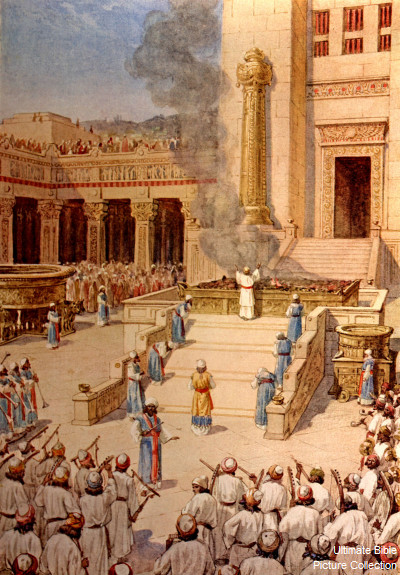
Then the king, and all Israel with him, offered sacrifice before the Lord. Solomon offered as sacrifices of well-being to the Lord twenty-two thousand oxen and one hundred twenty thousand sheep. So the king and all the people of Israel dedicated the house of the Lord. The same day the king consecrated the middle of the court that was in front of the house of the Lord; for there he offered the burnt offerings and the grain offerings and the fat pieces of the sacrifices of well-being, because the bronze altar that was before the Lord was too small to receive the burnt offerings and the grain offerings and the fat pieces of the sacrifices of well-being. So Solomon held the festival at that time, and all Israel with him—a great assembly, people from Lebo-hamath to the Wadi of Egypt—before the Lord our God, seven days. On the eighth day he sent the people away; and they blessed the king, and went to their tents, joyful and in good spirits because of all the goodness that the Lord had shown to his servant David and to his people Israel.


.jpg)