
- Session 1 - Mary, the Mother of Jesus
- Session 2 - John the Baptist
- Session 3 - Nicodemus
- Session 4 - Mary Magdalene
- Session 5 - Simon Peter (Part 1)
- Session 6 - Simon Peter (Part 2)
- Session 7 - Simon Peter (Part 3)
- Session 8 - Matthew and the Tax Collectors
- Session 9 - James, John, Thomas, Philip, and the Rest
- Session 10 - Judas
- Session 11 - The Scribes, Pharisees and Teachers of the Law
- Session 12 - The Herods
- Session 13 - Pilate and the Other Romans
- Session 14 - The Crowds
- Session 15 - The Rich Young Ruler and His Friends
In our tenth session, we looked at Judas Iscariot. A recording of our discussion and some of the passages we discussed are below.
Judas in Mark
- Mark 14:10: Then Judas Iscariot, who was one of the twelve, went to the chief priests in order to betray him to them.
- Mark 14:43-45: Immediately, while he was still speaking, Judas, one of the twelve, arrived, and with him there was a crowd with swords and clubs, from the chief priests, the scribes, and the elders. Now the betrayer had given them a sign, saying, “The one I will kiss is the man; arrest him and lead him away under guard.” So when he came, he went up to him at once and said, “Rabbi!” and kissed him.
Judas in Matthew
- Matthew 26:14-16: Then one of the twelve, who was called Judas Iscariot, went to the chief priests and said, “What will you give me if I betray him to you?” They paid him thirty pieces of silver. And from that moment he began to look for an opportunity to betray him.

- Matthew 26:24-25: The Son of Man goes as it is written of him, but woe to that one by whom the Son of Man is betrayed! It would have been better for that one not to have been born.” Judas, who betrayed him, said, “Surely not I, Rabbi?” He replied, “You have said so.”
- Matthew 26:47-50: While he was still speaking, Judas, one of the twelve, arrived; with him was a large crowd with swords and clubs, from the chief priests and the elders of the people. Now the betrayer had given them a sign, saying, “The one I will kiss is the man; arrest him.” At once he came up to Jesus and said, “Greetings, Rabbi!” and kissed him. Jesus said to him, “Friend, do what you are here to do.” Then they came and laid hands on Jesus and arrested him.
- Matthew 27:3-5: When Judas, his betrayer, saw that Jesus was condemned, he repented and brought back the thirty pieces of silver to the chief priests and the elders. He said, “I have sinned by betraying innocent blood.” But they said, “What is that to us? See to it yourself.” Throwing down the pieces of silver in the temple, he departed, and he went and hanged himself.
Judas in Luke & Acts
- Luke 22:3-6: Then Satan entered into Judas called Iscariot, who was one of the twelve; he went away and conferred with the chief priests and officers of the temple police about how he might betray him to them. They were greatly pleased and agreed to give him money. So he consented and began to look for an opportunity to betray him to them when no crowd was present.
- Luke 22:47-48: While he was still speaking, suddenly a crowd came, and the one called Judas, one of the twelve, was leading them. He approached Jesus to kiss him, but Jesus said to him, “Judas, is it with a kiss that you are betraying the Son of Man?”
- Acts 1-15-20: In those days Peter stood up among the brothers and sisters (together the crowd numbered about one hundred twenty persons) and said, “Brothers and sisters, the scripture had to be fulfilled, which the Holy Spirit through David foretold concerning Judas, who became a guide for those who arrested Jesus, for he was numbered among us and was allotted his share in this ministry.” (Now this man acquired a field with the reward of his wickedness, and falling headlong, he burst open in the middle, and all his bowels gushed out. This became known to all the residents of Jerusalem, so that the field was called in their language Hakeldama, that is, Field of Blood.) “For it is written in the book of Psalms,
‘Let his house become desolate,
and let there be no one to live in it’;
and
‘Let another take his position of overseer.’
Judas in John
- John 12:4-6: But Judas Iscariot, one of his disciples (the one who was about to betray him), said, “Why was this perfume not sold for three hundred denarii and the money given to the poor?” (He said this not because he cared about the poor but because he was a thief; he kept the common purse and used to steal what was put into it.)
- John 13:2a: The devil had already decided that Judas son of Simon Iscariot would betray Jesus.
- John 13:21-30: After saying this Jesus was troubled in spirit and declared, “Very truly, I tell you, one of you will betray me.” The disciples looked at one another, uncertain of whom he was speaking. One of his disciples—the one whom Jesus loved—was reclining close to his heart; Simon Peter therefore motioned to him to ask Jesus of whom he was speaking. So while reclining next to Jesus, he asked him, “Lord, who is it?” Jesus answered, “It is the one to whom I give this piece of bread when I have dipped it in the dish.” So when he had dipped the piece of bread, he gave it to Judas son of Simon Iscariot. After he received the piece of bread, Satan entered into him. Jesus said to him, “Do quickly what you are going to do.” Now no one knew why he said this to him. Some thought that, because Judas had the common purse, Jesus was telling him, “Buy what we need for the festival,” or that he should give something to the poor. So, after receiving the piece of bread, he immediately went out. And it was night.
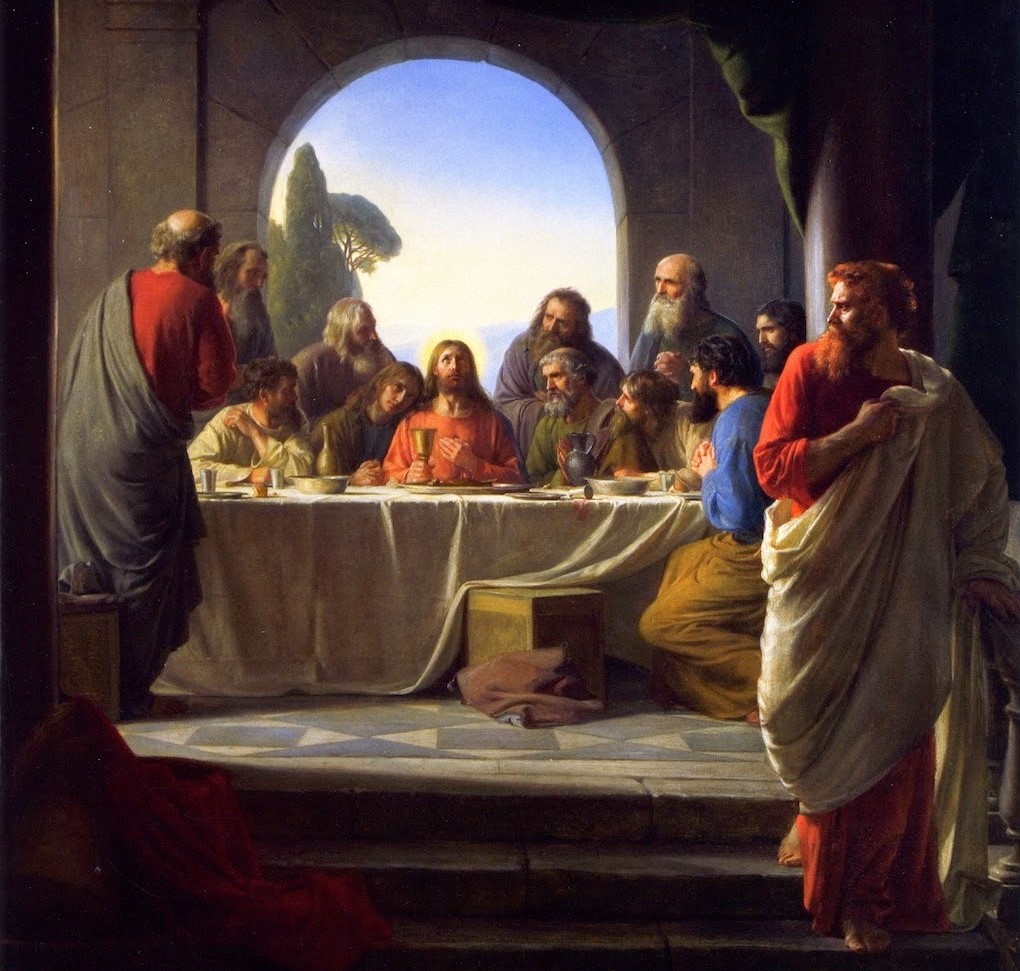
- John 18:1-9: After Jesus had spoken these words, he went out with his disciples across the Kidron Valley to a place where there was a garden, which he and his disciples entered. Now Judas, who betrayed him, also knew the place because Jesus often met there with his disciples. So Judas brought a detachment of soldiers together with police from the chief priests and the Pharisees, and they came there with lanterns and torches and weapons. Then Jesus, knowing all that was to happen to him, came forward and asked them, “Whom are you looking for?” They answered, “Jesus of Nazareth.” Jesus replied, “I am he.” Judas, who betrayed him, was standing with them. When Jesus said to them, “I am he,” they stepped back and fell to the ground. Again he asked them, “Whom are you looking for?” And they said, “Jesus of Nazareth.” Jesus answered, “I told you that I am he. So if you are looking for me, let these people go.” This was to fulfill the word that he had spoken, “I did not lose a single one of those whom you gave me.”


No comments:
Post a Comment