.jpg)
- Session 1 - The Announcements (Luke 1:1-56)
- Session 2 - The Births (Luke 1:57–2:21)
- Session 3 - Jesus in the Temple (Luke 2:22-52)
- Session 4 - The Ministry of the Baptist (Luke 3:1-20)
- Session 5 - Jesus is Identified (Luke 3:21–4:13)
- Session 6 - Off and Running (Luke 4:14–5:16)
- Session 7 - Early Controversies (Luke 5:17–6:11)
- Session 8 - Choosing and Preparing the 12 (Luke 6:12-49)
- Session 9 - The Christ (Luke 7:1-50)
- Session 10 - Hearing and Doing (Luke 8:1-21)
- Session 11 - Revealing the Power of God (Luke 8:22-56)
- Session 12 - You Are the Christ of God (Luke 9:1-27)
- Session 13 - A Different Kind of Christ (Luke 9:28-50)
- Session 14 - Beginning the Journey (Luke 9:51–10:24)
- Session 15 - Love of God and Neighbor (Luke 10:25-42)
- Session 16 - Prayer (Luke 11:1-13)
- Session 17 - Conflicts and Controversies (Luke 11:14-54)
- Session 18 - Getting Ready [Part 1] (Luke 12:1-34)
- Session 19 - Getting Ready [Part 2] (Luke 12:35–13:9)
- Session 20 - Unexpected Reversals (Luke 13:10-13:35)
- Session 21 - Kingdom Etiquette (Luke 14:1-35)
- Session 22 - Parables of Joy (Luke 15:1-32)
- Session 23 - The Problem with Wealth (Luke 16:1-31)
- Session 24 - Forgiveness and Faith (Luke 17:1-19)
- Session 25 - The Kingdom Is Coming (Luke 17:20–18:8)
- Session 26 - Rich and Poor (Luke 18:9-18:30)
- Session 27 - Approaching the City (Luke 18:31–19:28)
- Session 28 - The Entry into Jerusalem (Luke 19:29-48)
- Session 29 - Jesus in the Temple Again (Luke 20:1–21:4)
- Session 30 - The Coming End (Luke 21:5-38)
- Session 31 - The Last Supper (Luke 22:1-20)
- Session 32 - Parting Words (Luke 22:21-38)
- Session 33 - Prayer, Arrest and Denials (Luke 22:39-62)
- Session 34 - Trials (Luke 22:63–23:25)
- Session 35 - Crucifixion and Death (Luke 23:26-56)
- Session 36 - Empty Tomb and Emmaus Road (Luke 24:1-35)
- Session 37 - The Blessing and Departure (Luke 24:36-53)
In our nineteenth session, we looked at Luke 12:35–13:9 and talked about the motivation and message the disciples might claim. The discussion and passage are below.
Luke 12:35–13:9 [New Revised Standard Version Updated Edition]

“But know this: if the owner of the house had known at what hour the thief was coming, he would not have let his house be broken into. You also must be ready, for the Son of Man is coming at an hour you do not expect.”
Peter said, “Lord, are you telling this parable for us or for everyone?” And the Lord said, “Who, then, is the faithful and prudent manager whom his master will put in charge of his slaves, to give them their allowance of food at the proper time? Blessed is that slave whom his master will find at work when he arrives. Truly I tell you, he will put that one in charge of all his possessions. But if that slave says to himself, ‘My master is delayed in coming,’ and begins to beat the other slaves, men and women, and to eat and drink and get drunk, the master of that slave will come on a day when he does not expect him and at an hour that he does not know and will cut him in pieces and put him with the unfaithful. That slave who knew what his master wanted but did not prepare himself or do what was wanted will receive a severe beating. But the one who did not know and did what deserved a beating will receive a light beating. From everyone to whom much has been given, much will be required, and from the one to whom much has been entrusted, even more will be demanded.
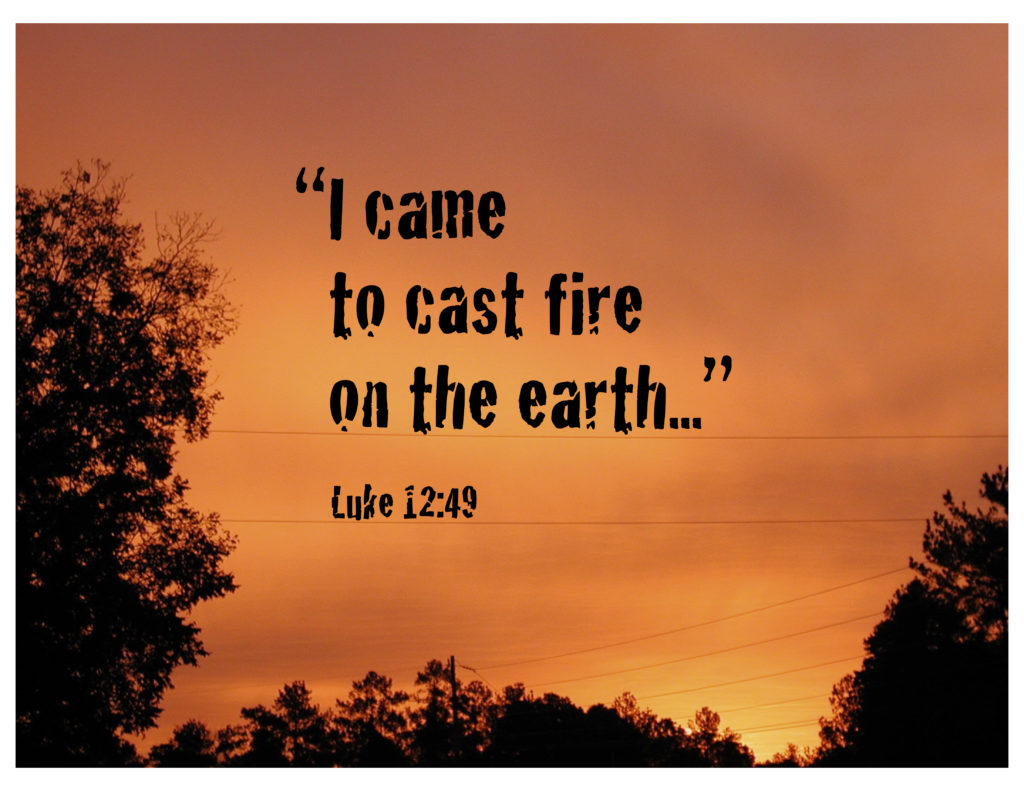
father against son
and son against father,
mother against daughter
and daughter against mother,
mother-in-law against her daughter-in-law
and daughter-in-law against mother-in-law.”
He also said to the crowds, “When you see a cloud rising in the west, you immediately say, ‘It is going to rain,’ and so it happens. And when you see the south wind blowing, you say, ‘There will be scorching heat,’ and it happens. You hypocrites! You know how to interpret the appearance of earth and sky, but why do you not know how to interpret the present time?
“And why do you not judge for yourselves what is right? Thus when you go with your accuser before a magistrate, on the way make an effort to reach a settlement, or you may be dragged before the judge, and the judge hand you over to the officer, and the officer throw you in prison. I tell you, you will never get out until you have paid the very last penny.”
At that very time there were some present who told Jesus about the Galileans whose blood Pilate had mingled with their sacrifices. He asked them, “Do you think that because these Galileans suffered in this way they were worse sinners than all other Galileans? No, I tell you, but unless you repent you will all perish as they did. Or those eighteen who were killed when the tower of Siloam fell on them—do you think that they were worse offenders than all the other people living in Jerusalem? No, I tell you, but unless you repent you will all perish just as they did.”


No comments:
Post a Comment