
- Session 1 - Mary, the Mother of Jesus
- Session 2 - John the Baptist
- Session 3 - Nicodemus
- Session 4 - Mary Magdalene
- Session 5 - Simon Peter (Part 1)
- Session 6 - Simon Peter (Part 2)
- Session 7 - Simon Peter (Part 3)
- Session 8 - Matthew and the Tax Collectors
- Session 9 - James, John, Thomas, Philip, and the Rest
- Session 10 - Judas
- Session 11 - The Scribes, Pharisees and Teachers of the Law
- Session 12 - The Herods
- Session 13 - Pilate and the Other Romans
- Session 14 - The Crowds
- Session 15 - The Rich Young Ruler and His Friends
In our thirteenth session, we looked at Pilate and the the nature of Roman authority in Judea. A recording of our discussion and some of the material and passages we discussed are below.
Roman Rule
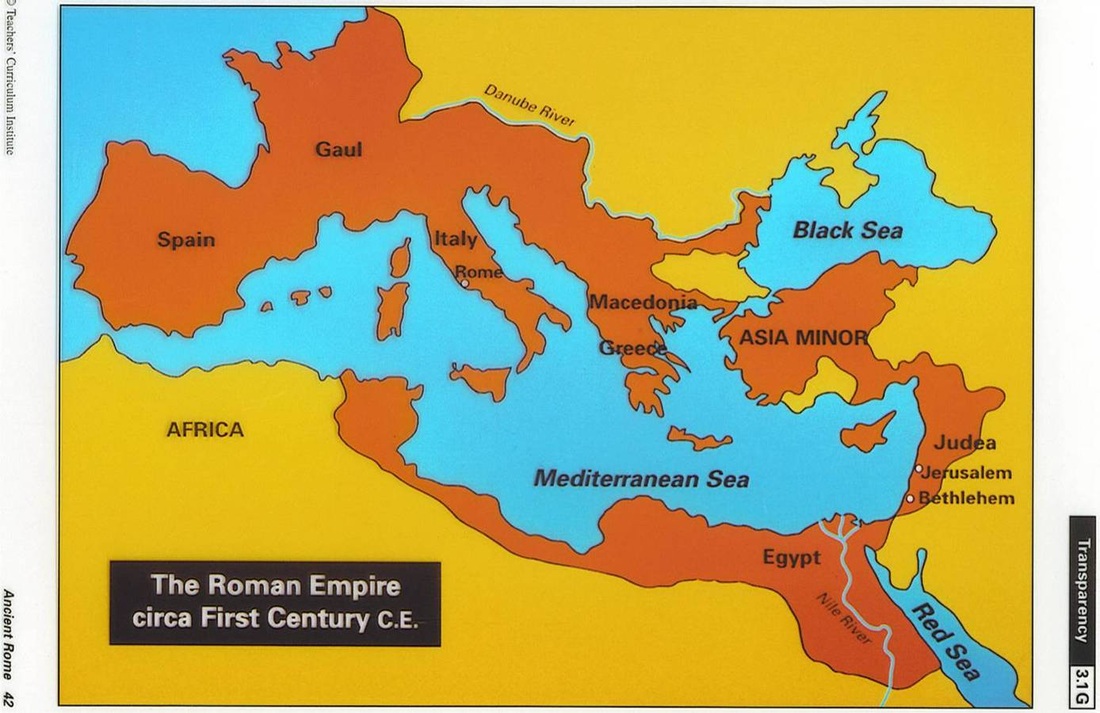
Roman Priorities
- Money
- Peace
- Unity
Pontus Pilate in Mark
Mark 15:1: As soon as it was morning, the chief priests held a consultation with the elders and scribes and the whole council. They bound Jesus, led him away, and handed him over to Pilate.
Mark 15:2-5: Pilate asked him, “Are you the King of the Jews?” He answered him, “You say so.” Then the chief priests accused him of many things. Pilate asked him again, “Have you no answer? See how many charges they bring against you.” But Jesus made no further reply, so that Pilate was amazed.
Mark 15:15: So Pilate, wishing to satisfy the crowd, released Barabbas for them, and after flogging Jesus he handed him over to be crucified.
Pontius Pilate in Matthew
Matthew 27:2-25: They bound him, led him away, and handed him over to Pilate the governor.
 Now Jesus stood before the governor, and the governor asked him, “Are you the king of the Jews?” Jesus said, “You say so.” But when he was accused by the chief priests and elders, he did not answer. Then Pilate said to him, “Do you not hear how many accusations they make against you?” But he gave him no answer, not even to a single charge, so that the governor was greatly amazed.
So when Pilate saw that he could do nothing but rather that a riot was beginning, he took some water and washed his hands before the crowd, saying, “I am innocent of this man’s blood; see to it yourselves.” Then the people as a whole answered, “His blood be on us and on our children!”.
When Judas, his betrayer, saw that Jesus was condemned, he repented and brought back the thirty pieces of silver to the chief priests and the elders. He said, “I have sinned by betraying innocent blood.” But they said, “What is that to us? See to it yourself.” Throwing down the pieces of silver in the temple, he departed, and he went and hanged himself. But the chief priests, taking the pieces of silver, said, “It is not lawful to put them into the treasury, since they are blood money.” After conferring together, they used them to buy the potter’s field as a place to bury foreigners. For this reason that field has been called the Field of Blood to this day. Then was fulfilled what had been spoken through the prophet Jeremiah, “And they took the thirty pieces of silver, the price of the one on whom a price had been set, on whom some of the people of Israel had set a price, and they gave them for the potter’s field, as the Lord commanded me.”
Now at the festival the governor was accustomed to release a prisoner for the crowd, anyone whom they wanted. At that time they had a notorious prisoner called Jesus Barabbas. So after they had gathered, Pilate said to them, “Whom do you want me to release for you, Jesus Barabbas or Jesus who is called the Messiah?” For he realized that it was out of jealousy that they had handed him over. While he was sitting on the judgment seat, his wife sent word to him, “Have nothing to do with that innocent man, for today I have suffered a great deal because of a dream about him.” Now the chief priests and the elders persuaded the crowds to ask for Barabbas and to have Jesus killed. The governor again said to them, “Which of the two do you want me to release for you?” And they said, “Barabbas.” Pilate said to them, “Then what should I do with Jesus who is called the Messiah?” All of them said, “Let him be crucified!” Then he asked, “Why, what evil has he done?” But they shouted all the more, “Let him be crucified!”
Matthew 27:26: So he released Barabbas for them, and after flogging Jesus he handed him over to be crucified.
Matthew 27:29-31: and after twisting some thorns into a crown they put it on his head. They put a reed in his right hand and knelt before him and mocked him, saying, “Hail, King of the Jews!” They spat on him and took the reed and struck him on the head. After mocking him, they stripped him of the robe and put his own clothes on him. Then they led him away to crucify him.
Pontius Pilate in Luke
Luke 23:1-12: Then the assembly rose as a body and brought Jesus before Pilate. They began to accuse him, saying, “We found this man inciting our nation, forbidding us to pay taxes to Caesar and saying that he himself is the Messiah, a king.” Then Pilate asked him, “Are you the king of the Jews?” He answered, “You say so.” Then Pilate said to the chief priests and the crowds, “I find no basis for an accusation against this man.” But they were insistent and said, “He stirs up the people by teaching throughout all Judea, from Galilee where he began even to this place.”
When Pilate heard this, he asked whether the man was a Galilean. And when he learned that he was under Herod’s jurisdiction, he sent him off to Herod, who was himself in Jerusalem at that time. When Herod saw Jesus, he was very glad, for he had been wanting to see him for a long time because he had heard about him and was hoping to see him perform some sign. He questioned him at some length, but Jesus gave him no answer. The chief priests and the scribes stood by vehemently accusing him. Even Herod with his soldiers treated him with contempt and mocked him; then he put an elegant robe on him and sent him back to Pilate. That same day Herod and Pilate became friends with each other; before this they had been enemies.

Then they all shouted out together, “Away with this fellow! Release Barabbas for us!” (This was a man who had been put in prison for an insurrection that had taken place in the city and for murder.) Pilate, wanting to release Jesus, addressed them again, but they kept shouting, “Crucify, crucify him!” A third time he said to them, “Why, what evil has he done? I have found in him no ground for the sentence of death; I will therefore have him flogged and then release him.” But they kept urgently demanding with loud shouts that he should be crucified, and their voices prevailed. So Pilate gave his verdict that their demand should be granted. He released the man they asked for, the one who had been put in prison for insurrection and murder, and he handed Jesus over as they wished.
Luke 23:26-31: As they led him away, they seized a man, Simon of Cyrene, who was coming from the country, and they laid the cross on him and made him carry it behind Jesus. A great number of the people followed him, and among them were women who were beating their breasts and wailing for him. But Jesus turned to them and said, “Daughters of Jerusalem, do not weep for me, but weep for yourselves and for your children. For the days are surely coming when they will say, ‘Blessed are the barren, and the wombs that never bore, and the breasts that never nursed.’ Then they will begin to say to the mountains, ‘Fall on us,’ and to the hills, ‘Cover us.’ For if they do this when the wood is green, what will happen when it is dry?”
Pontius Pilate in John
 John 18:28-19:16: Then they took Jesus from Caiaphas to Pilate’s headquarters. It was early in the morning. They themselves did not enter the headquarters, so as to avoid ritual defilement and to be able to eat the Passover. So Pilate went out to them and said, “What accusation do you bring against this man?” They answered, “If this man were not a criminal, we would not have handed him over to you.” Pilate said to them, “Take him yourselves and judge him according to your law.” The Jews replied, “We are not permitted to put anyone to death.” (This was to fulfill what Jesus had said when he indicated the kind of death he was to die.)
Then Pilate entered the headquarters again, summoned Jesus, and asked him, “Are you the King of the Jews?” Jesus answered, “Do you ask this on your own, or did others tell you about me?” Pilate replied, “I am not a Jew, am I? Your own nation and the chief priests have handed you over to me. What have you done?” Jesus answered, “My kingdom does not belong to this world. If my kingdom belonged to this world, my followers would be fighting to keep me from being handed over to the Jews. But as it is, my kingdom is not from here.” Pilate asked him, “So you are a king?” Jesus answered, “You say that I am a king. For this I was born, and for this I came into the world, to testify to the truth. Everyone who belongs to the truth listens to my voice.” Pilate asked him, “What is truth?”
After he had said this, he went out to the Jews again and told them, “I find no case against him. But you have a custom that I release someone for you at the Passover. Do you want me to release for you the King of the Jews?” They shouted in reply, “Not this man but Barabbas!” Now Barabbas was a rebel.
.jpg/960px-Ecce_homo_by_Antonio_Ciseri_(1).jpg)
Now when Pilate heard this, he was more afraid than ever. He entered his headquarters again and asked Jesus, “Where are you from?” But Jesus gave him no answer. Pilate therefore said to him, “Do you refuse to speak to me? Do you not know that I have power to release you and power to crucify you?” Jesus answered him, “You would have no power over me unless it had been given you from above; therefore the one who handed me over to you is guilty of a greater sin.” From then on Pilate tried to release him, but the Jews cried out, “If you release this man, you are no friend of Caesar. Everyone who claims to be a king sets himself against Caesar.”
When Pilate heard these words, he brought Jesus outside and sat on the judge’s bench at a place called The Stone Pavement, or in Hebrew Gabbatha. Now it was the day of Preparation for the Passover, and it was about noon. He said to the Jews, “Here is your King!” They cried out, “Away with him! Away with him! Crucify him!” Pilate asked them, “Shall I crucify your King?” The chief priests answered, “We have no king but Caesar.” Then he handed him over to them to be crucified.
So they took Jesus,
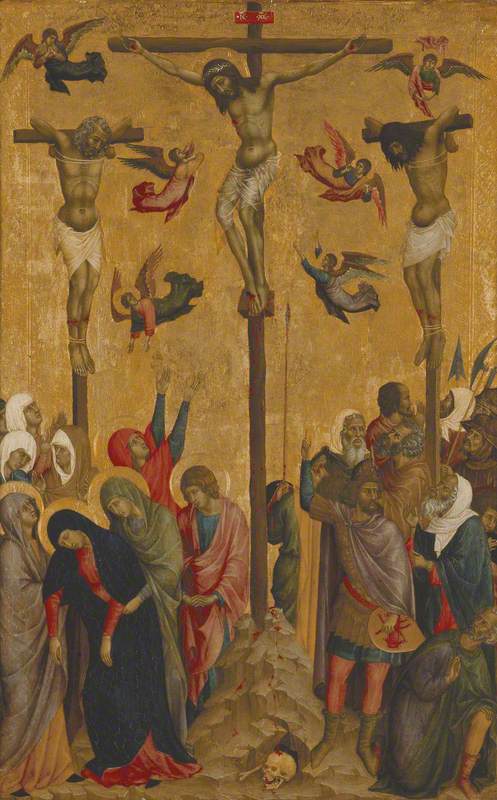
“They divided my clothes among themselves,
and for my clothing they cast lots.”
And that is what the soldiers did.
Meanwhile, standing near the cross of Jesus were his mother, and his mother’s sister, Mary the wife of Clopas, and Mary Magdalene. When Jesus saw his mother and the disciple whom he loved standing beside her, he said to his mother, “Woman, here is your son.” Then he said to the disciple, “Here is your mother.” And from that hour the disciple took her into his own home.
After this, when Jesus knew that all was now finished, he said (in order to fulfill the scripture), “I am thirsty.” A jar full of sour wine was standing there. So they put a sponge full of the wine on a branch of hyssop and held it to his mouth. When Jesus had received the wine, he said, “It is finished.” Then he bowed his head and gave up his spirit.


No comments:
Post a Comment